[ad_1]
For Maine artist Carly Glovinski, the garden has become her most powerful teacher.
“Gardening came and found me pretty hard,” laughed the New England native during a conversation earlier this spring. Recently, Glovinski opened “Into the Garden,” her third solo exhibition with New York’s Morgan Lehman Gallery. In this show, she explores gardening both as an actual extension of art-making and a parallel practice rooted in tending and time.
The artist first became interested in gardening while in residency at Surf Point in southern Maine. There, she discovered that Surf Point’s grounds had once been home to Wild Knoll, the house of the prolific 20th-century author May Sarton. Sarton’s 1977 book The House by the Sea detailed her garden and the home where she lived for 22 years. Wild Knoll was demolished some years ago, and the grounds had become overgrown.

Installation view “Carly Glovinski: Into the Garden” at Morgan Lehman Gallery, 2026.
“The site had secret garden vibes,” she recalled. “Pulling back a bunch of overgrown invasive plants, I’d find a beautiful peony the size of a grapefruit.” She began reading Sarton’s journals. ”She writes accounts of living on this very spot, tending to gardens, writing, and having writers over and fostering creative discourse,” she said. “It was like this magical portal opened.”
Glovinski, who was not much of a gardener at all at that point, felt moved to tend the land. “I wanted to explore this parallel between the creative pursuits of gardening and art and how gardening can offer sanctuary to even other creatives,” she said. “I thought: a good way to do that may be to start by making a garden right here on this land.”

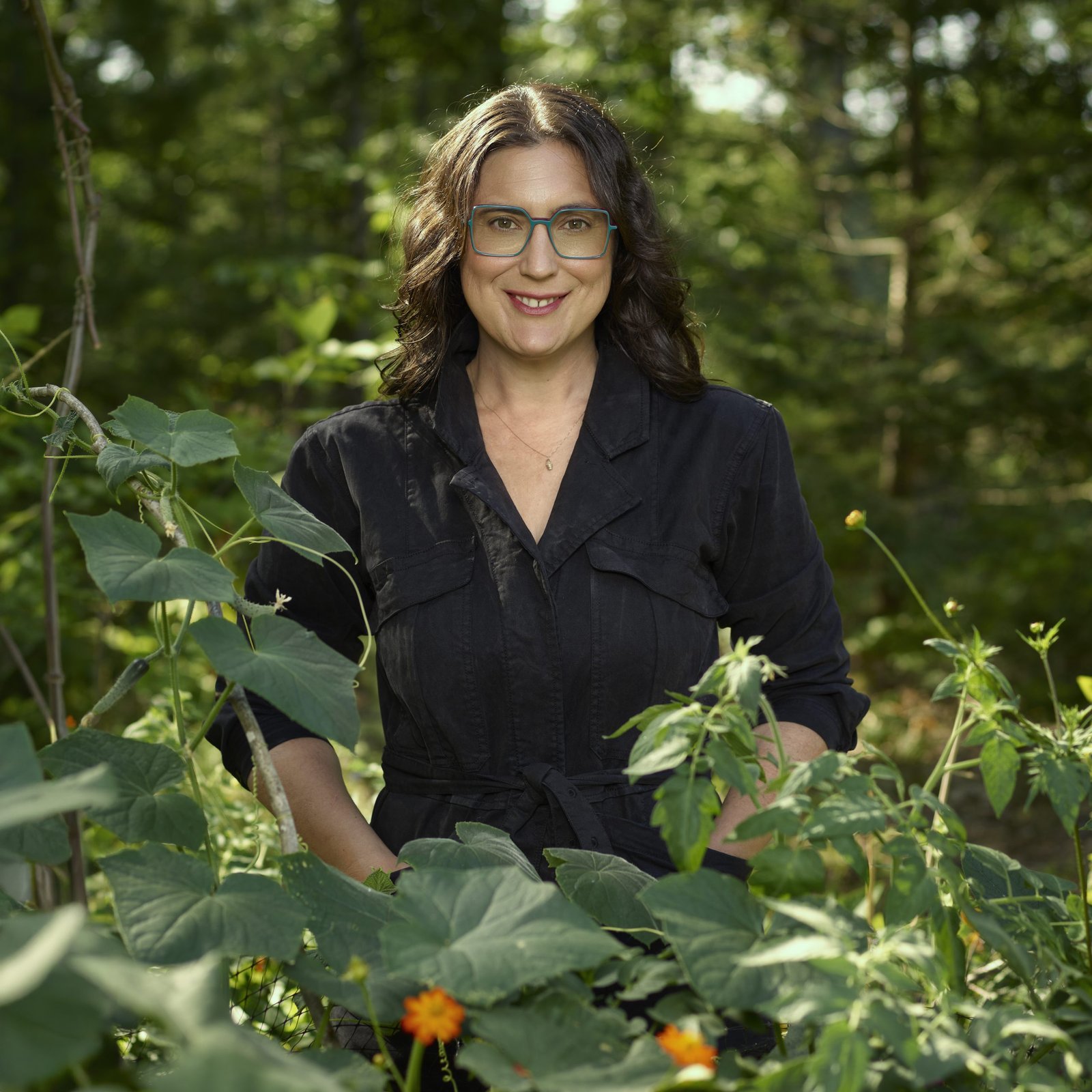
Carly Glovinksi. Photo: Michael Winter.
Glovinski threw herself headlong into the world of gardening. Ultimately, that garden, known as the Wild Knoll Foundation Garden, was planted across the entire footprint of the now-lost home, and is a site-specific living work as well as a community garden.
The experience led Glovinski to embrace gardening in her own life. “There’s a loss of control that’s necessary to learn,” said the artist of the discipline. “The immediate parallel between gardening and art making is this idea of just constantly showing up. As an artist, I go to my studio, and sometimes I have success. A lot of times I don’t, but I keep going. It’s like this ritual. Gardening is the same way.”
In recent years, Glovinski’s works have engaged with gardening and gardens through large-scale installations and site-specific works such as Almanac, on view at Mass MoCA through 2026, and Opelske, a three-story botanical mosaic permanently installed at the Boston Seaport.
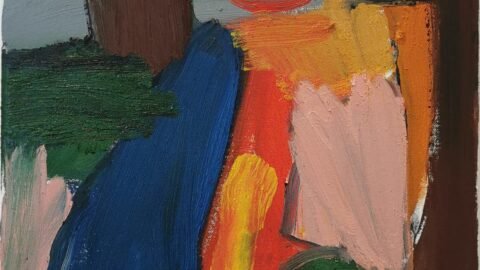
“Into the Garden” also marks an important moment in Glovinski’s practice, as she returns to painting after a two-decade hiatus. In the show, her new acrylic paintings on canvas aren’t traditional landscapes so much as the artist’s attempts to express “the experience of gardening.”

Installation view “Carly Glovinski: Into the Garden” at Morgan Lehman Gallery, 2026.
Another writer’s garden brought her back to painting on an intimate scale. In the summer of 2025, Glovinski spent time on Appledore Island, an island off the coast of Maine, where the 19th-century writer Celia Thaxter once lived and gardened. There, the artist felt inspired to make observational plein air paintings. Thaxter’s garden was beloved in its time, as she played host to an artistic community, providing a sanctuary for creative life. Thaxter detailed the story of her garden in the book An Island Garden (1894). Today, on the island, some of Thaxter’s plants—snowdrops, the hops vine, and day lilies—continue to blossom.
“I had to build a garden to make paintings again,” said Glovinski. “There’s no denying that experience of arriving at a spot, feeling its creatively charged history, and then having the writing of another creative person reference it.”

Installation view “Carly Glovinski: Into the Garden” at Morgan Lehman Gallery, 2026.
In paintings such as Snapdragon Support System (2026), she paints the bird’s-eye view of a garden plot with buds of snapdragons just breaking through the soil. A web of turquoise strings crisscrosses the view, a supportive device for young plants, appearing as a kind of geometric abstraction. The exhibition also includes several large-scale, shaped, wall-based works, based on pressed-flower specimens, as well as works on herbarium paper. Glovinski’s works focus on gardening as a process, rather than a final state of bloom.
From both Sarton and Thaxter, the artist has learned that gardens are places of creative communion and sharing. She hopes visitors to the show will come away with an understanding of the “garden as a sanctuary, as a lived space, as an opportunity for communities.”
[ad_2]
Source link