[ad_1]
Jenny Challenger is blending ancient craft with modern conservation, and carving out a life rooted in art, family and the natural world.

Jenny Challenger has always had art in her blood. The 23-year-old illustrator and woodworker from Hellifield, North Yorkshire, seems born to mix creativity with the natural world. “I knew I wanted to be an illustrator from the day I was born,” she says. Her mum, a mural painter, encouraged every scrap of creativity from her kids. Jenny remembers afternoons making tiny nature fairies from leaves, sticks, and imagination. “I still do that now with the kids,” she laughs.
“For the first two years, I hardly did any art because I was just carving spoon after spoon.”
Illustration was only part of the story, though. Jenny’s love of woodcarving started with her dad, a self-described hermit who lives on a narrowboat. “He started doing woodworking himself. I remember seeing him carve a litle clothing peg out of hazel. I was fascinated. It was beautiful, something different, not just using a pen, and it was in tune with nature.”
Her first carving was a spoon, inspired by traditional Welsh and Cornish designs. “I carved my first spoon and then I literally didn’t stop. For the first two years, I hardly did any art because I was just carving spoon after spoon.” Alongside her dad’s guidance, she found inspiration online from YouTubers like Zed Outdoors. “his channel was a huge inspiration for me.”

That fascination has grown into a thriving craft. Jenny now works every Thursday with Hungarian axe maker and carver Peter Kovacs, someone she admired online before meeting him. It was a happy coincidence that brought them together. Jenny happened to be in Skipton when Peter was running an open workshop. “I messaged him, and he picked me up ten minutes later. We spent the day carving and chatting about the world, nature, music, and folklore. He’s incredible at what he does, but never had the passion for illustration. After that, he messaged me saying, ‘I think your art would be amazing. Do you want to basically go into partnership with me?’”

Their collaboration is a proper skill swap. Jenny teaches illustration while Peter shows her the ins and outs of woodworking. Now, they sell their pieces all over the country together.
Jenny’s journey hasn’t just been about craft, it’s been about connection to people, family, and nature. Her stepchildren, Kova, six, and Salix, three, have had a huge influence. “Meeting them changed me. I didn’t even want kids at first, but suddenly I met a partner who was right for me. They’re amazing, like my best friends now.” Their names reflect a deep love of trees and nature.

Nature itself has always been central to Jenny’s life and art. Her parents’ adventures gave her a strong bond with the outdoors. She also spent part of her childhood rescuing animals on a farm, nursing lambs and even a magpie back to health. “We had a pet sheep called Twiggy for a few years,” she recalls. “I was always immersed in nature.”

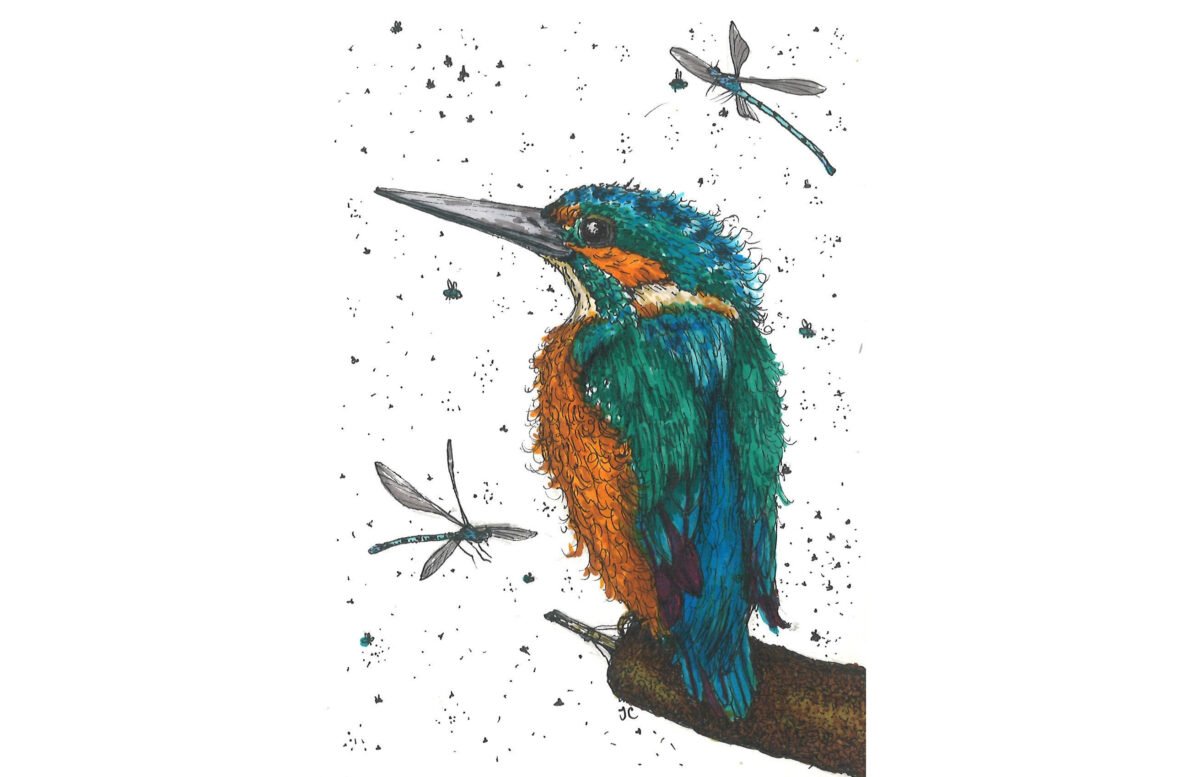
Her respect for wildlife is clear in her art. For her A-level final project, she painted a huge mural about the forgotten beauty of botanical artwork. “It was about us losing touch with the world around us. It feels like everyone is glued to screens and doesn’t even notice the birds and plants around them.” Jenny’s work isn’t just decorative; it carries a message about conservation and awareness.

Sustainability is central to her practice, too. “All my stuff I print locally. I don’t get anything posted. It’s all plastic-free or recyclable. When I package it, I use materials from parcels people have lying around,” she explains. This ethos extends to her work with Broughton Hall, where she paints murals as part of a nature recovery project that has planted hundreds of thousands of trees. “At first, they called me the toilet artist because I was painting inside compost toilets. I’ve ended up painting in a holiday cottage toilet too,” she laughs.

Jenny’s carving is just as meticulous. Spoons, her first love in woodworking, take patience and care. “On a good day, I’d say it takes three or four hours to make a spoon. When I first started, it would take a week.” She now decorates spoons using the Swedish technique kohlrosing, carving fine patterns into the wood and rubbing in cinnamon and oil to make the design permanent. “It’s been around for hundreds of years. People used to do a lot of pattern work on old spoons.”
“I want to use my art not just for pretty illustrations but to show the reality of things happening and make people aware.”
Although woodworking is often seen as an older person’s hobby, Jenny embraces it with youthful energy. “When I first started, it was just me and a bunch of older men,” she laughs. “Now the younger generation is starting to get into traditional crafts too.”

Jenny also sells her illustrations locally, preferring cafés, pubs, and gift shops to online platforms. “I find the best places are coffee shops and cafés. I go in, show my face, and ask, ‘Do you want to sell my prints and cards?’ Most of the time they say yes.” From Skipton to Ramsbottom, Ingleton to Otley, her work is dotted across the North.

Volunteering at Yorkshire Wildlife Rescue has shaped her art, too. “It’s inspired my work because I’ve got up close with so many different animals. Mainly hedgehogs and tawny owls. I’ve handled kites and buzzards and learned to give medication to these animals,” she says. This experience has led her to plan a series of work portraying animals facing persecution or suffering, blending beauty with awareness. “I want to use my art not just for pretty illustrations but to show the reality of things happening and make people aware.”
Ancient trees have recently become another focus for Jenny. She and her partner Joel travel the country to sketch centuries-old oaks. “They’re incredible. They’ve seen so much change and they’re still here. Oaks especially hold so much wildlife, and I just think they’re beautiful.”

Despite her ambitions and achievements, Jenny remains grounded. She lives at the top of her mum and stepdad’s house in Hellifield, a communal family-style setup that suits her free-spirited life. She reflects on the Craven landscape with honesty, noting that while Yorkshire is home, it’s surprisingly depleted of trees and wild spaces. “Craven is one of the most tree-depleted areas in the whole country. It’s quite bleak because we’ve stripped a lot for moorland and agriculture. I love Yorkshire, but I want to see it returned to nature a bit more.”
Jenny Challenger’s journey is one of curiosity, patience, and deep respect for craft, nature, and people. From the first spoon carved in her teens to murals, prints, and rescue-inspired illustrations, her work blends old techniques with modern concerns. “Everything I do has a story. I want people to feel it, connect with it, and care about the world around them,” she says.
[ad_2]
Source link