[ad_1]
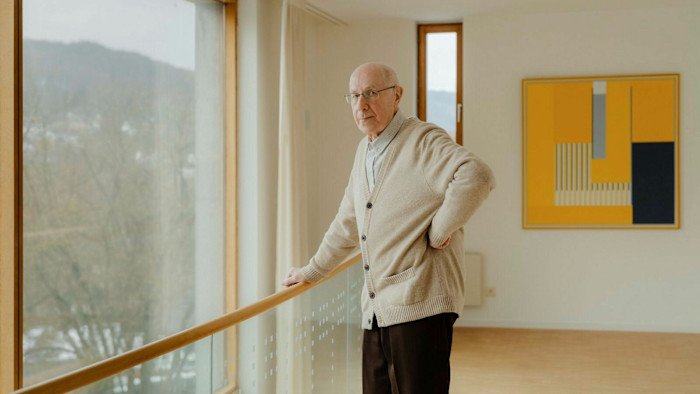
There’s snow underfoot on the January day that I visit Léon Wuidar. On the outskirts of the Belgian town of Esneux, on a hill climbing up from the Ourthe Valley, the winter vista lends a chilly severity to the brutalist building that has been home to the artist for half a century. What from the outside resembles a wartime concrete bunker is on the inside, however, radiantly churchlike. It’s sparse but serene, purist but playful: a space inspired by Wuidar’s geometric abstraction — as interpreted by the late Belgian architect Charles Vandenhove.
“It’s very simple, very grounded, very monastic, you could say,” says Wuidar, warm in both manner and dress, in a tomato-red cardigan. At the age of 87, he is experiencing something of an Indian summer in his career. His work was relatively unknown until a decade ago, when he was signed by Brussels-based gallery Rodolphe Janssen. He’s also since been taken on by White Cube and last week opened a solo show in Paris — his fifth with the gallery.

“It was a fantastic surprise when Jay [Jopling] and I discovered Léon’s work,” says White Cube global director Mathieu Paris. “There’s an exactitude and consistency to his paintings, but he does it with humour. There’s a very Belgian, quasi-surrealist side to some.” In 2023, the Centre Pompidou added three of Wuidar’s paintings to its collection. “And it’s just the beginning,” says Paris, alluding to further institutional acquisitions in the pipeline.
Wuidar was born in the nearby city of Liège, where he lived in the apartment above the family business, a manufacturing enterprise creating workwear for local miners and factory employees started by Wuidar’s grandmother. Growing up in postwar Belgium, his upbringing was “traditional, strict and Catholic”, he recalls. “My parents weren’t curious, but I was.” From the age of 12, he knew he wanted to be an artist — a conviction that was cemented, he says, when he discovered the work of modern British artist Ben Nicholson.

From 1960 to 2000, he worked as a teacher of drawing and graphic art, while developing his own creative practice. Self-taught, his studies of structure and colour evolved from the figurative to the abstract, and ranged from the minimal to the somewhat mystical.
Today his studio is a hive of daily activity and is physically central to his home. It sits at one end of a building dating to the 1970s — a space where exposed concrete block walls meet a statement stepped ceiling — and connects to a three-storey structure added in the 1990s. Both are the work of Vandenhove, commissioned by Wuidar.
“We met in the 1960s at a gallery opening but we already knew each other’s work,” says Wuidar. The house wasn’t, however, much of a collaboration: “Vandenhove is an architect who would never accept input, but he was sensitive to my work, which is why [the building] is the way it is,” he explains. Wuidar’s home and his creations have the same regimented angularity.


It was also not a straightforward project: over a period of two years, Vandenhove produced six different designs. “Then when we were meeting to go over the final details, he said, ‘Léon, I need more time, I have to start all over again.’ It hit me hard.” It was worth the wait, though; “This one, the seventh, is the best of them all,” says Wuidar with glee.
Construction overlapped with that of another bold — and significantly bigger — Vandenhove building nearby: the Sart-Tilman University Hospital in Liège. Its striking tiered composition, in glass, steel and concrete, was augmented inside with numerous artist interventions, including those by French conceptualist Daniel Buren and US minimalist Sol LeWitt. Wuidar covered the walls of the dialysis department with a motif based on a line drawing of his from 1978. He was also able to piggyback the project in terms of materials — Burgundy limestone floor tiles, for instance, were bought in bulk and used in both hospital and home.

“But when the house was finished, Charles Vandenhove never sent me an invoice,” says Wuidar. Instead of his fee, “he just told me that he wanted two paintings — he chose two very nice ones, but I didn’t feel it was enough. So I also sent him a number of original drawings.” One of them was later recreated by the architect on an enamel-topped table, designed for the restaurant in a retirement home — an example of the table now resides in one of Wuidar’s bedrooms.
There are other design pieces by Vandenhove, too: a round walnut dining table and chairs and, above them, an octagonal ceiling light in blue and white glass; a simple, double-stemmed steel standing lamp and a custom bookcase. Paintings by Wuidar hang throughout the home. There are artworks that play with language and typography; some that incorporate Egyptian motifs; many that resemble architectural structures and volumes. He changes them around often.
“I rediscover them — you can speak about ‘the collection’, or you can use another term. It’s my source of business. My stock,” he says with a smile.


The new show focuses on his work from the 1960s and 1970s. Paris pinpoints “La naissance de Vénus, 13 juin 1966” as a highlight; “it’s one of the largest formats Léon ever worked on, in a very monochromatic painting,” he says of the grey-on-grey canvas. “This grisaille refers to so many north European paintings since the Renaissance.”
Since the late 1950s, every one of Wuidar’s pieces has been framed in the same way, with a thin piece of wood — a feature that is echoed in the simple wooden door frames of his home. “He has framed his life in the same way that he frames his paintings,” says Paris.
But despite the austerity of the design, the place is full of life. Wuidar raised two daughters here with his first wife, Francine Boulanger, who died in 1990. Now he shares the space with his wife Michèle Rots. Sometimes they live in one building, sometimes in the other, she says. Bookshelves overflow, wine is brought out with lunch, and the geometric Austrian-made cutlery that Wuidar bought when he first married in the late 1960s is put to good use.


The 1990s addition (for which Vandenhove did send an invoice, “a significant one”) was prompted by a need for more storage space, and now Wuidar’s “stock” room takes up the lion’s share of the ground floor. Alongside the racks of canvases, a shelf holds “memories of his life since childhood”. It includes a chintzy ceramic ashtray from his grandparents and an antique English mustard pot, alongside his own creations: an old glass pharmacy jar, for instance, is filled with colourfully painted wooden batons — “My idea was that if medicine makes people feel better, art can too.”
A watercolour above the doorway, meanwhile, is by Sol LeWitt — the result of a written correspondence with the famed minimalist about the formation of a star motif in their work. “I received a postcard from Sol saying simply, ‘How did you construct yours?’” Wuidar recalls. “I responded by letter, with drawings, and one day I received a big envelope in the mail containing this present.”

Up on the second floor, either side of a vast double-height window, are two small relief sculptures by the 83-year-old abstract British artist John Carter. For the most part, though, the pieces by other artists don’t reveal household names. There’s a framed Congolese textile work that he admires for its inventiveness and two carved wooden sculptures by Joseph Wiliquet, a local artist with whom he exchanged work in the 1960s. In his bedroom, a tiny, intricate drawing is the work of little-known Belgian artist Marcel Lempereur-Haut, while his studio is home to a richly coloured and “very strange” canvas by Henri-Jean Closon, who worked as a butcher and painted in his spare time.
Wuidar’s affinity with such outsider artists is apparent. His own steadfast commitment to his artistic vision is present in every inch of his idiosyncratic home — and, increasingly, far beyond.
‘Léon Wuidar’, White Cube Paris, until February 21; whitecube.com
Find out about our latest stories first — follow @ft_houseandhome on Instagram
[ad_2]
Source link