[ad_1]
The View From is excerpted from The Asia Pivot, Artnet Pro’s biweekly members-only newsletter providing mission-critical analysis, insights, and exclusive intelligence on developments in Asia’s art markets, with a focus on business opportunities and challenges. Subscribe here to receive it directly to your inbox.
At the just-concluded Art Basel Hong Kong, a few highlights stood out for me. It was great to see the large knitting piece and performance by Movana Chen in the Encounters sector. Installation pieces by Huan Po-Chi presented poetic narratives of harsh labor conditions of female textile workers in Asia through black-and-white photographic images. I also liked Ade Darmawan’s installation, which talked about a complex colonial narrative through natural aroma taken from local plants.
At CHAT, we’re always thinking beyond the traditional boundaries of contemporary art—we try to situate our work within a broader cultural context. We’re not a textile museum, per se; we’re a center for heritage and creative experimentation. Textiles are our foundation, but we constantly aim to extend beyond the notion of heritage and reimagine how textile art functions in the present.
What we’ve observed—especially during the pandemic—is that many artists began engaging with manual labor and traditional craft practices, such as weaving, embroidery, and dyeing. These tactile forms offered a kind of meditative counterbalance to the digital saturation we all experienced. Artists like Ari Bayuaji from Indonesia started weaving during that time, and Singaporean artist Feyrool Darma, who comes from a graffiti background, began working with textiles and dye. These shifts were fascinating because they showed how artists integrated craft into their broader practices in meaningful ways.
Fiber art in Asia has a distinct lineage from that of the West. In Europe and the U.S., what we know as “fiber art” emerged in the 1960s as a subgenre of Modernism. Artists there were fascinated by the geometric structures of traditional weaving, which echoed the aesthetics of Modernist abstraction.
But in Asia, especially in Southeast and Central Asia, the 1960s were also a period of nation-building. Artists turned to traditional crafts—like batik and weaving—not only as cultural heritage but also as a way to construct a modern art language rooted in local identities. While these works may resemble craft, they functioned as modern art with a distinct political and cultural agency.
At CHAT, we’re interested in these blurred boundaries—between artist and artisan, art and craft—and in challenging the categories that have long defined what is considered “contemporary art.”
We’ve seen a growing interest in these practices, not just in local or regional contexts but on global platforms—biennales, international group shows, and large-scale exhibitions. This is partly because textile-based and community-rooted practices speak to timely concerns, like labor, female solidarity, and sustainability.
Even in places without robust art markets, like parts of Indonesia, artists continue to create with what’s accessible to them. That resilience and creativity are very powerful. I think more institutions and curators are recognizing the importance of supporting these practices.

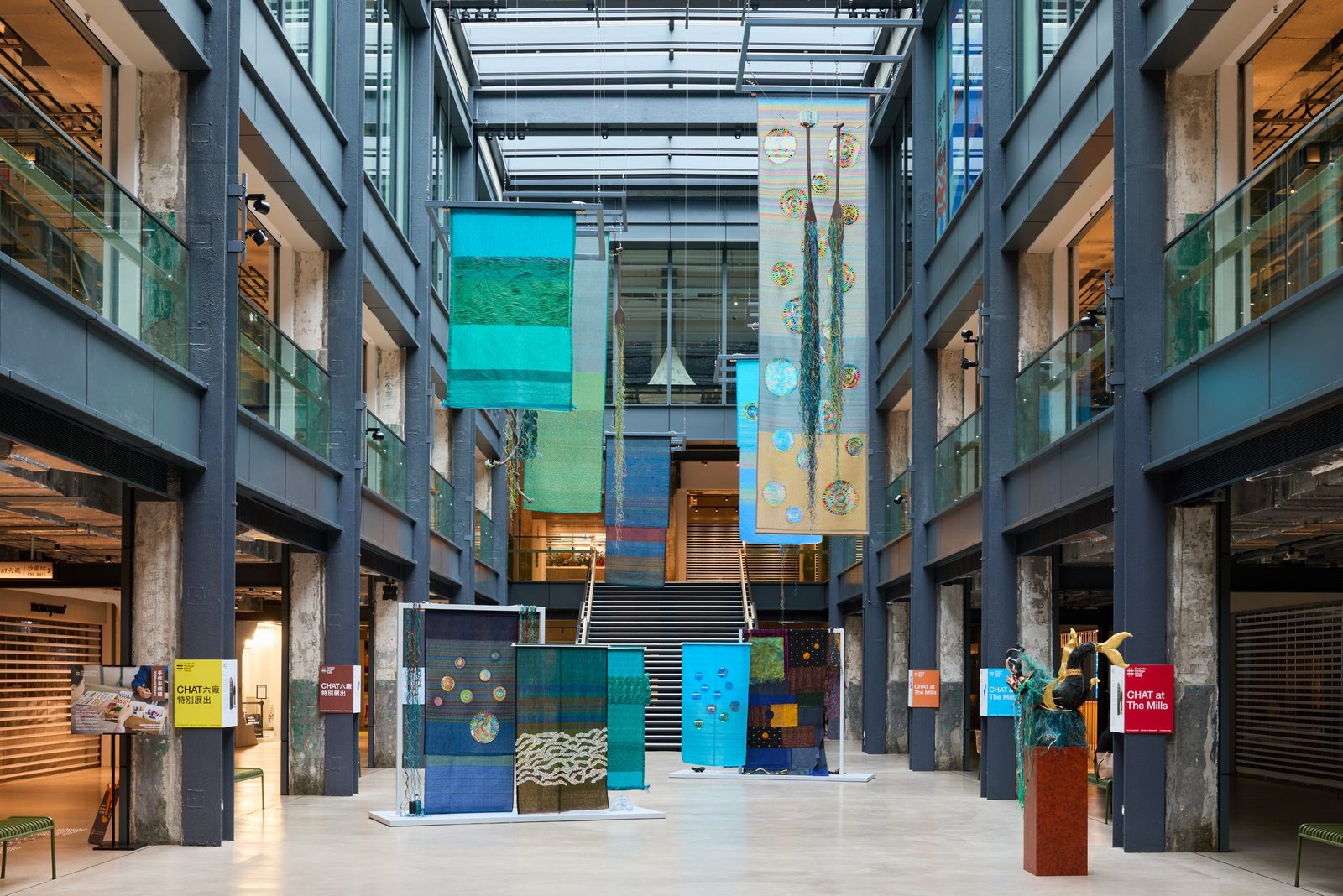
Exhibition view: ”Busy Needles – Textile Embellishments of Hong Kong,” CHAT (Centre for Heritage, Arts and Textile), Hong Kong, 2025. Image courtesy: CHAT (Centre for Heritage, Arts and Textile), Hong Kong
Textile is still an underrated medium. When I first joined CHAT in 2016, there was hesitation—even resistance—from some artists and curators to engage with textiles. They didn’t want to be labeled as “textile artists,” but just as “artists.” Textile was seen as something secondary—a “third citizen,” so to speak. That perception has gradually changed, especially in recent years, and it’s been amazing to witness that shift.
Hong Kong continues to be a key art hub in Asia. Its infrastructure and position as a trading center attract international galleries and collectors. Japan, where I originally come from, on the other hand, has incredible collections and very talented curators, but it hasn’t been as internationally communicative or accessible.
There’s great potential in Japan, but the system needs to support the younger generation more effectively—especially when it comes to collectors. I’ve seen some promising efforts, like Art Week Tokyo in November, but young collectors in their 30s or 40s still need guidance and strategic advice in building their collections.
—As told to Cathy Fan
Takahashi Mizuki is the executive director and chief curator of CHAT (Centre for Heritage, Arts and Textile) in Hong Kong. After serving as a founding curatorial member of the Mori Art Museum in Tokyo from 1999 to 2003, Takahashi worked as senior curator at the Contemporary Art Center, Art Tower Mito in Japan and realized numerous transdisciplinary exhibitions, addressing various artistic forms like manga, film, fashion, architecture, performance, and contemporary art. Takahashi was a research fellow at Central Saint Martins, the University of the Arts London from 2015 to 2016. She curates, writes, and gives lectures extensively in Asia and Europe.
[ad_2]
Source link