
Nichole Herbert Wood is standing by “The Green Man”, a metal figure holding aeroplane propellers that sits in a tree-filled courtyard on Moulding Lane in Deptford, south-east London. The sculpture marks a smart residential development, named Deptford Foundry after the metal foundry established here in 1831 by engineer Josiah Stone; it subsequently became a printworks. This colourful history is central to developer Anthology’s storytelling about its community.
But there is a new spin on the old tale of former industrial workshops being refurbished or swept aside for dwellings, with only the romantic connotations of a name to link past and present. Herbert Wood is an economist and co-owner of social enterprise Second Floor Studios & Arts, and was part of the planning for this 316-home site. She worked with Anthology to ensure delivery of a suite of 85 ground and first-floor artists’ studios, re-anchoring art and craft in this rapidly gentrifying corner of the city.
Far from leaky garrets or the post-industrial spaces that more usually provide a temporary toehold for artists in the city, these are purpose-built studios, their fit-out agreed with developers prior to occupancy, with the intention they remain studios in perpetuity. They accommodate ceramicists, fine artists, videographers, jewellers, printmakers and picture restorers. Within a year of their opening in 2019, they were full. Their success has catalysed the start of a new chapter that hopes to see more artist organisations and residential property developers working together.


At the centre of this new energy, Herbert Wood has published an innovative formula for affordability for artist studios in residential developments — one she hopes will inspire developers and landlords to revise their calculations of cost and benefits, and to see the question of affordability from the artist’s point of view. The idea is gaining traction. Can it fulfil its potential?
The Section 106 planning requirement for developers to provide affordable workspace, combined with financing through long-term loans provided by Charity Bank and charitable lenders Figurative, enabled Herbert Wood to set a rent in Deptford Foundry that artists can afford. Propelling its success, says Herbert Wood, were three ingredients: the developer’s recognition of the artists’ value to a community; the fact that artists, while not high payers, are steady payers, and there is no lack of them; and the growing aptitude of lenders to facilitate projects that may outlive them, before they see a return (much like planting trees). Critical to them all, however, is the preparedness to refocus on the idea of affordability with a new lens.

In an open letter on the website of the organisation she co-founded in 2017, London’s Affordable Artists Studio Network (LAASN), a group of 10 leading not-for-profit artists’ studio providers, Herbert Wood suggests the whole notion of affordability in London is misconceived. She quotes the think-tank New Economics Foundation: “The housing market has become completely detached from the reality of people’s incomes.” And the problem is only exacerbated, she argues, for studio spaces, which have to be paid for in addition to artists’ homes.
When it comes to the commitment to provide “affordable” homes or workspaces, local councils and developers default to the idea of a percentage of market rate, says Herbert Wood, who has worked in the provision of artists’ studio spaces since 2011. But as figures produced in 2024 by the Design and Artists Copyright Society (DACS) make clear, she continues, even if market rate is tagged to the average London gross income of £47,500, which it generally isn’t, that makes both homes and studios unobtainable for most artists and makers, whose national mean combined income is £17,500. They are barely more affordable for those achieving the London living wage (£27,007). Studio affordability should be understood from the bottom up as a reasonable percentage of artists’ actual income, argues Herbert Wood. She suggests 15-20 per cent.
According to Eline van der Vlist, chief executive of SPACE studios, ground floors of newly developed buildings lie empty “because developers don’t make the rent low enough for us to rent them and they don’t talk to us early enough in the process to make the spaces suitable for artists”.
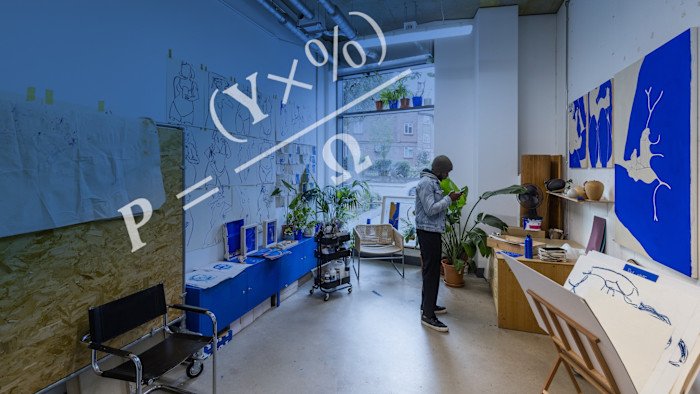
The Herbert Affordability Formula

P — Defined affordability, per square foot
Y — Income, after tax
% — Percentage of income
𝛀 — Average studio size in sq ft
The Herbert Affordability Formula is a framework developed to determine affordable rent for artists’ studios. It is based on a percentage of artists’ actual earnings rather than market rates, and factors in specific studio location or postcode, and studio size. HAF sets out to shift the focus from what landlords can charge to what artists can actually afford.
Mary-Alice Stack, chief executive of community interest company (CIC) Creative United says that Herbert Wood “has grasped the nettle that has been stinging us all for so long and come up with an innovative formula for defining what affordable actually means in today’s world for a London-based artist or creative”.


But challengers point out that the needs of artists differ greatly; from graduate painters requiring lots of space, to artist jewellers requiring a tabletop and more security, to ceramicists with their complex water and electricity needs. Ellen Taylor, head of operations and finance at arts charity and gallery The Koppel Project, adds that grants and public funding add a complex layer. She suggests that affordability is not just about rates: “It’s also about the opportunities you are offering — and the location.”
But given that rents at this level are significantly lower than amounts chargeable to other businesses who compete for affordable workspace under Section 106 clauses, will any developers see the benefits?
Until recently, one popular way to charge lower rents for artists was through the use of “meanwhile” spaces. These are empty or abandoned properties awaiting refurbishment, let cheaply in return for maintenance and guardianship. Pioneers were artists Bridget Riley and Peter Sedgley who, in 1968, inspired by similar artist-led initiatives in New York, and supported by the Greater London Council and the Arts Council of Great Britain, opened the artist-run SPACE studios in empty warehouses at St Katharine Docks beside the river Thames. The model has inspired many of London’s more than 200 studio providers, as well as urban artist communities worldwide.

Property owners and developers have long benefited from the presence of artists in their buildings, bringing both security (by virtue of occupancy) and vibrancy to the neighbourhood. But increasingly the precarity of the system has irked many artists, particularly as the costs of fitting out to serve their needs have grown. Roland Fischer-Vousden, co-founder and director of Set, which negotiates on behalf of artists for “meanwhile spaces”, says: “I was shown a space yesterday that’s empty because the cost of fitting it out as a studio is too high. It’s easiest for the owner to pay a fine for having an empty space.”
Meanwhile, the premium on former industrial spaces helped cause the vacancy rate in London to drop from 16 per cent in 2001 to 4 per cent in 2021, according to a 2022 Industrial Land Commission report. It highlighted that “in central London it is as low as 2 per cent. Such low vacancy rates prevent a normal ‘ebb and flow’ in the property market and are a sign of intense pressure on industrial space.” One reason cited was an “almost unquenchable demand for homes”.


In 2014 the Greater London Authority (GLA) published a report announcing a crisis in affordable artists’ studio space and the failure of the market to resolve it. In response, and partly inspired by San Francisco’s Community Arts Stabilization Trust (CAST), founded in 2013 to support the acquisition of real estate in the city for the benefit of arts and culture, the GLA, together with Bloomberg and Arts Council England, set up the Creative Land Trust in 2019, to support the permanent acquisition in London of artists’ studio spaces. It has proven harder to achieve than hoped, however, with only three properties so far secured.
It is into that breach that LAASN has stepped. But it is not the only arts fundraising group shifting tactics. For more than 20 years, the charity Acme has experimented with different models for the purchase of both old and new spaces; this month it announced it had raised enough funds to buy its Acme Propeller Factory in Deptford thanks to a spectrum of donations including £2.5mn from the Julia Rausing Trust.

Tannery Arts has ended years of nomadism to enter into a collaboration with developers London Square, which wished to keep artist studios on site. After a deal was struck under Section 106 in 2016, the organisation moved with its free public gallery, Drawing Room, into purpose-built studios near the Old Kent Road in 2023, under a 25-year lease. “The rent was set at a price per square foot rather than percentage of market rate,” says Tannery Arts studio manager Alicja Orzechowska. “The latter leaves us vulnerable to increases which we, and the artists we support, can’t afford.”
Tannery Arts had material input into the studio designs, suggesting north-facing, sloping windowed roofs. Walking through the development, the bold gallery signage and open doors to the publicly accessible library welcomes visitors and passers by. As Fiona Long, co-director of Tannery Arts puts it, “It’s nice living around artists.”


Certainly that is the view of Matt Slade, retail director of the 85-acre residential development Quintain Living Wembley Park, which is delivering a total of 56 studio spaces to Second Floor Studios & Arts. “Artists’ spaces were the best fit for us, in terms of our Section 106 obligations,” he says. Artists typically want around 250-300 sq ft, whereas other users want more space. Further, “we see a whole host of tangible and intangible benefits — from embedding the sense of creativity in the community, to commissioning the artists to create public art works and watching open studios drive footfall”.
From Quintain’s perspective, Herbert Wood’s numbers only work at scale. “We provided 26 per cent more space than planning required, to meet her challenge.” Slade adds, “The rent is so small that it doesn’t repay the costs of what it takes to provide the spaces to the relevant spec, but the benefit to residents, to the community and to art is considerable.”
It looks as if the wheels are beginning to turn; Gemma Dean, head of development at affordable workspace charity Creative Land Trust, says: “I think local authorities are increasingly looking at how Section 106 agreements can be adapted to better suit the creative sector rather than being a desk-based workplace policy.” Herbert Wood’s formula has provided new impetus.
Find out about our latest stories first — follow @ft_houseandhome on Instagram