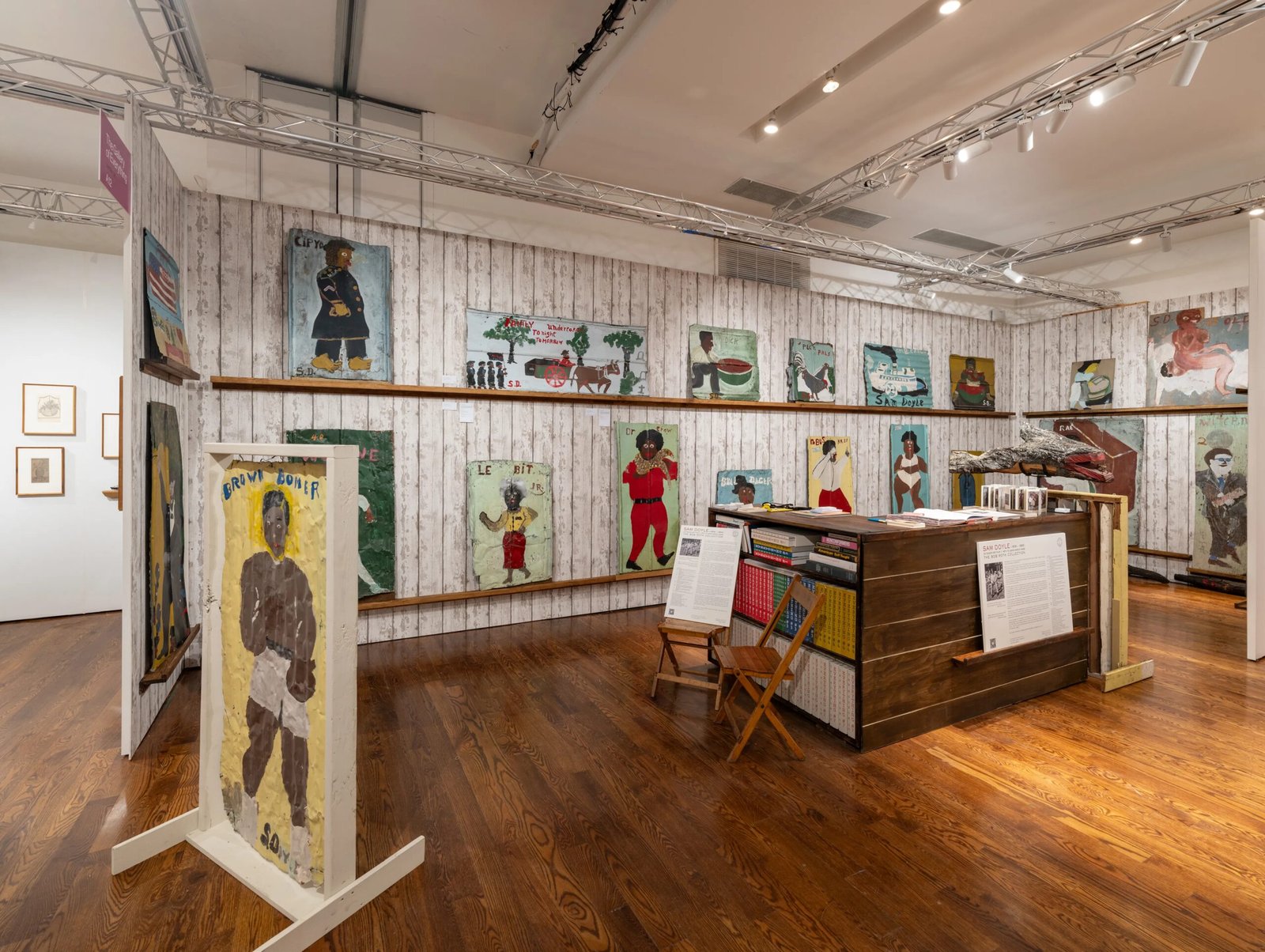
Just before the exit, one arrives at London-based Gallery of Everything, which has built a reputation across major international fairs for discovering and repositioning visionary figures—from Madge Gill at Frieze Masters to Afro-Caribbean Surrealist painter Hector Hyppolite at Art Basel Paris. At the Outsider Art Fair, the gallery presents a full booth dedicated to Sam Doyle (1906-1985), drawn from the collection of Bob Roth. Born into the Gullah community of St. Helena Island, South Carolina, Doyle was a self-taught artist who transformed the front yard of his home into the St. Helena Outdoor Art Gallery, covering it with bold, graphic paintings on corrugated tin, scrap metal and found wood. A natural storyteller, he captured the lives of friends, neighbors, local heroes and healers through vivid portraits often paired with sharp, witty captions, while also reflecting the broader history of Black emancipation and cultural life. His work gained national attention following its inclusion in the landmark exhibition “Black Folk Art in America: 1930-1980” (1982), later entering the orbit of Jean-Michel Basquiat, who collected and displayed Doyle’s works in his studio. Today, Doyle is recognized as a central figure in 20th-century African American art, with works held in major institutional collections including the Smithsonian, LACMA and the High Museum.
The presentation, composed of museum-caliber works offered for sale for the first time, has already attracted strong institutional interest, with prices ranging from $55,000 to $95,000. “Sales surpassed expectations, with major works placed early in the fair and sustained interest from leading contemporary collectors and institutions,” founder Jack Barrett told Observer, underscoring both growing market confidence and renewed recognition of Doyle’s significance. “Off the radar for so long, he was much beloved by Jean-Michel Basquiat for a reason: his representations of local and national heroes, combined with his distinct and witty textual captions, capture the essence of Black society as it emerged into a more public consciousness. We are proud to represent the work and tell his story.” And suddenly, we can really see where Basquiat got his inspiration from.
Particularly notable were the acquisitions of two works of significant narrative and historical depth: CIPYO, which portrays a formerly enslaved man who commandeered a boat to secure his freedom before becoming a local senator, and WADA, a rare double-sided work featuring a prominent local figure on one side and legendary boxer Joe Louis—the “Brown Bomber”—on the other.