With its vast artistic heritage, Europe presents dozens of top museum exhibits each year. Here is a short list of great art shows to see in 2025.
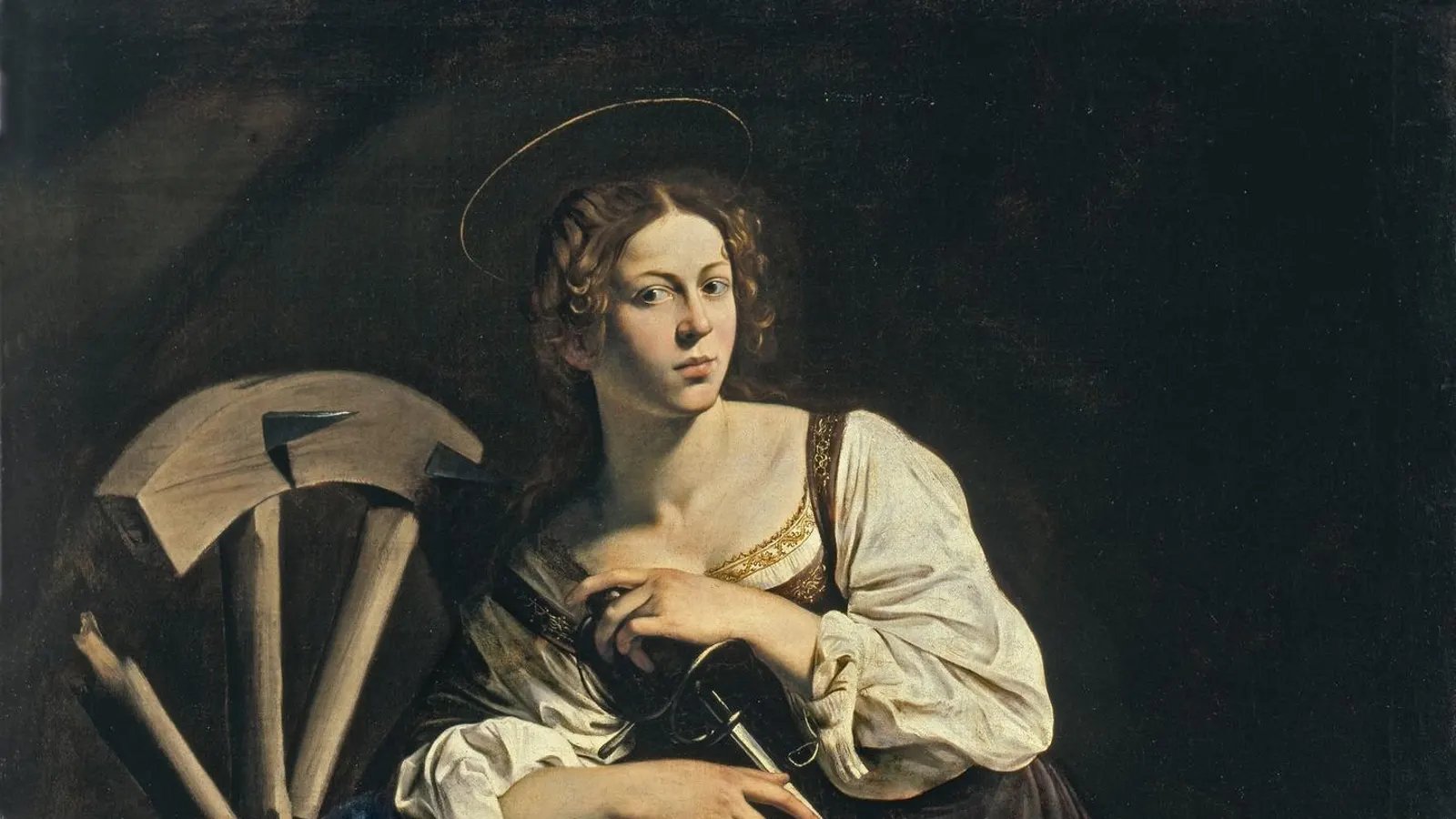
Saint Catherine of Alexandria, c. 1598, by Caravaggio. From the Thyssen-Bornemisza Museum. Photo by Fine Art Images/Heritage Images/Getty Images
Heritage Images/Getty Images
Sometimes described as the “bad boy” of Baroque art, Caravaggio (aka Michelangelo Merisi da Caravaggio, 1571-1610), led a short life marked by almost relentless drama, due in no small part to the conflitti generated by his volatile personality. Given his penchant for discord, it’s not surprising the canvases he painted often depicted violent and turbulent images, which despite the subject matter were rendered with sublime finesse and masterful depictions of light and shade. (Caravaggio was a pioneer in what came to be known as tenebrism, a form of chiaroscuro on steroids.)
Famed critic Bernard Berenson placed Caravaggio in the pantheon of artistic greats, stating that with the exception of his homonymic compatriot, Michelangelo Buonarotti, no other Italian painter had as much impact on the history of Western art.
To commemorate the artist and to coincide with the Jubilee Year celebrations in Rome, the city that is home to the greatest number of Caravaggio’s works, the Gallerie Nazionali di Arte Antica in conjunction with the Galleria Borghese will be hosting a major exhibit from March 7—July 6, 2025, at the Palazzo Barberini. Caravaggio’s Ecce Homo, on loan from Madrid’s Prado, will be making its way back to Italy for the first time in hundreds of years. Other seminal works from the Thyssen-Bornemisza Museum (also in Madrid), as well as the Kimbell Art Museum in Fort Worth and Wadsworth Atheneum of Art in Hartford, will also be on display.
When in Rome: Caravaggio liked to go to a restaurant, La Campana, which astoundingly still exists, and is thought to be the oldest restaurant in the Eternal City. Head here (Vicolo della Campana,18, not far from the Piazza Navona) for hearty Roman classics.
Jas De Bouffan, Cezanne’s family estate, in Aix-en-Provence. Photo by API/Gamma-Rapho via Getty Images
Gamma-Rapho via Getty Images
This year, Aix en Provence celebrates its most famous son, Paul Cézanne, the late 19th-century Post-Impressionist and Modernist avant la lettre, with a major program of exhibits called Cézanne 2025. The main show will be at Aix’s Musée Granet (June 28—October 13, 2025). One hundred pieces, many culled from top museums around the world, will showcase how Cézanne’s native territory and his family home, Jas de Bouffan, impacted his work. Referring to Aix, the artist once said, “When you’re born there, it’s hopeless, nothing else is good enough.”)
The Card Players, circa 1892-1896. Photo by Fine Art Images/Heritage Images via Getty Images
Fine Art Images/Heritage Images via Getty Images
Cézanne lived and worked at Jas de Bouffan for nearly 40 years (1860-1899), creating 36 oil paintings, including the famous The Card Players, and 17 watercolors influenced by the estate. Parts of the manor house will open to the public this summer in time for the exhibition.
The Bathers, 1899-1904. Photo by by Heritage Art/Heritage Images via Getty Images
Heritage Images via Getty Images
Visitors will be able to explore five hectares of grounds and take in some of the landscapes Cézanne depicted in his paintings. You can also stop by the artist’s last studio, Les Lauves, where he painted The Bathers series. In addition, Cézanne enthusiasts can head to the Bibémus quarries, six kilometers from Aix, where he frequently painted (notably, The Red Rock).
Bibémus Quarries in Aix-en-Provence. Photo by Alain BENAINOUS/Gamma-Rapho via Getty Images
Gamma-Rapho via Getty Images
Another outdoors option is the The Route Cézanne, a designated historic road linking Aix-en-Provence and Le Tholonet to take in vistas that inspired the artist.
Additional exhibits in Aix to tie in with the celebration include L’expo des expos–Cézanne au Pavillon Vendôme en 1956 et 1961, at the Musée du Pavillon de Vendôme, June 19—November 2, 2025, highlighting two major 20th-century shows that were devoted to his work. The Musée du Vieil Aix will host Aix et Cézanne from June 6, 2025, to January 5, 2026.
When in Aix-en-Provence: Head to Les Deux Garcons, a bistro and café where Cézanne and his friend, the writer Émile Zola, hung out.
The Paris Noir exhibition at the Centre Pompidou traces the presence and influence of Black artists in France between 1950 and 2000. (Photo by STEPHANE MOUCHMOUCHE/Hans Lucas/AFP via Getty Images)
Hans Lucas/AFP via Getty Images
Paris Noir: Artistic Circulations and Anti-colonial Resistance, 1950–2000, at the Centre Pompidou, March 19-June 20, 2025, will explore the aesthetic and cultural impact of Black artists who worked in France in the second half of the 20th century. After WWII, Paris became a vital creative and political hub attracting an international rosters of creative talents, like the painters Beauford Delaney; Ed Clark, an Abstract Expressionist; and Gerard Sekoto, a leading South African artist, as well as such literary figures as author James Baldwin and poet Léopold Sédar Senghor (later the president of Senegal), who sought to define a post- and de-colonial future and to develop new trans-cultural artistic expressions.
Pieces from 150 artists hailing from Africa, the Caribbean and the Americas, many not shown in France before, were included in the exhibit, (Photo by STEPHANE MOUCHMOUCHE/Hans Lucas/AFP via Getty Images)
Hans Lucas/AFP via Getty Images
Pieces from 150 artists hailing from Africa, the Caribbean and the Americas, many not shown in France before, will be included in the exhibit, which will give context to how their work influenced Modernism and Post-Modernism. There will also be four installations to provide new insights into the artists’ influence and contributions.
When in Paris: Beauford Delaney immortalized Paris café life in his work, and frequented spots like Le Dôme and La Coupole among other places. James Baldwin was a regular at Café de Flore.
The White Horse, 1818-1819, by John Constable. Photo by Heritage Art/Heritage Images via Getty Images
Heritage Images via Getty Images
View of Orvieto by J.M.W. William Turner, Tate Gallery. Photo by DeAgostini/Getty Images
De Agostini via Getty Images
Painters J.M.W. Turner and John Constable were, as they say in England, as different as chalk and cheese. Intense rivals, both men were transformative artists, re-imagining the art of landscape painting in the early 19th century. Turner came from modest circumstances, but saw fame early; Constable grew up in affluence, with recognition arriving more slowly. While each turned to nature for their subject matter they did so from different vantage points—Turner drawing inspiration from his many travels and from the sea, Constable from his native Suffolk countryside.
The Tate Gallery in London honors the work of both artists this fall, with the much anticipated, Turner and Constable, marking the 250th anniversary of their birth dates, 1775 (Turner) and 1776 (Constable). The Tate is calling the show, running from November 27, 2025, to April 12, 2026, a “definitive” exhibition. It dovetails with the Turner 250 celebrations being held throughout the country this year. Prior to the opening, you can visit the Tate to see the world’s largest collection of Turners; the museum has nine rooms devoted to the artist.
When in London: Turner was a member of the Athenaeum Club, still a members-only institution (it has reciprocals with a number of US private clubs). But you cane experience a bit of Turner and Constable’s London by making a visit to the Royal Academy of Arts, where both artists studied, although Turner earned the Academy’s prestigious designation of Royal Academician in 1802; Constable was elected years later in 1829.