The future of a derelict church which contains an artwork of “dazzling beauty” is to be secured. A 1955 mural by Hungarian George Mayer-Marton of Christ on the cross dominates the interior of Holy Rosary RC Church in Oldham.
The church, which was given Grade II listed status in 2022, has stood empty after closing in 2018 when its congregation dwindled then scattered.
An 18-month national campaign led by Mayer-Marton’s great nephew, Nick Braithwaite, and backed by the country’s leading art experts and SAVE Britain’s Heritage was staged to save the mural.
It had been feared the unremarkable nature of the church would mean it would never be considered of sufficient importance to be given listed building status, and that the site was at risk from developers. But on the advice of their advisors, Historic England, the Department for Digital Culture, Media and Sport, decided it and the mural warranted protection.

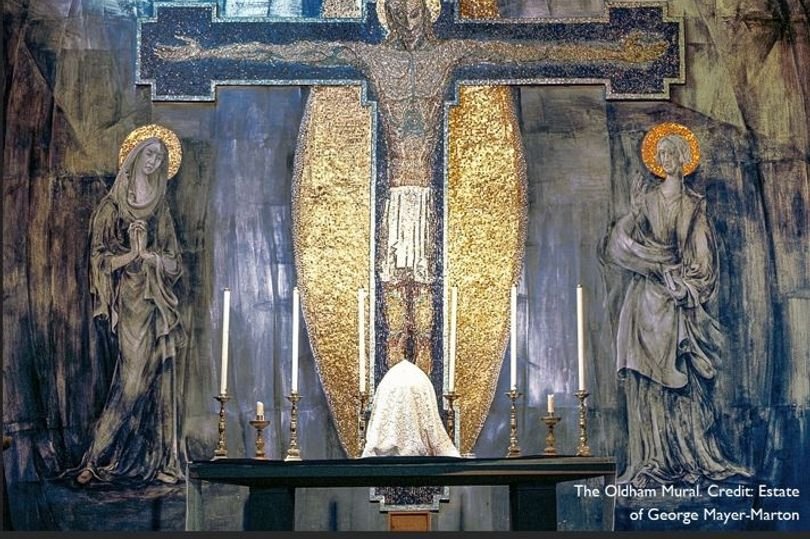
The magnificent mural by George Mayer-Marton inside the former church in Fitton Hill Oldham before it was partially painted over in the 1980s.
Made up of a painted fresco and mosaic, the mural depicts the figure of Christ in golds and tans against a dark blue cross and gold mandorla.
In 2018 Tristram Hunt, Director of the Victoria and Albert Museum in London, said: “The V&A regards ‘The Crucifixion’ … to be a remarkable example of Post-war mural art and the revival of the mosaic in Britain. It is also emblematic of the influence of European emigre modernists on British art.
He added, “A powerful interpretation of a common religious subject, it is a work of considerable importance for the history of British modernism. Far from a slavish imitation of the art of the past, his interpretation of Christian iconography in a modernist idiom is one of dazzling beauty. It is also testament to the enlightened Post-war ecclesiastical commissions of the Catholic Church awarded emigre artists from Central Europe.”

A sketch for the Oldham church mural by George Mayer-Marton.
Now the Oldham Mural & Cultural Heritage Trust, led by a strong local board of trustees, will take forward a vision for Holy Rosary Church in Greater Manchester and secure funding.
The trust plans to transform the church into a cultural heritage and arts centre. This will bolster an ongoing campaign to protect and restore an extraordinary in-situ artwork by Mayer-Marton.
The new trustees are Kim Rogers, founder of local youth charity Spark Oldham; Ottilia Ördög, director of youth arts and music not-for-profit Beat Bazaar (Manchester) and partner at Counterculture LLP; Krisztina Katai-Nagy, former Consul General of Hungary in Manchester; and Stephen Haines, health and safety expert and former parishioner and altar boy at the church.

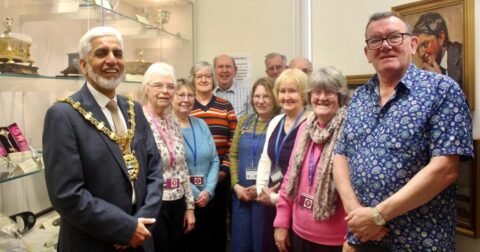
Local MP, Jim McMahon, talks to new trustee, Kim Rogers, founder of Spark Oldham, during a visit to mark the launch of the Oldham Mural and Cultural Heritage Trust.
Local MP Jim McMahon and SAVE Britain’s Heritage has been working behind the scenes with the community to find a new use for the derelict church. SAVE was also instrumental in getting the Oldham Mural and its setting listed.
Ottilia Ördög said their vision was to transform the repurposed building into a cultural heritage and youth and community arts centre for young people and wider community of Fitton Hill.
She said: “This will be a vibrant, creative space where young people can express themselves freely, develop new skills, access creative activities and benefit from high‑quality alternative education through arts, music and meaningful engagement.
“By celebrating a local piece of international artwork, the centre would not only broaden horizons for young people but also help raise pride across the local community, strengthening identity, belonging, and cultural connection across Fitton Hill.”
Local resident and fellow trustee, Kim Rogers, founder of Spark Oldham, added: “The building has so much potential. I have worked on the estate for over 15 years and seen the need for an amazing space like this for the community, especially the young people. If you are a business and you can support us with bringing this amazing space to life, please get in touch.”

The Oldham mural by artist, George Mayer-Marton, after it was partially painted over in the 1980s.
Henrietta Billings, director of SAVE Britain’s Heritage, said: “We’re thrilled that the community has come together in this way with such passion and vision. Not only will their plans secure the future of the building and its extraordinary artwork, but they will also be providing a fantastic home for local young people to explore their own creativity.”
Mr McMahon, MP for Oldham West, Chadderton, and Royton, said: “Over the years, the Holy Rosary Church on Fitton Hill has stood as more than just bricks and mortar: it’s been a place where people came together and built a strong sense of community. The beautiful George Mayer-Marton mural inside was recognised for its heritage value when it received grade II listed status following a successful campaign I was pleased to back. There’s a real opportunity here which is why we’re still working to bring the church back into community use.”
Opening up the former church is seen as a milestone in the long-running efforts to protect the mural.
It was created in 1955 using a rare combination of mosaic and fresco to portray the Crucifixion, with Christ flanked by figures of Mary and St John.
Sadly the mural was partly painted over by a well-meaning priest in the 1980s and the church was shut in 2017 and targeted by vandals. The mural had almost been forgotten until SAVE and the artist’s great nephew led a campaign to get it listed.
The directors of world-famous art museums and the Consulate General of Hungary in Manchester threw their weight behind the campaign which ended with the artwork and building getting listed status.
But a viable long-term use has to be found for the former church to lift the threat of dereliction and demolition.
As reported in the Manchester Evening News another impressive Mayer-Marton mural which was hidden for 30 years behind plaster in the foyer of the former St Ambrose Barlow RC High in Swinton could not be saved. Applications to have that listed were turned down by Historic England and last month it was destroyed by Salford Council who own the land it stood on.
Mayer-Marton who died in 1960 was a leading figure in the Viennese art world in the 1920s and 1930s. He and his wife escaped Nazi persecution in 1938, but faced another tragedy in 1940 when an incendiary bomb struck their London studio home, destroying most of George’s life’s work.

George Mayer-Marton, the Hungarian-born artist, lost his life’s work when his home and studio in London was hit by an incendiary bomb during the 1940 Blitz. Two of his church murals survive in Manchester and Oldham
In 1952 he was appointed as a lecturer at the Liverpool College of Art where he established the Department of Mural Art and the UK’s first course in this technique. During his time at the college Mayer-Marton completed more than 200 oil paintings and was commissioned by the Roman Catholic Church to carry out works at a number of churches in Lancashire and Cheshire, completing numerous frescoes and mosaics, one of which, the Pentecost, now resides in the Metropolitan Church of Christ the King in Liverpool.
The Oldham Mural is one of only two ecclesiastical murals by Mayer-Marton that survive in situ, and the only one that incorporates both fresco and mosaic. It is thought to be the first use in this country of the Byzantine mosaic method he employed.
In its report recommending listing, Historic England said: “The mural is highly unusual and possibly unique in this country in its striking aesthetic combination of neo-Baroque mosaic and modernist Cubist-influenced fresco inventively applied to traditional Christian iconography in a deeply personal evocation of suffering and redemption.”
New evidence has concluded that the fresco remains intact under the overpainting and that it is possible to restore the mural to its original condition.