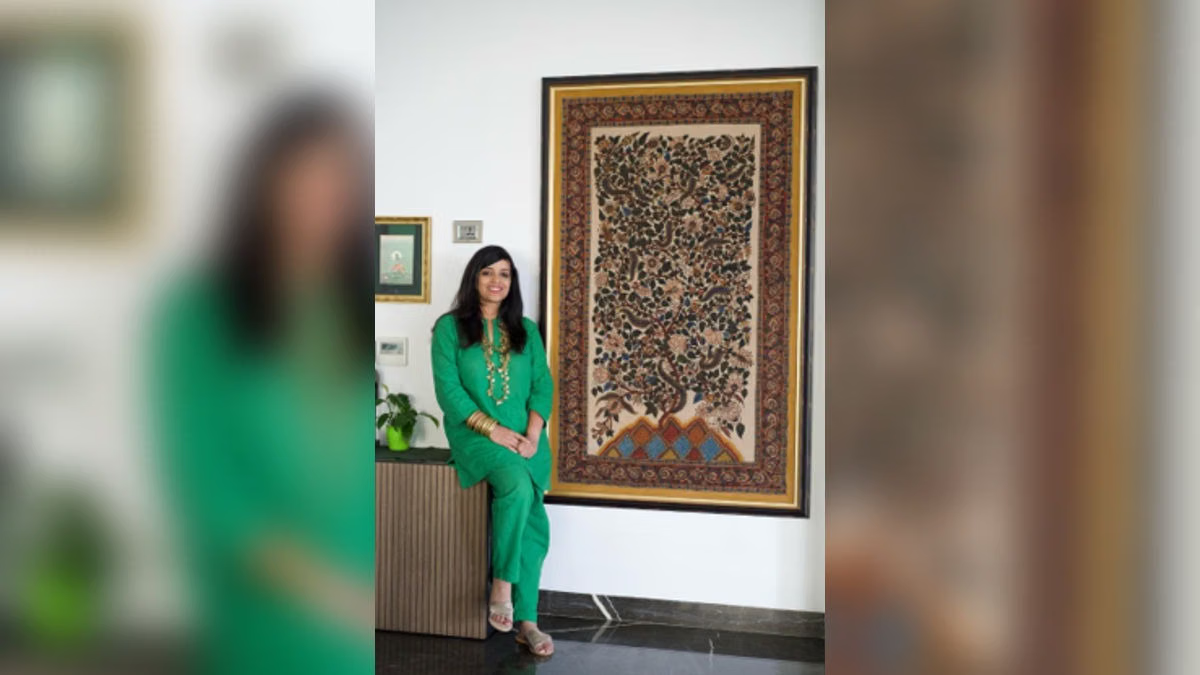
Yosha Gupta, Founder and CEO of MeMeraki, shares how the company grew from a deeply personal calling into a culture-led business creating sustainable livelihoods for master artisans. Drawing from years spent working across fintech, technology, and global institutions, she reflects on building systems for craft, enabling artists as contemporary creators, and placing Indian heritage into modern homes, workplaces, and global spaces.
1. You moved from global fintech to building MeMeraki, a culture-tech company rooted in India’s heritage arts. What gave you the conviction that this could be built as a scalable, impact-led business and not just remain a niche idea?
The confidence came from seeing two worlds up close. I spent nearly fifteen years working across fintech, technology, and development roles in the Asia Pacific region, including with the World Bank Group. That work taught me that real scale is not accidental. It happens when access, visibility, and trust are built into the system.
When I started spending time with traditional master artisans in India, I saw something very familiar. Extraordinary skill and discipline on one side, and on the other, broken access to markets and income that depended on intermediaries or seasonal exhibitions. There was clearly demand, even globally, but no infrastructure that allowed artists to participate consistently.
That made it obvious to me that this was not a niche problem or a charity problem. It was a systems problem. Craft had simply never been designed for the modern economy. MeMeraki began with the belief that if we built the right systems around storytelling, access, and long term partnerships, heritage arts could scale in a way that respected both the artist and the art.
2. MeMeraki has created a new category by enabling traditional master artisans to become digital creators. What truly differentiates your model from conventional art marketplaces or craft collectives?
We do not start with selling. We start with the artist. Everything we build is designed around long term value creation rather than one time transactions. Our work begins with helping artists articulate their practice and build confidence as creators in the contemporary world. From there, they participate across multiple formats, including teaching masterclasses, creating curated works, contributing to installations, and collaborating with brands and institutions. This allows them to earn across different income streams instead of relying on a single channel.
Storytelling plays a central role in this. When audiences understand the process, history, and intent behind an artwork, the relationship becomes deeper and more sustained. Over time, this creates an ecosystem rather than a marketplace. Artists are not suppliers. They are long term partners and cultural carriers.
3. Your work has been recognised through multiple awards and has also attracted investor backing. How important has this validation been in proving that culture-led businesses can be both credible and commercially sustainable?
Culture is often seen as either sentimental or niche, and that makes it a hard space to build in. Recognition helps change that perception. Receiving the National Startup Award from the Government of India was an important moment. It acknowledged that culture tech is a serious business category and that building structured access for traditional artists matters economically, not just culturally. Support from Next Bharat Ventures has also reinforced the belief that this is a long term opportunity, not a short term experiment.
For us, this kind of validation builds trust. It reassures artists, partners, and institutions that this work is being done with rigour and commitment. It also signals that heritage-led businesses can be credible, commercially sustainable, and deeply impactful at the same time.
4.You have worked on several large-format projects spanning masterclasses, curated collections, and collaborative installations. Which projects best represent MeMeraki’s ability to blend heritage, technology, and modern consumption?
Projects like the Tholu Bommalata installation at GMR Hyderabad Airport and the Cheriyal mask installations at national cultural platforms reflect this well. Both were led by master artisans and grounded in deep research, but executed at a scale suited to public, contemporary environments. What mattered most was creating context around the art. Through documentation and storytelling, audiences were able to engage with the work beyond surface aesthetics. Our international collaborations in places like Singapore and Hong Kong have shown similar results. When Indian heritage is presented with care and context, it resonates naturally with global audiences.
5. Livelihood creation is central to MeMeraki’s mission. What kind of transformation are you seeing in the lives of artisans who now have access to global audiences and structured digital income streams?
The most meaningful change has been income stability. Many artists now earn more predictably across the year rather than depending on seasonal opportunities. Over time, this stability allows them to plan better, invest in materials, and pass on skills to the next generation. There is also a visible shift in confidence. When artists see their work valued in global classrooms, institutions, and public spaces, it changes how they see themselves. They move from feeling invisible to being recognised as experts and creators. That sense of dignity is just as important as income.
6. Design preferences are evolving, with homes and workspaces moving away from minimalism towards more expressive, story-driven spaces. How are traditional Indian art forms influencing this shift in contemporary design?
Traditional Indian art forms are deeply narrative. They carry stories of place, belief, ecology, and community. As people look for spaces that reflect identity and values, heritage art offers something meaningful rather than decorative. In homes, workplaces, and public environments, we see Indian art adding warmth and depth. It anchors spaces in the story. Instead of being used as surface decor, it becomes part of how a space feels and functions. This is where heritage and contemporary design meet naturally.
7. MeMeraki works closely with designers, collectors, and consumers. How do you guide them to integrate heritage art into modern lifestyles without it feeling ornamental or outdated?
Everything begins with context. We look at how a space is used, who inhabits it, and what story it needs to tell. Scale, material, placement, and colour are considered carefully so the artwork feels integral to the space. Artists are involved closely in this process. Formats may adapt, but the essence of the craft is never compromised. This allows heritage art to feel timeless rather than nostalgic, and relevant rather than ornamental.
8. As someone shaping the intersection of culture, design, and technology, what have been the biggest mindset shifts required from both artisans and urban consumers?
For artisans, the shift has been about seeing technology as a tool rather than a threat. Digital platforms allow their work to travel, create new formats, and reach audiences they never had access to earlier. For urban consumers, the shift is about engaging with heritage as living culture. When people understand the story and effort behind a piece, their relationship with it deepens. It becomes something they live with, not just look at.
9. Beyond commerce and education, how do you see platforms like MeMeraki playing a role in shaping India’s cultural narrative on a global stage?
We believe cultural narratives are strongest when they are carried by living creators. MeMeraki allows master artists to teach, collaborate, and create directly with global audiences. As this network grows, it becomes a cultural bridge. Indian heritage enters global conversations around design, sustainability, and storytelling without being diluted or flattened. Over time, this builds recognition for Indian craft as a living, evolving practice shaped by the artists themselves.
10. Looking ahead, what’s next for MeMeraki in terms of scale, new formats, or global expansion, and how do you plan to deepen impact while staying true to your core mission?
The focus is on building long term cultural infrastructure. We are expanding our work with master artisans, especially in documenting lesser known and endangered traditions, while creating reliable income opportunities around them. We are also deepening institutional and global collaborations and investing in formats that combine physical spaces, education, and digital engagement. Growth for us is not about speed. As long as income stability, creative dignity, and long term opportunity remain central, scale follows in a way that feels honest and sustainable.