
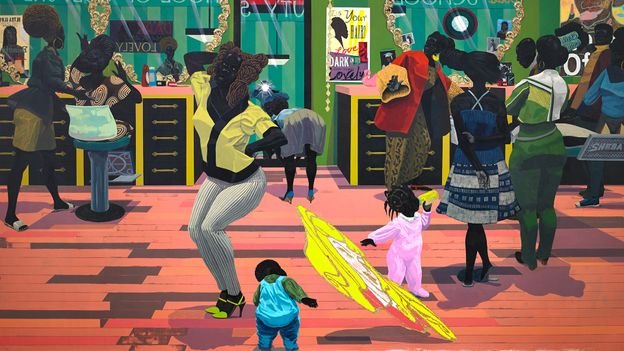
As Godfrey puts it: “He really respects the tradition of Western art. What he challenges is the fact that Western art museums haven’t, until recently, had large-scale paintings featuring black people.”
Most notably, in the foreground of the painting, a distorted, anamorphic depiction of Walt Disney’s Sleeping Beauty in yellow is scrutinised by an intrigued toddler in dungarees. This detail directly references Hans Holbein the Younger’s The Ambassadors (1533), in which two friends stand among an array of artefacts, while a distorted skull is hidden at the bottom. “In that painting, Holbein was thinking about how their lives were haunted by death,” explains Godfrey. “Kerry uses that idea to think about how white standards of beauty might intrude upon the beauty salon.”
Marshall also scatters mirrors across School of Beauty, School of Culture, a nod to Jan van Eyck’s Arnolfini Portrait(1434) and Diego Velázquez’s Las Meninas (1656), two works renowned for playing with reflection. In Van Eyck’s domestic scenes, a curved mirror offers viewers an expanded view of the room. Meanwhile, the placement of the mirror at the back of Velázquez’s painting reveals the reflection of King Philip IV and Queen Mariana. In Marshall’s piece, as the woman at the centre poses, supposedly for the viewer, the mirror behind reveals the flash of a photographer’s camera, as he raises his arms in front of their face to take the photo. “Those are all very deliberate and direct references,” Marshall says. “But in general, for the average person, without any of those references, this place looks familiar.”
Nods to contemporary black culture are just as prevalent in the painting. A signed poster of Lauryn Hill and another for the UK-born artist Chris Ofili’s 2010 Tate Britain show are depicted on the walls of the salon. At the time of the Tate exhibition, Ofili was widely considered the most famous black artist in British history, though Marshall first saw Ofili’s work in New York before seeing it in London. “They were the best paintings I’d ever seen because they were rich, complex, and layered,” he says, adding that he believes Ofili “operates at the highest level that paintings can be made”.
For Godfrey, Marshall’s diverse mix of references, from art history to black culture, is part of his genius: “He will refer to Raphael and Holbein because he is a scholar of painting and its history, and he’ll refer to Lauryn Hill because he’s a person in the world and he listens to great music.”