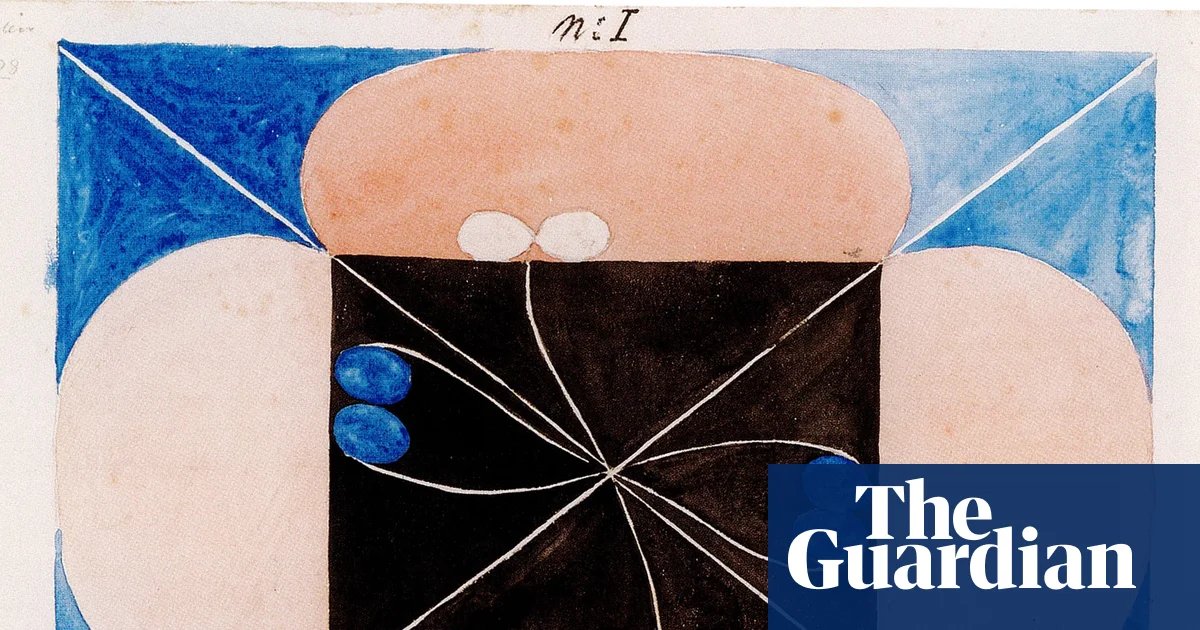
The Swedish artist Hilma af Klint died believing the world was not ready for the mystical paintings that would shock the art world half a century later.
The painter, now credited with pioneering the abstract art movement, did not seek recognition after peers rejected her avant garde works. Instead, she ordered that they be hidden for 20 years after her death and never sold.
Now the clairvoyant and mystic, who believed she was directed by higher spirits, is to be given her first solo exhibition in France, more than 80 years after her death.
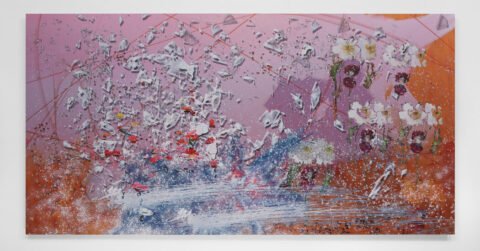
An exhibition organised by the Grand Palais and the Pompidou Centre will celebrate what is described as her magnum opus, Paintings for the Temple, produced when she was part of a spiritual women’s group that shared utopian visions.
Pascal Rousseau, the show’s curator, said af Klint had been long overlooked in France and the event was part of an international re-evaluation of the artist’s work and “the role of women in the field of modern art”.
“This exhibition highlights the many sources of inspiration in her work and questions how art history has long overlooked women artists and their contributions to foundational movements,” he said.
Even today, af Klint’s name is not immediately recognisable, unlike her male successors Wassily Kandinsky, Piet Mondrian and Kazimir Malevich, who declared themselves the inventors of abstraction. When af Klint’s work was finally shown outside Sweden in the 1980s, demonstrating that she had been the first by several decades, art history books had to be rewritten.
Born in 1862, af Klint was one of the first women admitted to Stockholm’s Royal Academy of Fine Arts, where she trained as a classical painter. She produced much of her best work as a member of the Theosophical Society and “the Five”, a spiritualist group she formed with four other women. Theosophy, popular in artistic circles around the end of the 19th century, has been described as a form of occultism involving esoteric or supernatural beliefs.
Rousseau said af Klint believed in angels, reincarnation and messages from other worlds.
“It was a crazy obsession that lasted 30 years, but what is incredible is what she did with it, that she used it to produce such original and groundbreaking work,” he said.
Af Klint produced and sold classic portraits and landscapes, but kept her spiritual paintings under wraps, convinced the world would not understand the secret signs and mysterious codes within.
At least one Stockholm museum refused to exhibit female painters’ works and when she persuaded the philosopher and artist Rudolf Steiner, also a theosophist, to view her work in 1908 he was unenthusiastic, suggesting it was of little worth.
Before her death in 1944 she instructed that her works, including more than 1,200 paintings and 126 illustrated sketchbooks, remain sealed for 20 years and never be sold.
The art expert Prof Caroline Levisse said af Klint felt above earthly concerns and deliberately chose not to reach out to her contemporaries, adding to her obscurity.
“In fact, she didn’t want to be exhibited in a museum, she wanted her work to be in a temple. It was the spiritual that appealed to her,” Levisse said. “I think her attitude was: this is art for the future and people will get it eventually.”
Apart from a few small shows in Sweden, her paintings were not exhibited to a wider public until 1986, in Los Angeles. It was not until 230 of her works were displayed in a sellout 2013 exhibition in Stockholm that she gained international attention. A biography was published in 2022 and the following year she was the subject of an Oscar-nominated film.
“Even after she was first discovered in the 1980s she was often ignored. In 2010, MoMa [in New York] had an exhibition of abstract art and didn’t include her, which is crazy,” Levisse said.
“Now she is being given her rightful place in the history of abstract art but it means we have been forced to rethink that history. What she did was experimental, new and impressive. She definitely did abstract art first.”
The Paris exhibition includes af Klint’s The Ten Largest, a series of paintings on paper mounted on canvas, each measuring around 3.3 x 2.4 metres (10.8 x 7.9ft).
“They are very fragile and in need of restoration so it may be the last chance to see them for some time,” Rousseau added.