
[ad_1]
In 2024, Paramount Pictures released Better Man, a musical biopic about the life and career of British singer Robbie Williams. The film was like most other entries in that oversaturated genre, except for one little detail: its protagonist was portrayed not as a human, but a chimpanzee. Inspired by Williams’s self-perception—director Michael Gracey told the BBC his star felt “like a performing monkey”—this creative choice isn’t as bizarre as it seems. Far from unprecedented, the singer’s simian CGI makeover actually taps into an age-old artistic convention known as Singerie.
French for “monkey trick,” Singerie refers to visual art that swaps human subjects with primates, dressing them in human clothing or showing them performing human actions. Rooted in allegorical ancient and medieval fables, the genre emerged in the early 1600s and reached its zenith during the Rococo period two centuries later, when European and particularly French painting revolved around themes including playfulness, pleasure, and undoubtedly, exoticism.
Found on canvases, textiles, and porcelain, Singerie imagery was especially popular with members of the upper class, who saw the motifs as mild parody and a charming celebration of their own follies and decadent escapades.

David Teniers II, Singerie (c. 1640–90). Photo: Heritage Art / Heritage Images via Getty Images.
In many works of Singerie, primates are associated with baseness, primitiveness, and immorality. Echoing Enlightenment philosophy and foreshadowing colonial-era racial theory, they represent people’s failure to keep their natural inclinations towards lust, gluttony, greed, and other vices in check through the power of reason. Think, in this instance, of Monkeys Feasting, a painting by Flemish artist Jan Brueghel the Elder from c. 1620 that puts a bestial spin on familiar scenes of bacchanalian excess and revelry.
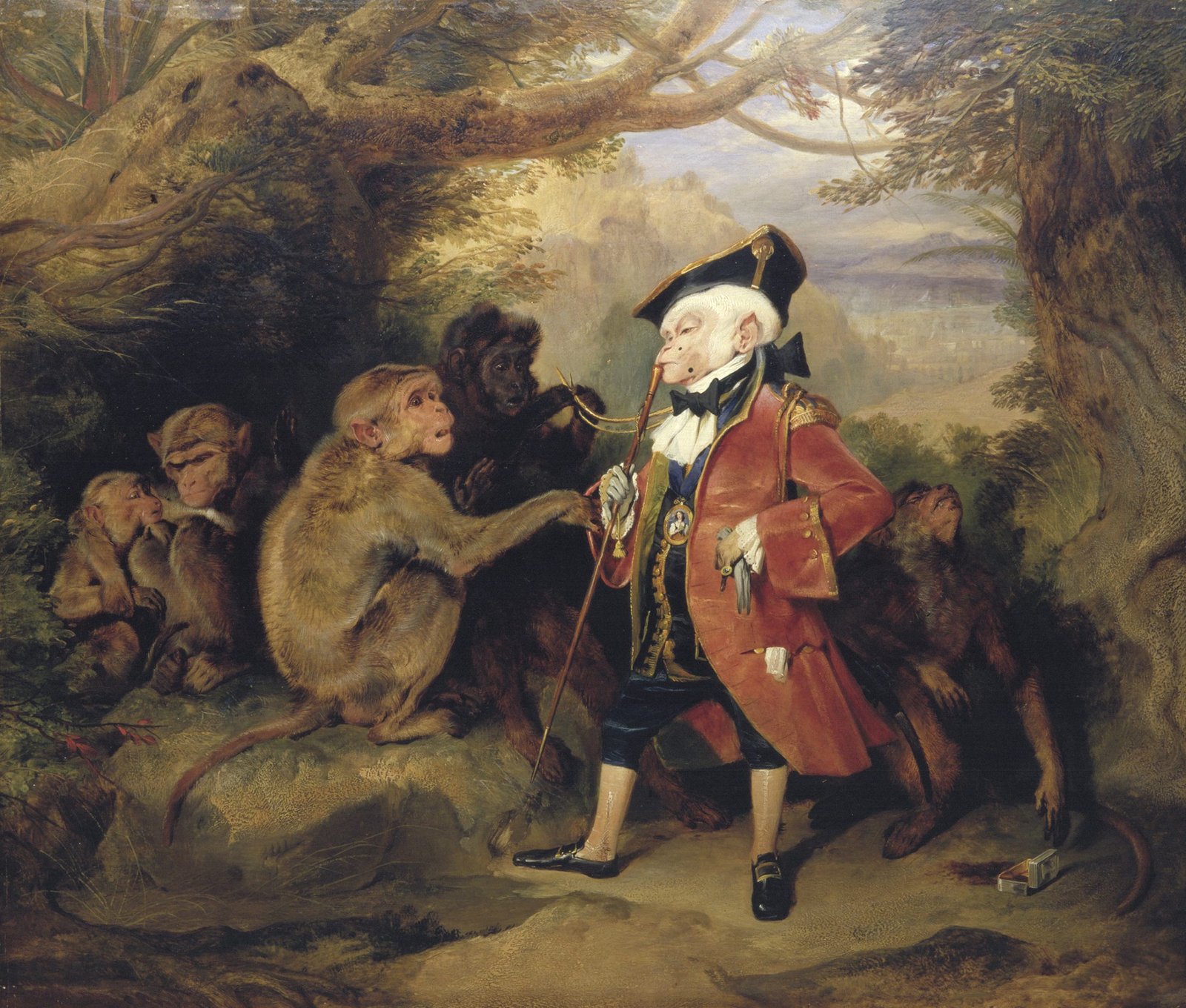
Elsewhere, simians poke fun at the things that people think separate them from other animals, like culture, civilization, and high society. Such symbolism is on full display in The Monkey Who Had Seen the World, an 1827 painting by British artist Edwin Landseer. It depicts a monkey in with a red coat, powdered wig, and tricorne hat standing next to a group of naked, more naturalistically rendered monkeys in a forest. Fancying himself more refined than and consequently superior to his brethren, the subject is a perfect illustration of the proverb, “A monkey in silk is a monkey no less.”

Louis Desplaces after Antoine Watteau, Painting (La Peinture) (c. 1700–39). Photo by Sepia Times/Universal Images Group via Getty Images.
Other works of Singerie fall under the category of ars simia naturae, a Latin phrase meaning “art is the ape of nature.” Painters from the Renaissance onwards believed that artists should study and copy nature and, like monkeys, learn through imitation. Paintings like The Monkey Sculptor by Antoine Watteau, from 1710, express this idea in visual form.

Banksy, Devolved Parliament (2009). Photo by Tristan Fewings via Getty Images for Sotheby’s.
Although Singerie fell out of fashion in the 19th century, primates continue to show up in art. Today, they are most common in satirical or protest art like Devolved Parliament, a 2009 oil painting by Banksy that replaces the politicians of Britain’s parliament with chimpanzees. Another contemporary artist keeping the tradition alive is Walton Ford, an aspiring natural history painter turned visual artist whose Singeries resemble their Rococo-era predecessors in both style and subject. Turns out, monkeys never really fell out of fashion.
What’s the deal with Leonardo’s harpsichord-viola? Why were Impressionists obsessed with the color purple? Art Bites brings you a surprising fact, lesser-known anecdote, or curious event from art history.
[ad_2]
Source link


