Art curators are always on the hunt for exciting new talent to share with the world. For some, being among the first to spot and support an artist who becomes the next big thing is a career-defining achievement. But what exactly are they looking for—and where do they go to find it?
Earlier this year, I spotlit a handful of small museums that have an outsize impact on the art world, in large part due to their track record of elevating the best emerging artists. Furthering the conversation, I’ve spoken to seven leading curators who are on the ground identifying the artists who you’ll probably be talking about in three years’ time. They are willing to demystify their process and share the magic ingredients that they believe make a little-known artist “one to watch.”

Installation view of “Hangama Amiri: A Homage to Home” at The Aldrich Contemporary Art Museum, 2023. Photo: Jason Mandella, courtesy of the artist and Cooper Cole, Toronto, and T293, Rome.
The question feels more relevant than ever in 2025, as a new debate about the purpose of contemporary art has emerged in the wake of Dean Kissick’s widely-read polemic “The Painted Protest,” which was published by Harper’s last fall. The critic railed against a contemporary art scene that he found to be overly dictated by identity politics at the expense of art’s capacity to be nothing more (or less) than “the purest expression of the human spirit.” The divisive essay was reviled by many but praised by others for “saying the quiet part out loud,” in the words of curator Helen Molesworth. The resulting discourse, as well as broader political developments, prompted my colleague Ben Davis to wonder, will the art world go post-woke in 2025?
Historical Heft
If the conversations I’ve had with top curators are anything to go by, the answer is no. Several stressed that they are still seeking to uplift historically marginalized artists and practices and find themselves moved by art that speaks to its broader geopolitical context.
“I work with a feminist perspective and I’m looking for artists who are working with subject matter or histories that have been erased,” said Amy Smith-Stewart, chief curator at The Aldrich Contemporary Art Museum in Connecticut, a long-serving and influential advocate of emerging artists in the U.S.
One example that stands out is her 2023 show “Hangama Amiri: A Homage to Home,” which traveled to the Kemper in Kansas City, Mo. last year. The Afghan Canadian artist, who fled Kabul as a child, creates textiles covered in text and images that refer to her experiences as an immigrant and memories of her homeland. Smith-Stewart, aware that the U.S. had only just pulled out of Afghanistan in 2021, after two decades, felt Amiri’s work was particularly timely.

Amy Smith-Stewart. Photo by Gloria Pérez.
In some cases, rectifying past Western or Eurocentric biases is an institution-wide focus, as in the case of the Kunsthalle Bern. Since 2023, the Swiss museum has been helmed by Greek curator iLiana Fokianaki, who is determined to diversify the exhibition program through her new code of conduct. “The priority is to fill in historical gaps but also connect Switzerland to the world through the work of artists that are working in continents that Switzerland still has mercantile relationships to or has colonial entanglements with,” she explained, of art’s potentially educational, even diplomatic, function.
More Than Trendspotting
While curatorial priorities like these are nothing new, the curators I spoke to were universally wary of succumbing to passing trends in their desire to be responsive to the present moment. This can be easier said than done.

Installation view of “BEDROCK” at 20 Jordan Street, part of Liverpool Biennial 2025. Photography by Mark McNulty
“You’re never outside of a cultural moment so you might sometimes think your research is quite unique but it will be part of a wider movement,” according to Marie-Anne McQuay, curator of the current 13th Liverpool Biennial, on view through September 14. “It’s really difficult for artists when there’s a perceived trend and then [the culture] moves on. I try not to work in relation to trends because I think that does damage to artists.”
One example of something that might be classed as a trend is the growing popularity of textile art, which Smith-Stewart pointed out has “been associated with craft and relegated to the margins.” The fact of this bias, and the need to reverse it, is a widely accepted truth in the art world, if one that Kissick scoffs at in the introduction to his infamous essay.
Being on trend, however, is no guarantee of quality. Or, as Fokianaki put it, “A lot of textile art has been produced lately that is not very good.” Every curator agreed that clarity of purpose and originality are what really makes good art stand out from the crowd.
For Lisa Long, former artistic director of the Julia Stoschek Foundation in Germany, art doesn’t need to be overtly political. “I do believe artists make their work for a specific reason that may be urgent to them,” she said, “I can see when they really believe in what they’re making and that is something I connect with very strongly.”
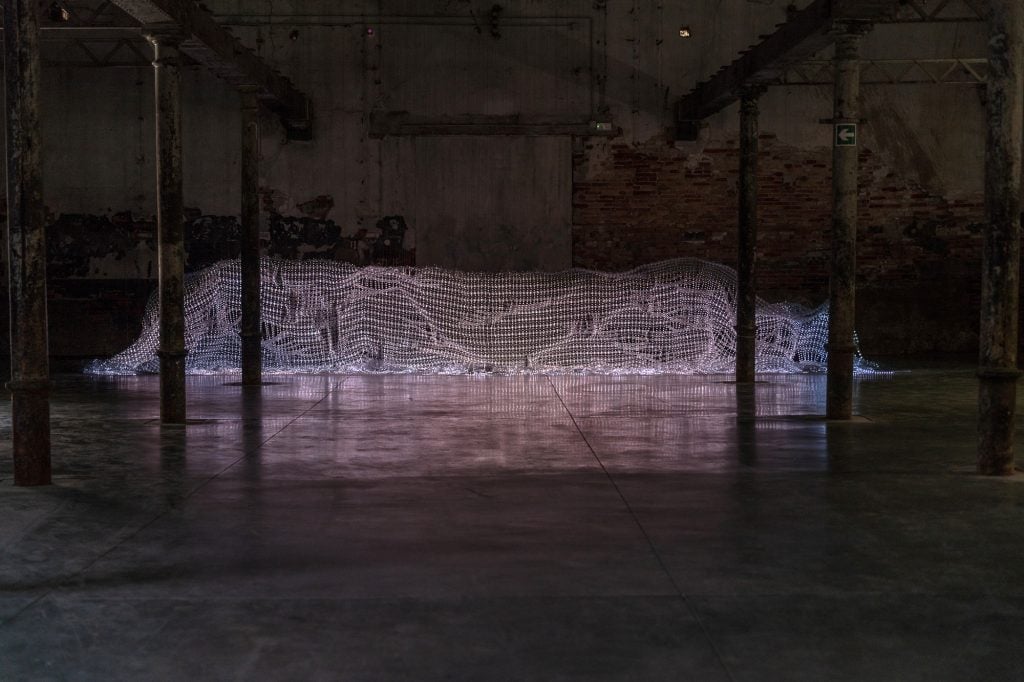
WangShui. Photo: Andrea Avezzù, Courtesy La Biennale di Venezia
Seeing Work In Situ
The curators described social media as a “visual diary” or a “rolodex” but agreed that nothing replaces the old-fashioned ways of encountering art. These include art fairs, studio visits, exhibitions, MFA programs, and grad shows. “I’m a very experiential person,” explained Smith-Stewart. “I’m drawn to this field because I love the experience of being with art and with artists.”
This usually requires some degree of international travel. “Emerging talent is very local because these artists don’t have recognition yet,” according to Long, calling from Tunisia. Two recent month-long curatorial residences in Barcelona and Madrid exemplified “the importance of opportunities for curators to be in a place for more than a few days,” she said. Only then can they hope to become properly immersed in a scene and build up a wider network.

Artist Rindon Johnson. Photo: Lena Maria Loose
So, how can a curator be sure an artist is ready to take the next big step? The final call comes down to gut instinct. At the Julia Stoschek Foundation in 2019, Long staged the very first institutional shows of artists WangShui and Rindon Johnson. “People couldn’t believe the foundation had taken such a risk,” she recalled. While each studio visit had left Long excited about the artists’ ideas, the clincher was the maturity of their approach. It’s important to find artists “who are interested in feedback, in that back and forth,” she said. “With young artists, often there’s things to be learned from how exhibitions are installed.”
The sentiment was echoed by Nora Lawrence, executive director of Storm King Art Center, a 500-acre outdoor museum in New York’s Hudson Valley. The unique character of the institution means she is often assisting artists in broaching a whole new context and scale. These commissions take substantial preparation and require flexibility in terms of location and materials.
“Occasionally, someone jumps at the opportunity, but then you start talking practicalities and they need to think about them a bit more,” she said. After all, monumental public pieces at Storm King need to withstand potentially tumultuous weather conditions and all kinds of contact from visitors.

Installation view of Josephine Halvorson, Measures (2016) in “Outlooks: Josephine Halvorson” at Storm King Art Center, Mountainville, NY. Photo: Jeffrey Sturges.
For artists who are willing, however, the commission can mark a major breakthrough. For this reason, Lawrence tries to be imaginative in her search, one time reaching out to the painter Josephine Halvorson. She admired her work, produced en plein air, for how “attuned it is to very small scales of change in her environment,” she said. “It felt like that type of careful attention to the world around her that might resonate outdoors and in sculpture.” Halvorson jumped at the chance, and the 2016 show pushed her to embark on other surprising new ventures.
Programming Pressures
One pressure that can shape a museum’s programming priorities is funding, a source of perpetual pressure on many cultural institutions. As was noted in the New York Times, mega-gallery Hauser and Wirth represented artists at four of New York’s biggest museums this spring: Jack Whitten at MoMA, Amy Sherald at the Whitney, Rashid Johnson at the Guggenheim, and Lorna Simpson at the Met. That galleries regularly offer financial support to institutional shows featuring their artists is a well-known phenomenon that creates the conditions for this kind of accidental monopoly. In turn, it damages the exhibition prospects of artists who are backed by smaller galleries or no gallery at all.

Installation view of “Abang-guard: Makibaka,” 2025. Photo: Hai Zhang, courtesy Queens Museum.
“You do feel the pressure sometimes in terms of funding,” acknowledged Hitomi Iwasaki, head of exhibitions at Queens Museum. “An exhibition more involved with socio-cultural issues is not sexy enough for a corporation.” She believes that some curators who are moving into development roles are helping boost awareness of the issue and “are able to navigate their own organization’s policy to go against that current, so that a greater diversity of perspectives is possible.”
For her part, Hitomi has made supporting emerging artists a core part of the Queens Museum’s mission, thanks to its biannual Jerome Foundation Fellowship. Selected via open call, two New York-based visual artists who have not yet had solo gallery shows or received major grants, receive $20,000, as well as free studio space and mentorship for one year as they work towards a solo exhibition. More opportunities like these, which alleviate many of the primary stressors on emerging artists like rent and establishing connections, would allow artists to begin building their careers from a more empowered position.

Bonaventure Soh Bejeng Ndikung, curator of the 36th Bienal de São Paulo. March 13, 2024. © Franziska Sinn / Fundação Bienal de São Paulo
Bonaventure Soh Bejeng Ndikung, who is currently curating the 36th Bienal de São Paulo, set to open this fall, has a different vision for how the dynamic between curators and artists could develop. “I do not think that the main goal of an artist is to catch a curator’s attention,” he said. Rather, artists should focus on their work and what they want to say.
“The relationship between artists and curators must be symbiotic for it to be healthy. It shouldn’t be hierarchical or parasitic,” he added. “As much as artists could be on the radar of curators, so too could curators be on the radar of artists.”