The concept of legacy is often associated with challenges. Featuring past winners of the Life In My City Art Festival (LIMCAF), the show presents a complex exploration of legacy, moving beyond sentimental nostalgia. With nearly 60 works on display, the exhibition, opening on Saturday, September 20, is a dynamic and thought-provoking reflection on the artists’ experiences and perspectives. Rather than a polished commemoration, Legacy reveals a more nuanced and multifaceted understanding of legacy, one that is still evolving and open to interpretation.
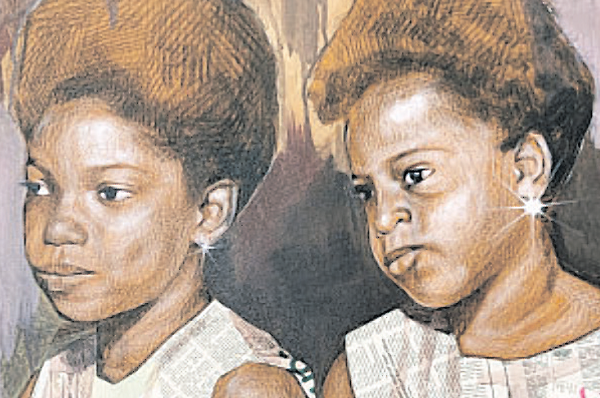
Take Nnamdi Hector Udoka, the Enugu-based figurative artist for instance. His artwork explores the complexities of history, memory, and accountability through his distinctive crisscross drawing technique. His pieces navigate the tension between representation and fragmentation, reflecting the instability of collective memory. Udoka’s work is rooted in Eastern Nigerian traditions while engaging with contemporary issues. By reworking figurative forms, he highlights the fragility of recollection and the potential for memory to be distorted. This approach to legacy emphasises the contested nature of remembering and forgetting.
Meanwhile, Mariagoretti Chinenye Eze approaches her work differently. As a photographer and graphic designer based in Abuja, she arranges her images into thematic clusters that invite critical examination. Mariagoretti uses photography as a means of inquiry, challenging assumptions and encouraging viewers to consider multiple perspectives. Her subjects are portrayed in nuanced, multifaceted ways, reflecting broader societal tensions. Despite her notable achievements, including top awards at LIMCAF and the Spanish Visual Art Competition, her practice remains characterised by experimentation and questioning. Each image prompts further reflection, underscoring photography’s potential to spark new ideas and challenge existing ones.
If Mariagoretti’s lens multiplies perception, Ejiofor Samson, a sculptor trained at the University of Nigeria, Nsukka treats wood as both a material and a metaphor. His sculptures blend functional and abstract elements, combining practical woodworks with imaginative carvings. Despite winning the overall prize at LIMCAF in 2022, Samson’s practice remains characterised by experimentation and exploration. His sculptures can be seen as arguments shaped into form, with rough edges and surfaces that reflect the material’s inherent qualities. In his work, wood is not a passive medium but an active participant, influencing the creative process. The result is a negotiation between the artist’s intentions and the material’s properties, yielding complex and thought-provoking pieces.
No less restless is Emmanuel Gbenga Eweje, whose versatility makes him difficult to pin down. Drawing, acrylic painting, and the meticulous craft of thread painting all converge in his practice, each medium approached with an eye for cultural symbolism and layered narrative. Already a decorated artist—three-time winner of the Felabration art competition, participant in residencies from Lagos to Chicago—Eweje carries his acclaim lightly, using it as a springboard for ever more expansive experiments. Thread becomes a metaphor for continuity, but also for rupture: stitches that hold together, or stitches that scare. His works shimmer with detail yet resist the seduction of surface beauty; they are conversation pieces in the truest sense, designed to provoke exchange. Beyond the gallery, Eweje’s practice extends into pedagogy and healing—an Arts in Medicine Fellow, he has seen how art sutures community as much as canvas. Within Legacy, his contribution underlines a crucial point: legacy is not passive inheritance, but active weaving, an endless work of repair.
Then there is Izuchukwu Muoneme, who makes sculpture out of what others discard. A trained painter with both BA and MFA degrees from Nnamdi Azikiwe University, now pursuing doctoral research at UNN, Nsukka, Muoneme has drifted from easel painting into the stubborn materiality of waste. His chosen medium—aluminium cans once filled with soft drinks, energy boosters, and other disposable pleasures—could so easily lapse into eco-preaching. Instead, he handles them with painterly sensitivity: shredding, cutting, collaging, arranging fragments of colour into uneasy geometries. The works speak at once of consumerism’s casual excess and of the fragile beauty to be found in what is thrown away. Muoneme calls attention to the psychological as much as the environmental cost of litter. His collages, glinting with commercial hues, are like mirrors held up to our consumption, catching us in their sharp edges. Legacy, in his hands, is both accusation and possibility: the residue of waste reimagined as art, the evidence of our appetites transformed into warnings and fragile offerings.
The exhibition, which is also featuring other past top winners of the LIMCAF like Abiodun Emmanuel, Adebayo Ebenezer Seun, Chibuike Ifedilichukwu, Chichetam Okoronta, Edward Samuel, Ezichi Nkwocha, Ibrahim Afegbu, Idowu Abayomi, Ijiko Kelvin, Klaranze Okhide, Lucky Ezah, Mayi Theophilus, Mbaeri Stephen, Motorola John, Ngozi-Omeje Ezema, Okechukwu Eze, Olayemi Sunday Opeyemi, Onyinye Ezennia, Oryina Priscilla, Paul Emenike, Popoola Nurudeen, Segun Victor Owolabi, and Shade Fagorusi, is characterised by a dynamic tension between the artists’ works.
This discordant harmony propels the show forward, reflecting the multifaceted nature of legacy. Rather than presenting a polished narrative, Legacy reveals a fractured and debated concept. The exhibition’s impact is not one of reverence, but of energy and provocation. While LIMCAF’s mission focuses on art as a tool for empowerment and development, the artists’ works challenge and interrogate these notions. The result is a legacy that is not static, but dynamic and contested. The exhibition leaves the viewer with a sense of reinvention and unfinished business, highlighting the enduring power of art to spark critical thinking and reflection.