[ad_1]
Art watchers who consider themselves well versed in Cumbria’s community of talented painters may wonder how they have missed the high-quality work of Eva Ullrich.
She has been back where she grew up for the past five years, and her surname will be familiar – she is the daughter of well-known potter, Hans Ullrich. Her sweeping paintings will surely catch the eye of anyone who appreciates a unique perspective or method of conveying light on landscape and sky.
Yet Eva concedes she is not well known in her home county, but she has plans to change that and has already begun introducing her art to a much wider audience. This is not to say she isn’t already successful. Far from it. Eva’s work can be found in hotels from the United States to Singapore, across Europe to Australia, on private luxury yachts, in Swiss mountain resorts and in corporate offices in London, among others, thanks to regular commercial commissions for a variety of clients, art consultants and interior designers. Galleries and partners she works with include Artelier, Art in Offices, Envie d’Art, Saatchi Art and The Auction Collective. Her biggest work to date, Cloudbreak, measures 5.1m, the requirement of the Seattle hotel that commissioned the ambitious work for its double height atrium at the entrance to a ballroom. The client used a high-resolution scan of the image to print onto wallpaper to cover the 36m by 6.5m space.

Whilst there is no doubting Eva’s pedigree, the chance to reveal herself to Cumbria was more a question of both timing and location.
Having completed a one-year art foundation at Leith School of Art, in Edinburgh, followed by four years studying painting and printmaking at The Glasgow School of Art, she was invited to show in the Scottish New contemporaries at the Royal Scottish Academy in Edinburgh. From this, Eva was selected to exhibit in Open Dialogues, part of GENERATION 2014, which included Turner Prize-winning artists. She then headed to Bristol, where she says she learned how to make a living as an artist. During this time, she exhibited regularly at the affordable art fairs in London and Brussels, as well as New York, Hamburg and Singapore and had solo exhibitions in London and Scotland.
She worked from Jamaica Street Studios, one of the biggest artist-run studios outside London, for six years and, after that, has been selling online and abroad to commission.

She did show in Cumbria at Grizedale Forest visitors’ centre alongside the Jerwood Encounters exhibition TERRA in 2012 but had done little here since then. That was until recently, when she unveiled her work in By Osmosis, an exhibition held in a former hay barn next to the studio building she shares with her father at the family home at Skelsmergh, near Kendal.
The barn at Red Bank Farm, where she used to play and swing from the beams as a child, has been transformed into an exhibition space for contemporary art in an unexpected rural context.
‘Having come back home five years ago, I felt like I was missing the day-to-day interactions I used to have with other artists in Bristol, hence deciding to organise my solo exhibition,’ she explains.
‘I have been planning to show in the barn for the last couple of years. I often benefit from an external deadline so when I saw that the Visual Arts Association, of which I’m a member, was inviting applications for their first-ever OpenSpaces2025 – an artist-led global art trail encouraging artists to exhibit in unusual and everyday spaces – I thought it would be the perfect fit.

‘Reimagining our traditional, Lake District barn into a place to show my work felt like a homecoming, a return to the source of my earliest creative influences. The landscape here is part of me, it’s what I know.
‘It was exciting to give this traditional building a new role to exhibit my art in the place where I absorbed some of my earliest creative influences. It’s not an average gallery space and the informal atmosphere means people aren’t intimidated.’
The barn could not be a better blank canvas for her abstract-leaning work, whose vibrant yet natural tones are set against warm stone, fresh lime plaster and timber beams and joists. Juxtaposed with the landscape that originally inspired Eva to paint and continues to inform her work, the exhibition offers a richer viewing experience for visitors than a more sterile, urban gallery setting.

A mix of both previous and new work including the original of Cloudbreak was for sale, the scale of the building’s walls and its lofty height allowing it to breathe amid natural materials and emphasising the sense of tranquillity emanating from the paintings.
As well as exploring the Lake District and the Highlands and coastline of Scotland, Eva has gained inspiration from research trips to remote locations in Arctic Norway and Iceland capturing the fleeting light that defines these northern landscapes. The memory of this experience of landscape at home and abroad and its patterns are the starting point for her work.
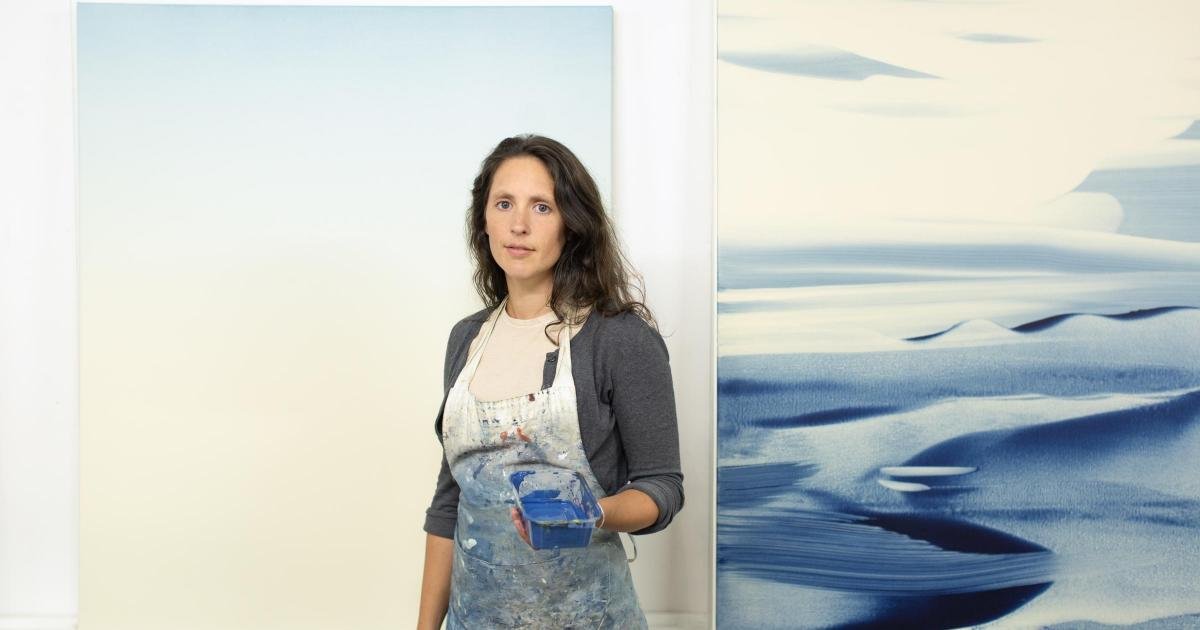
Using ‘the inherent language of paint’ as she describes it, she creates bold, confident, atmospheric pieces that capture the essence of specific places or natural events with a submersive quality. She explains the process is meditative in the same way that our experience of landscape can transcend the obvious. ‘I never know quite how it’s going to turn out when I start but I’m trying to portray an emotional aspect of experiencing landscape, sculpting light and creating space to get lost in.’

Expressive and full of movement, her monochrome tones are both compelling and calming. Solstice, Shadow and Ripple can be seen as snowy mountain landscapes, as ice and water or sky and cloud formations or all three depending on how each individual viewer interprets their blend of light and shade.
In beautiful Glimmer she moves away from the spectrum of paler blues through to deep indigo in a less abstract image of moonlight breaking through cloud, reflecting on water. ‘For years, I was scared to use blue because I was told by a tutor that it was too obvious for landscape. I know now what they meant, and I’ve found a way of working that’s true to me,’ she explains.
‘I love monochrome because it allows me to focus on my mark making; it’s freeing, stripping it back to the bare essentials.’

Windswept and Moorland are more clearly a traditional view and tone of landscape but still handled in her more abstract, sweeping style. Foothills has a sepia quality while Solar Flare brings oranges and blues of a Caribbean sunset together and Golden Hour echoes colours and shapes reminiscent of sand dunes.
Her understanding and appreciation of colour comes, in part, from knowledge gained while working for the fine art paint maker, Wallace Seymour, near Settle, which sources many of its earth pigments locally and whose paints Eva still uses.
Whether expressing cloud or a snowy mountain face, the outcome is both subtle and
dramatic. Acrylic paint is applied with physicality – ‘it’s almost like a dance or a workout routine,’ she says. She employs unglamorous, domestic tools like squeegees for cleaning cars bought at Halfords, wallpaper brushes, draught excluders, windscreen wipers and sponges in experimental, diverse and dynamic mark making. In her need to slow down the fast-drying properties of acrylic paints, she uses ultrasonic humidifiers left on for hours to create an almost sauna-like atmosphere in which to work.

As well as selling originals, including more affordable sizes that she frames using her German-born grandfather’s old framing guillotine, Eva released a new set of limited edition prints to coincide with the exhibition that are also available on her website. She says: ‘Allowing myself and my paintings to be more visible locally within Cumbria has been a very positive experience and an excellent springboard from which to connect more deeply with fellow creatives in the area.’ It has sparked exciting conversations about ideas for the future, too. ‘I was looking for more opportunities to have discussions about my work with people. We have had visitors to the show who possibly wouldn’t normally go to an art gallery, and all generations, too. Hopefully it has felt more accessible and a little bit different.’
The opening of By Osmosis was a blend of art and music provided by Lake District-based artist-producer and musician Tiiva, who composed a piano EP for the event during a week-long residency at Red Bank Farm last year. ‘I would like to think of this barn space as a way of connecting different art forms, so it was very appropriate that the paintings and the piano music could be experienced at the same time, making it very immersive,’ adds Eva.
After her first show at home, next is Nature Turns, a Royal Scottish Academy show in Edinburgh, running through December and January. Eva plans to keep pushing her painting practice and make the most of having access to her new, large studio space. New limited-edition prints will follow and she is also developing plans for ‘Red Bank Studios’ with more shows.
‘We have a group show planned for the spring that will feature both fine art and contemporary craft side by side united by a connection to the land. It is the crossover of art forms and processes which I find most exciting – music, visual art, traditional crafts, poetry, dance – and the barn is a very versatile performance and exhibition space,’ she says.
Find Eva at evaullrich.com and follow her on Instagram: @evaullrich
[ad_2]
Source link