KATHMANDU, FEBRUARY 7
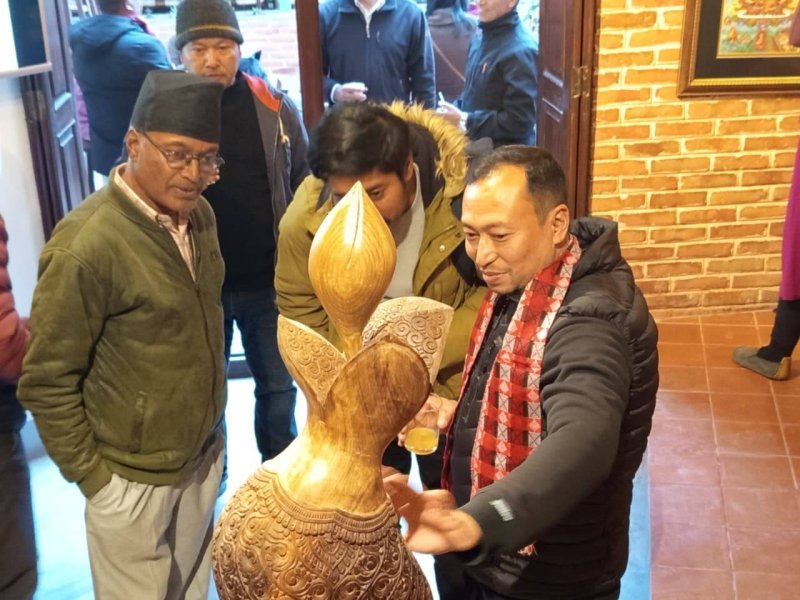
At The Nanee in Bhaktapur, Living Heritage brings together traditional artists whose practices continue to be shaped by daily life, ritual, and community. Curated by multidisciplinary artist Manish Lal Shrestha, the exhibition focuses on artistic traditions of the Kathmandu Valley, including paubhā painting, sculpture, metal repoussé, and theatre. The exhibition opened on 6 February and will remain on view until 18 February 2026.
Speaking at the opening, Shrestha described living heritage as something that exists through continued practice rather than preservation alone. He noted that traditional art is often treated as something from the past, when in reality it is still being made, learned, and adapted. “Living heritage is what we have been doing every day since generations,” he said, explaining that the exhibition aims to reclaim traditional practices so they can be carried forward. Emphasising the inseparability of art and everyday life, he added, “Art is culture.”
The exhibition features paubhā works by Devendra Sinkhwal, Rajani Sinkhwal, and Ujay Bajracharya, sculpture by Indra Prasad Shilpakar, and metal repoussé by Rajesh Shakya. Together, the artists reflect different generations and lineages of practice rooted in Newar artistic traditions.
Paubhā artist Rajani Sinkhwal, who works as a full-time artist, spoke about how the art form carries more than visual tradition. “It’s not just the art that is living,” she said. “The skills are passed down with heritage.” She expressed hope that visitors would move beyond seeing art as a hobby and begin to take artists and their work seriously as a profession. She also spoke about the growing presence of women in the field, noting that while fewer women have traditionally worked in this space, more female artists are now emerging and gaining recognition.
Another participating artist, Devendra Sinkhwal, shared that he began learning paubhā painting at the age of 13 from his uncles and grew up surrounded by art and culture in Bhaktapur. “This has been continuing for hundreds of years, and it is still continuing,” he said. While thangka painting is widely recognised, he pointed out that paubhā remains lesser known, expressing hope that exhibitions like Living Heritage help bring broader visibility to the tradition.
Sculptor Indra Prasad Shilpakar highlighted the importance of sustaining traditional skills in the present, particularly in the context of Nepal’s vulnerability to earthquakes. Reflecting on heritage preservation, he said, “If there is another big earthquake in the future and our old temples fall down, the government should think of having the talent to rebuild them.”He stressed that traditional artists remain essential to the survival of Nepal’s architectural and cultural heritage, especially when institutional support and formal education in traditional arts remain limited.
Alongside painting and sculpture, the exhibition also includes metal repoussé works by Rajesh Shakya, a Lalitpur-based artist with over 18 years of experience in Newar metal traditions. His practice spans large-scale religious commissions and contemporary exhibition contexts, demonstrating how inherited techniques continue to be adapted in the present.
Paubhā artist Ujay Bajracharya, who is also involved in teaching and writing on traditional Buddhist art, contributes works shaped by both practice and pedagogy, reinforcing the role of learning and transmission within living heritage.
The exhibition is hosted at The Nanee, an experiential heritage property in Bhaktapur, under the custodianship of Shailaja and Ajay Bahadur Pradhanang. Their involvement situates the exhibition within a space that itself reflects Bhaktapur’s architectural and cultural character, extending the idea of living heritage beyond the artworks and into the venue itself.
The opening evening concluded with a theatre performance by Sarwanam Theatre, led by playwright and director Ashesh Malla, a pioneer of modern street theatre in Nepal. The performance brought movement, voice, and embodiment into the exhibition, reinforcing the idea that heritage is not only seen but performed and lived. Ending the evening, the theatre segment underscored the exhibition’s central premise: that tradition survives not by being fixed in time, but by being continually practiced, questioned, and shared.