
[ad_1]
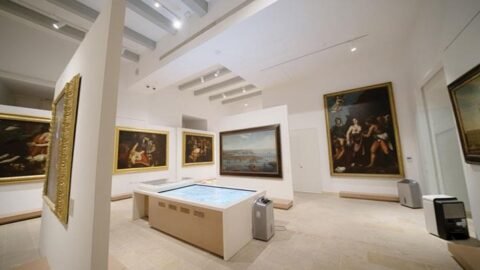
The problems don’t lack rehearsal. It’s a given that the principal home of the National Galleries’ Scottish collection in a rear basement of its main campus on the Mound in Edinburgh is both physically inadequate and psychologically offensive. In one of his first public pronouncements, the new director-general of NGS, John Leighton, confirmed that addressing this issue would be one of his top priorities. Other Scottish works hang in the NGS’s Gallery of Modern Art and new plans for the Portrait Gallery will also offer increasing hanging space. But the fact remains that at any one time a substantial proportion remains unseen, and what is on view is not afforded the prominence you might reasonably expect of a national gallery in a capital city.
Equally, tranches of Scottish work belonging to the Glasgow municipal collection languish unseen despite the major refurbishment of Kelvingrove. Previous attempts to liberate more Scottish art and display it with a proper degree of conviction and ambition have all foundered because of a lack of funding, or because the idea became enmeshed in civic rivalries and personal prejudice.
The notion now being f loated by SirAngus Grossart and Lord Macfarlane, to utilise the McLellan Galleries in Glasgow as a centre for Scottish art, looks to be on a much healthier footing. Both are Glasgow boys who served their time on the National Galleries board in Edinburgh. Both have an intimate knowledge of the civic and national collections; both are collectors and patrons in their own right; and both have a track record in making things happen. Among their previous incarnations, Grossart chaired the Heritage Lottery Fund in Scotland, which agreed funds to kickstart the Kelvingrove bid, and Macfarlane led the massive fundraising project that delivered it.
They have found ready allies in city council leader Stephen Purcell and his executive director of culture and sport, Bridget McConnell, who want to secure the future of the McLellan Galleries. Together they have been exploring its use in a way that would give visitors to both Edinburgh and Glasgow, and places furth of both, the opportunity to see major works of Scottish art, possibly on a rotating basis, in a setting devised to celebrate indigenous work.
Catalonia and Estonia are two of the nations that recently reaped the rewards of showcasing their country’s work in new settings. Collectively, Scottish art owned across the galleries in all of Scotland’s cities and towns is a wonderful resource. There are also substantial private collections from which loans would be more readily available were a sufficiently prestigious home on offer.
Ultimately, Scotland’s schoolchildren will be able to access a great deal of that heritage online, but how much more exciting is the prospect of a substantial part of the resource being physically toured and shared, while the McLellan’s handsome galleries are used as a significant new exhibition space devoted to Scottish art?
Yesterday’s meeting with the National Galleries chair and chief executive is just a toe in the water. Many technical and logistical hurdles may emerge, but there are four years to address them. And Angus Grossart is surely right to characterise the possibility not just as a much-needed fillip to the display of Scottish Art, but a golden opportunity to let Glasgow and Edinburgh f lourish in a mutually beneficial cause. In the last two decades of the twentieth century, there were several major exhibitions of Scottish art. All were spectacular successes in terms of visitor numbers.
That hunger for our own art history is undiminished. We’ve just seen record tourist numbers for Scotland. A permanent centre for Scottish art could only boost those further. Better yet, it would tap into that yearning of both the public and the visual arts community to take our national visual artworks seriously enough to display them with pride and passion.
[ad_2]
Source link