
[ad_1]
- Modern conservation treats biodiversity as a scientific concept, and while useful, the deeper truth is that for much of human history, it was not an abstraction but rather was immediate, sacred and embedded in daily life.
- Ancient rock art makes this clear, as petroglyphs and panels often depict animals, and in relation to humans. It’s also a global phenomenon, not just an artistic expression centered in Europe.
- “If so many human societies across history understood the natural world as worthy of depiction, reverence and symbolic centrality, what does it say about our own era that we are presiding over its rapid destruction?” a new analysis wonders.
- This article is an analysis. The views expressed are those of the author, not necessarily of Mongabay.
Across continents and cultures, one of the most striking features of ancient rock art is how often it places the natural world at its center. Whether etched into sandstone cliffs in the Sahara, painted in hidden shelters in Southern Africa, or drawn on stone faces deep in the Amazon, the recurring subject is not architecture, warfare or abstract political power.
It is animals, forests, rivers, spirits of the land and the intimate relationship between people and the living world around them. I have seen rock art in remote regions of the Amazon, left by ancient San communities in Angola, across the Ennedi Plateau in Chad, and in the Nuba Mountains of Sudan, I have come to believe that these works reveal something profound: long before the language of “biodiversity” existed, many human societies understood that their survival, identity and spirituality were inseparable from the ecosystems that sustained them.
Modern conservation discourse often treats biodiversity as a scientific concept — a measurable index of species richness, ecological resilience and genetic variation. This framing is useful, but it can obscure an older and deeper truth. For much of human history, biodiversity was not an abstraction. It was immediate, sacred and embedded in daily life. The extraordinary prevalence of animal and ecological imagery in rock art across the world suggests that early human societies recognized, at minimum intuitively, the centrality of the natural world to both material survival and cultural meaning.

In the Amazon, rock art panels often depict animals, serpentine forms, hunting scenes and symbolic representations of ecological relationships. These images are not random decoration. They required tools, planning, creation of color, scaffolding, and profound reflection. And beyond that they appear to express cosmologies in which the forest was understood not as background scenery but as a living, agentive force — an animate world inhabited by spirits, ancestors and nonhuman beings worthy of reverence. In many Indigenous Amazonian worldviews, this understanding persists today: animals and plants are not merely resources but relations. Such perspectives challenge modern industrial assumptions that nature exists primarily for extraction.
Among the San peoples of Southern Africa, whose rock art traditions remain among the most symbolically rich in the world, animals similarly dominate visual representation. Antelope, eland and other fauna are depicted with extraordinary care and dynamism. Scholars have long argued that much of this imagery reflects not only subsistence concerns but spiritual and metaphysical beliefs, particularly surrounding trance, healing, and the permeability between human and animal realms. The animals portrayed were not simply prey; they were beings of power, significance and mystery. To paint them repeatedly and with such attention suggests a relationship of dependence intertwined with respect.
The rock art of the Ennedi Plateau in Chad offers a related but distinct perspective. There, cattle, wild fauna and human figures populate vast sandstone galleries across a now-arid landscape that was once ecologically lush. The paintings record not only a vanished environment but an apparent pastoral reverence for animals that sustained life. The detail and care with which cattle were rendered suggest they were more than economic assets; they were central to social identity, status and cosmology. In this way, the art documents not simply biodiversity itself, but the recognition of its importance to human flourishing.
Likewise, in Sudan’s Nuba Mountains, rock art traditions often depict animals, ritual scenes and symbols tied to landscape and livelihood. Though the cultural specifics differ, the underlying pattern is familiar: repeated visual testimony that the nonhuman world occupied a place of deep significance in human consciousness. The recent discovery of the cave art at Lubang Jeriji Saleh, Indonesia, profoundly altered our understanding of prehistory, demonstrating that some of humanity’s earliest known figurative art emerged in Southeast Asia, and challenging long-held assumptions that the birth of artistic expression was centered in Europe.
Of course, it would be simplistic and romantic to suggest that ancient peoples were conservationists in the modern sense. They hunted, altered landscapes, and undoubtedly contributed to local ecological pressures at times. But what the rock art strongly implies is that many societies understood themselves as existing within ecological systems, not above them. Nature was not viewed merely instrumentally. It was spiritually, socially and existentially central.
This matters because modern industrial societies have, in many respects, lost that orientation.
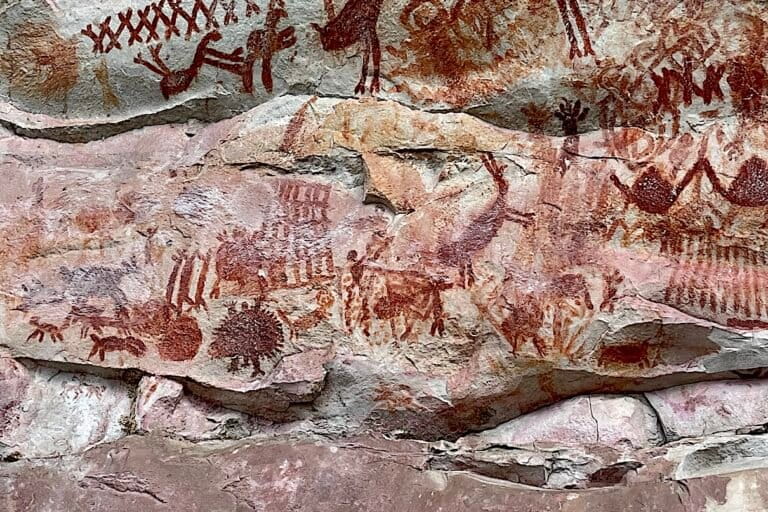
Today, biodiversity is often defended in utilitarian terms: ecosystem services, pharmaceutical potential, climate regulation, food security. These arguments are valid and important. But they can also flatten the moral landscape, reducing the living world to its usefulness for humans. Ancient rock art reminds us of another possibility — that biodiversity can be valued not only because it serves us, but because human cultures have long recognized beauty, power, sacredness and meaning in the plurality of life itself.
Our effort to understand the stories, symbolism, and meaning of rock art remains profoundly unfinished. The thousands of known sites are only part of the record; many more still lie hidden beyond the reach of scholarship and maps. Twice in my travels, I was led to remote stone faces, once in the Nuba Mountains of Sudan, and once in the far western Amazon. Indigenous and local guides cut through dense vines and bush with machetes to reveal astonishing images etched upon the rock. They told me they knew of no outsider who had ever seen them. In such moments, one feels there is something liminal here, that a cryptic ancient human story is still emerging from the earth, given to us, but still just beyond our grasp.
There is also a sobering irony here. Many of the regions where this rock art survives are among the world’s remaining ecological frontiers: remote parts of the Amazon, Indonesia, the central Sahara, isolated African highlands. The landscapes that preserved these artistic traditions are often the same landscapes now under pressure from mining, deforestation, desertification, conflict and climate change. The destruction of biodiversity in these places therefore threatens not only ecological systems but the cultural and historical memory embedded in them. When forests are cleared or ancient landscapes degraded, something more than habitat is lost. We lose part of the archive of how human beings once understood their place in the world.
What I have found most striking in visiting these sites is the consistency of the message despite vast geographical and cultural distance. Peoples separated by continents and millennia repeatedly chose to depict the living world around them. Again and again, they marked stone with images of animals, ecological abundance and human-animal interdependence. This cannot be accidental. It suggests that reverence for biodiversity — or at least recognition of its central importance — is not a niche cultural phenomenon but a recurring feature of human civilization.
Across an almost unfathomable span of time, the recurring image of human hands emerges in ancient rock art from every corner of the world; to me, these handprints are greetings through time — our ancestors reaching across millennia to remind us that they were here, that they saw the depth and beauty of this world.
To me, this raises an important ethical question: if so many human societies across history understood the natural world as worthy of depiction, reverence and symbolic centrality, what does it say about our own era that we are presiding over its rapid destruction?
We often imagine environmental concern as a modern development, born of science and climate awareness. Yet the evidence carved and painted onto stone across the world suggests otherwise. Respect for the living world may be among humanity’s oldest and most widespread moral intuitions. What is new is not reverence for biodiversity, but the industrial-scale capacity to erase it.

All this also underscores the extraordinary value of rock art as a teaching tool. In classrooms and public discourse, biodiversity is often presented through graphs, policy frameworks and scientific terminology that, while important, can feel abstract and emotionally distant. Rock art offers something different: it provides a deeply human and visual entry point into understanding how earlier societies perceived the living world. By examining what ancient peoples chose to depict on stone — again and again, across cultures and continents — students can begin to grasp that respect for ecological systems is not merely a contemporary scientific concern but part of a much older human inheritance.
Rock art helps bridge science, ethics, history and anthropology, making biodiversity not simply a technical issue of conservation policy, but a question about how human beings have understood their relationship to life on Earth across millennia. In this way, it can powerfully reframe environmental education, moving students beyond statistics toward a broader cultural and ethical appreciation of why biodiversity matters. It also leaves much room for mystery, as much of the message remains beyond our grasp.
Ancient rock art is therefore more than archaeological evidence or aesthetic achievement. It is testimony. It bears witness to the fact that human societies across vast stretches of time and geography saw themselves in a relationship with a biologically rich world and considered that relationship important enough to record in an enduring form.
In this sense, rock art offers a quiet but powerful rebuke to modern ecological indifference. It reminds us that our ancestors often lived with a deeper awareness of ecological dependence than many contemporary societies do. They may not have had the vocabulary of biodiversity science, but they understood that the fate of humans and the fate of the living world were intertwined.
We would be wise to recover some of that understanding.
Kerry Bowman, Ph.D., is a bioethicist and an assistant professor at the University of Toronto, Canada.
Banner image: Prehistoric rock art site in northeast Zimbabwe showing a variety of large animals including elephant and rhino. Image courtesy of Robert Stewart Burrett via Wikimedia Commons.
See a related commentary by this author:
Respecting uncontacted peoples can protect biodiversity and our humanity (commentary)

[ad_2]
Source link