Large-scale documentation of landscape changes, in a methodical but also random way, was conducted by Natalia LL, who circled around the area taking pictures of the local landscape every 250 meters from the car window. In a direct and somewhat paradoxical way, Wanda Gołkowska referred to the issue of overproduction in her ‘Disapprover (Dezaprobator)’ – an object with a tape wound on a reel with the text ‘OVERPRODUCTION OF WORKS OF ART AND OVERINFORMATION make it difficult to choose’.
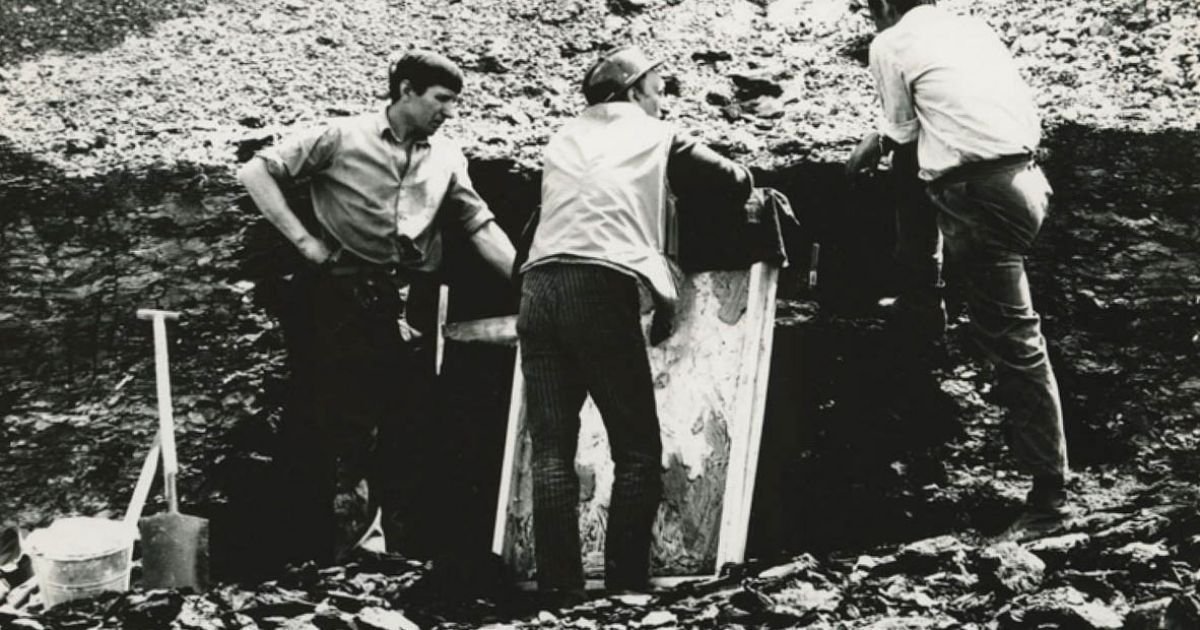
It is not without reason that in the title of the plein-air workshop in Opolno-Zdrój – and then several plein-air workshops in Osieki and Zielona Góra, following the trail blazed at the time – there was also science next to art. An important part of the plein-airs at the turn of the 1960s and 1970s were symposia with the participation of artists and scientists, supplementing the discussion on environmental changes with a specialists’ perspective. Importantly, the 1971 symposium was also attended by representatives of the local community – residents of Opolno-Zdrój, as well as the management of the mine and the miners working there. Representatives of the local industry did not stand in opposition to other participants of the symposium, who drew attention to the scale of environmental damage and sought opportunities to change course. The title of the paper delivered by Eugeniusz Mróz, the director of the Turów power plant, is meaningful – ‘Protection of the natural environment within industrial plants, including recreational areas’.
From a global perspective, the Zgorzelec region plein-air was rather in sync with the spirit of the times than constituted a revolution, but the atmosphere behind the Iron Curtain was completely different than in the West. A year after the plein-air, the members of the UN held a conference in Stockholm under the eloquent title ‘We only have one Earth’ to tackle the issues of environmental protection and climate change. With a, from today’s perspective, chilling precision they were predicted by the Club of Rome’s report ‘The Limits to Growth’ published in the same year. The Soviet Union did not take part in the conference at all, and since the time of Stalinism, its attitude towards the environment has remained extremely utilitarian, based on the exploitation of all possible resources.