
[ad_1]
Researchers directly date 57 pictographs in Texas and Mexico, demonstrating a continuous artistic and cosmological tradition spanning 5,760 years, which possibly influenced the beliefs of later Mesoamerican civilizations.
In the deep canyons of Texas and northern Mexico, hidden in limestone rock shelters, spectacular mural paintings have guarded their secrets for millennia. Now, a team of scientists has managed to decipher their timeline, revealing a story of astonishing persistence. According to a study published in Science Advances, the Pecos River style, a sophisticated tradition of rock art, began between 5,760 and 5,385 years ago and continued for more than 4,000 years, probably ending between 1,370 and 1,035 years before present.
The research, led by Karen L. Steelman, Carolyn E. Boyd, and J. Phil Dering, provides the strongest chronology to date for a rock art province in the Americas, based on 57 direct radiocarbon dates from the paintings themselves and 25 indirect dates from oxalate minerals at 12 different sites.
The results demonstrate that the Pecos River style pictographic murals were painted as unique entities distributed across the study area during the second half of the Holocene, the authors note in the study. This finding establishes a chronology and suggests that these hunter-gatherers faithfully transmitted a sophisticated and coherent belief system across generations, a system whose echoes may be found in the cosmologies of the great agricultural civilizations of Mesoamerica.
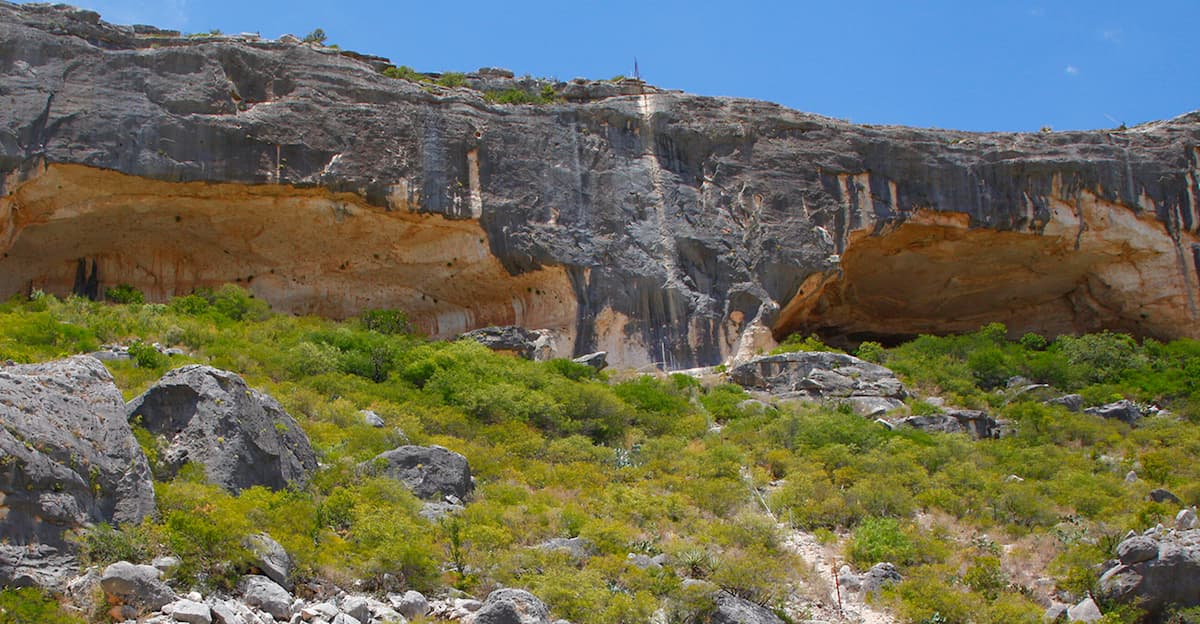
The study area, known as the Lower Pecos Canyonlands (LPC), is a unique region where three ecological zones converge. For more than 12,500 years, it was home to hunter-gatherer societies that left behind an exceptionally well-preserved archaeological record. But their most visible and enigmatic legacy is the murals of the Pecos River style.
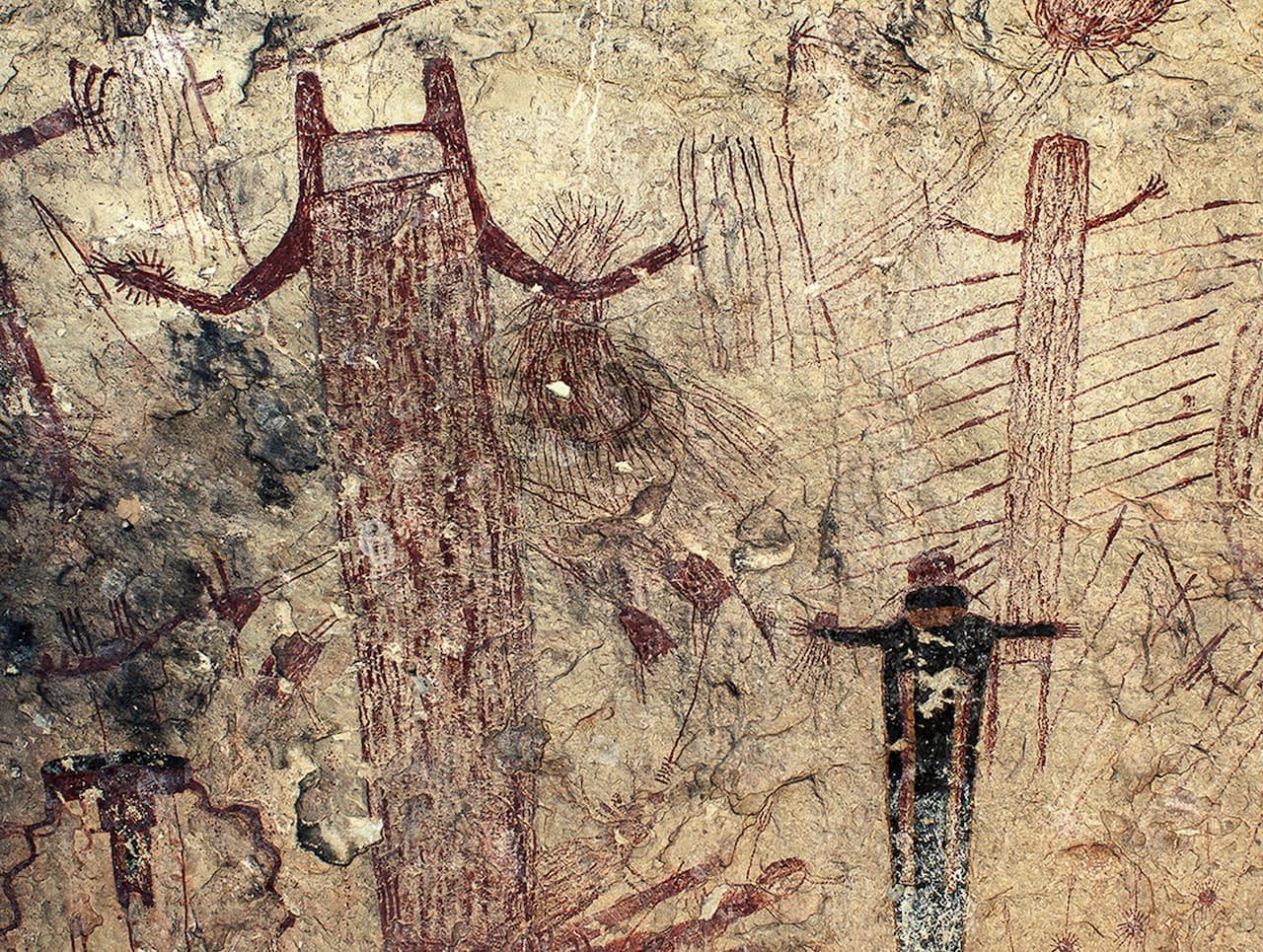
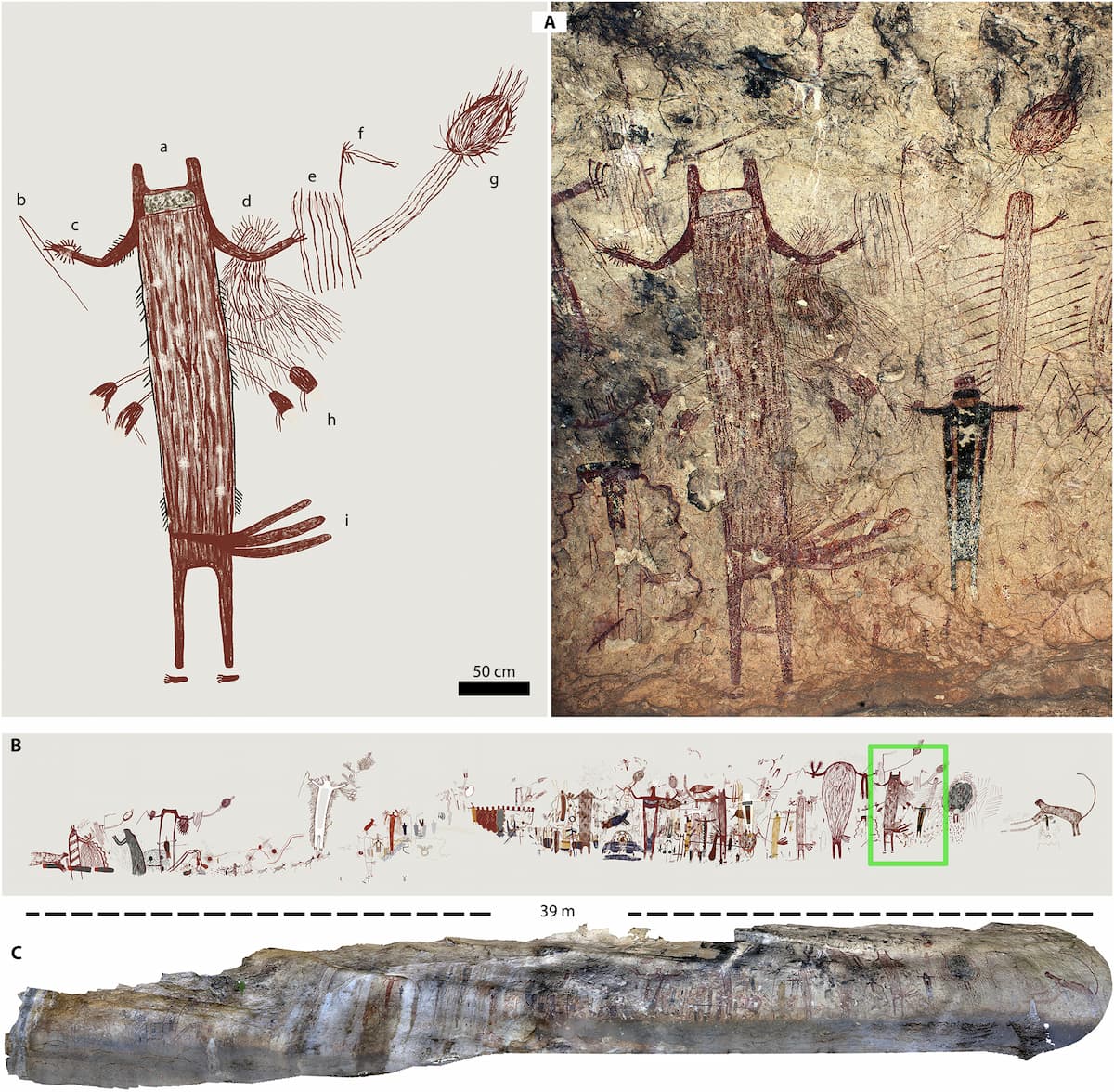
These artworks are complex and often monumental compositions measuring up to 150 meters long and 15 meters high, suggesting that their creators used scaffolding or ladders. The walls and ceilings of at least 150 rock shelters north of the Rio Grande are covered with anthropomorphic (human), zoomorphic (animal), and enigmatic figures, all intertwined in a polychromatic tapestry of red, black, yellow, orange, and white.
The human figures, ranging from 10 centimeters to 8 meters in height, are adorned with a specific visual vocabulary: headdresses resembling rabbit ears or antlers, wrist and elbow ornaments, and paraphernalia such as atlatls (spear-throwers), darts, and staffs. One particularly prevalent motif is the sacred bundle, an oval form resembling a spiny seed pod, attached to parallel lines extending from the non-dominant arm of an anthropomorphic figure.
Dating the Undatable: A Technical Feat
One of the greatest challenges in the study of rock art has always been dating it accurately. The research team overcame this obstacle using two independent state-of-the-art methods.
The first method involved direct dating of the paint itself. Artists of the Pecos River style used mineral pigments (iron oxides for reds and yellows, manganese for black) mixed with organic ingredients as binders or vehicles, possibly deer bone marrow fat and plant sap such as yucca. The researchers used a technique called plasma oxidation to carefully extract the organic carbon from tiny paint samples (1 to 2 cm²) without damaging the inorganic pigments or underlying limestone. This carbon was then dated using accelerator mass spectrometry (AMS).

Subscribe to our newsletter
Receive our news and articles in your email for free. You can also support us with a monthly subscription and receive exclusive content.
The second method involved dating calcium oxalate crusts, minerals that naturally form on the walls of rock shelters both below and above the paint layers. The underlying crusts provide a maximum age for the painting, while the overlying ones offer a minimum age. In all cases, these indirect dates corroborated the ages obtained directly from the paintings, giving strong confidence in the results.
To ensure the cleanliness of the samples, the team also analyzed controls from unpainted adjacent rock, which showed insignificant levels of organic carbon. Therefore, there is no physical or chemical contamination in the unpainted limestone substrate adjacent to the paint sample locations, the study states.
A Coherent Message Across Millennia
Iconographic and stratigraphic analysis (the study of paint layer superposition) revealed one of the most significant findings: these murals were not random collections of images added over centuries, but planned compositions, created in a relatively short period, perhaps even in a single event.
Using digital microscopy, the researchers analyzed 588 paint intersection points across eight murals. In 535 of these points, they identified a consistent sequence of color application: painters always applied the darkest colors first and the lightest last. Black was painted first, followed by red, then yellow, and finally white. Only in 10 locations did they deviate from this rule.
Because the painters adhered to this organized layering of colors, many figures are interlaced—that is, a paint layer of one figure is painted both over and under another figure, the authors explain. This interlacing of polychromatic figures to form a complex tapestry is evidence supporting a single painting event.
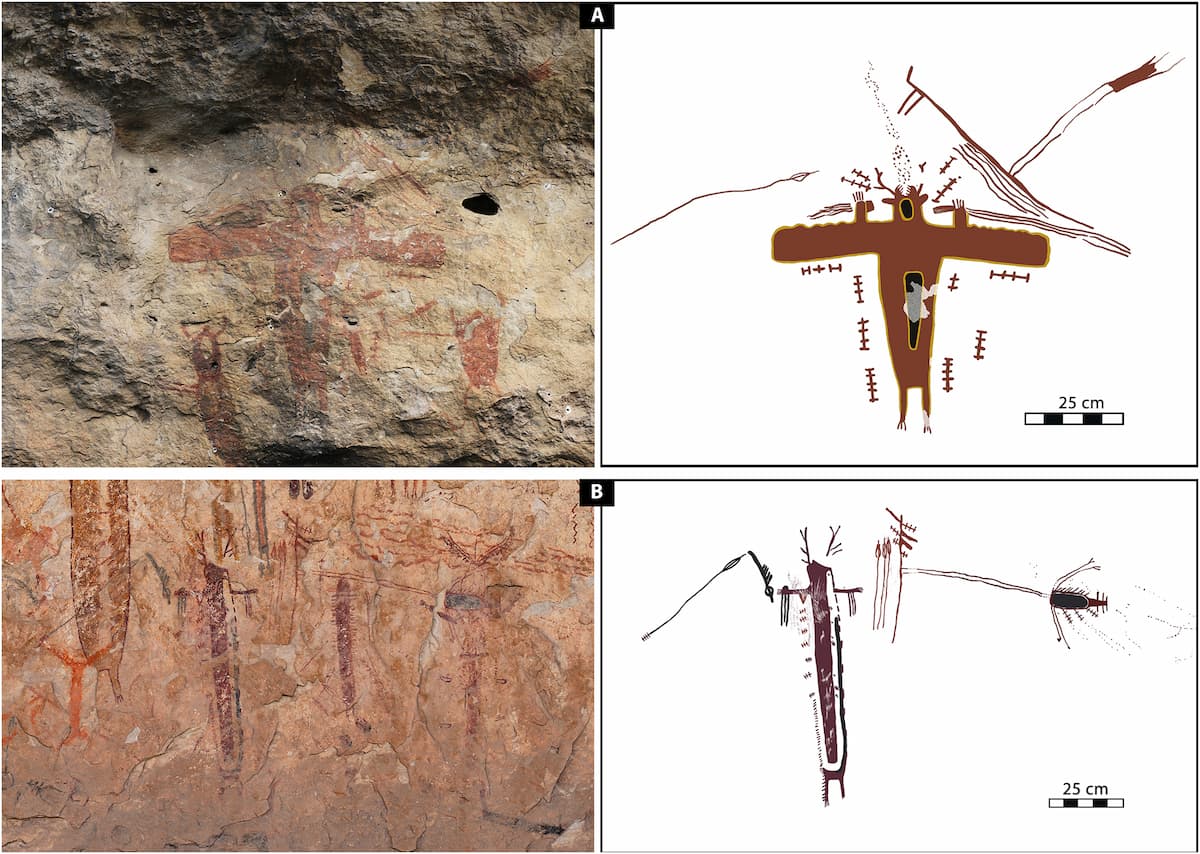
Radiocarbon dates within the same mural were statistically indistinguishable, reinforcing the idea that each panel was conceived and executed as a complete narrative unit.
The Bayesian chronological model, combining the dates with stratigraphic information, paints a picture of an incredibly long-lived tradition. The Pecos River style began between 5,760 and 5,385 calibrated years before present (cal BP). The painting spanned a duration of 4,095 to 4,780 years. This means that the tradition persisted for approximately 175 generations. It likely ended between 1,370 and 1,035 cal BP, raising the possibility that the practice continued until the introduction of the bow and arrow in the region.
Throughout this immense period, the style persisted through significant changes in climate (dry and wet periods), technology (as evidenced by changes in projectile point types), and land use (including intermittent bison hunting incursions). Despite these environmental and cultural fluctuations, the central message, encoded in the motifs and color sequence, remained constant.
A Lasting Legacy: The “Hard Core” of a Worldview
Why did nomadic hunter-gatherers invest so much time, resources, and labor into painting these complex murals for more than 4,000 years? The researchers propose that the answer lies in the very nature of the landscape and the function of the art.
They suggest that the Lower Pecos Canyonlands, with their deep canyons, caves, permanent springs, and winding rivers, were perceived as a “key cultural place,” a sacred landscape imbued with power and agency. From an Indigenous perspective even today, the paintings are not merely passive fixtures but living entities that directly communicate sacred ancestral knowledge, the study reads.
Creating murals in these places was not merely an artistic act but a ritual one. The fidelity in transmitting the style, motifs, and process over four millennia implies that the knowledge they contained was of vital importance.
This finding connects with a broader hypothesis regarding the antiquity of beliefs in the Americas. Scholars such as López Austin have argued that Mesoamerican peoples shared a deeply rooted set of cosmological concepts, a highly change-resistant “hard core.” Previous research had already noted parallels between the metaphysical concepts portrayed in Pecos River murals and the myths of the Aztecs (Nahua) and the Huichol (Wixárika) centuries later and far to the south.
Our chronological model situates the Pecos River murals within a timeframe that supports this hypothesis, Steelman, Boyd, and Dering conclude. We propose that the constancy in the production, location, and content of the Pecos River murals communicated a deeply rooted archaic worldview that eventually manifested in the symbolism and belief systems of later Mesoamerican farmers.
In essence, these paintings are the longest-lasting and best-dated rock art in the Americas, and the oldest surviving visual manifestation of a pan-American belief system, a silent yet eloquent testament to how the continent’s early inhabitants understood their universe and transmitted that knowledge across a sacred landscape, generation after generation, for a time span longer than the one separating our present from the construction of the pyramids of Egypt.
SOURCES
Karen L. Steelman et al., Mapping the chronology of an ancient cosmovision: 4000 years of continuity in Pecos River style mural painting and symbolism. Sci. Adv. 11, eadx7205(2025). DOI:10.1126/sciadv.adx7205
[ad_2]
Source link