
[ad_1]
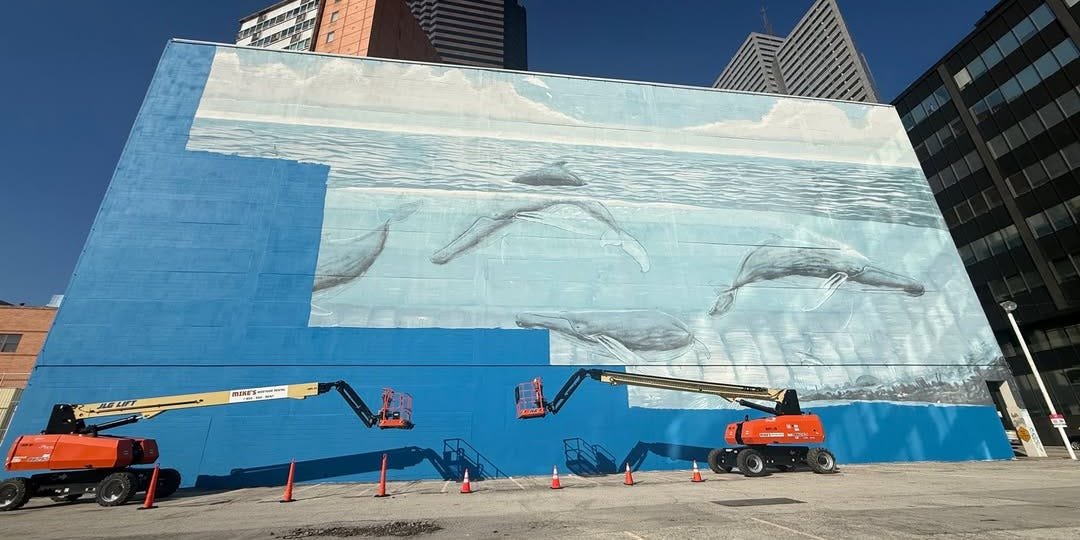
A public mural in downtown Dallas is reportedly being painted over to make way for art related to the 2026 FIFA World Cup. But the artist who created the original painting says he was never consulted. The eight-story mural depicted endangered whales and dolphins as part of environmental artist Robert Wyland’s Whaling Walls series, which consisted of 100 murals painted around the world since 1981 to raise awareness of ocean conservation. Last week, a painting crew began papering over Wyland Whaling Wall 82, titled Ocean Life, in blue. By midday Friday, Wyland’s mural, completed in 1999, was almost entirely obscured.
“This mural was created as a message of hope, conservation, and respect for our oceans,” Wyland, seen in the photo above in front of the Laguna Beach, California mural in 2019, said in a statement to CBS News. “It was a gift to the people of Dallas and a reminder that protecting our oceans is a responsibility we all share. To see an important public artwork with that kind of meaning treated as disposable is deeply painful.”
Dallas is set to host nine World Cup matches at AT&T Stadium, home of the NFL’s Dallas Cowboys. The arena will temporarily be renamed “Dallas Stadium” in accordance with FIFA rules that ban corporate-sponsored stadium names and unapproved advertising during its tournaments. The local World Cup planning committee has not announced what design will be replacing the mural, but speaking with local Dallas Fox affiliate KDFW, Wyland says he will likely be taking legal action.
The new paint job has drawn widespread criticism from locals and celebrities. “This makes me really sad,” Texas native and singer Kacey Musgraves wrote on her Instagram Stories, per The New York Post. “We suck the soul out of everything.” Caitlin Clark, the online executive editor for D Magazine, a monthly publication covering the Dallas-Fort Worth area, asks, “Why not just throw a vinyl banner over the wall? The 2026 World Cup only lasts for 39 days.”
The controversy arrives as FIFA faces broader condemnation over its handling of the 2026 tournament. Soccer’s governing body has drawn particular backlash for its ticketing strategy, which priced group-stage matches based on the perceived popularity of the teams involved rather than a flat rate, a departure from recent tournaments. Fans have also raised objections to heavily inflated prices on FIFA’s official resale platform, where the governing body takes a 30% fee, split evenly between buyer and seller, on each resale transaction.
Rachel King (she/her) is a news writer at Town & Country. Before joining T&C, she spent nearly a decade as an editor at Fortune. Her work covering travel and lifestyle has appeared in Forbes, Observer, Robb Report, Cruise Critic, and Cool Hunting, among others. Originally from San Francisco, she lives in New York with her wife, their daughter, and a precocious labradoodle. Follow her on Instagram at .
[ad_2]
Source link