[ad_1]
Curated by Jawad Elhusuni and Mohamed Shembesh, the exhibition reflects on Libya’s colonial past and the role of architecture in shaping its future.

Entrance to the gallery, with work by Jawad Elhusuni Architects. Photo: Sanad Egrima
‘Post-Colonial Reclamations: Between Al-Berka and Sidi Hussein’ revisits Benghazi more than a decade after the renovation of Shajara Square, offering a lens into how architecture, memory, and heritage intersect in Libya’s ongoing reconstruction. Presented at Barah Gallery, the exhibition assembles architects, students, and photographers to examine contested colonial-era buildings and propose new ways of reclaiming their significance.
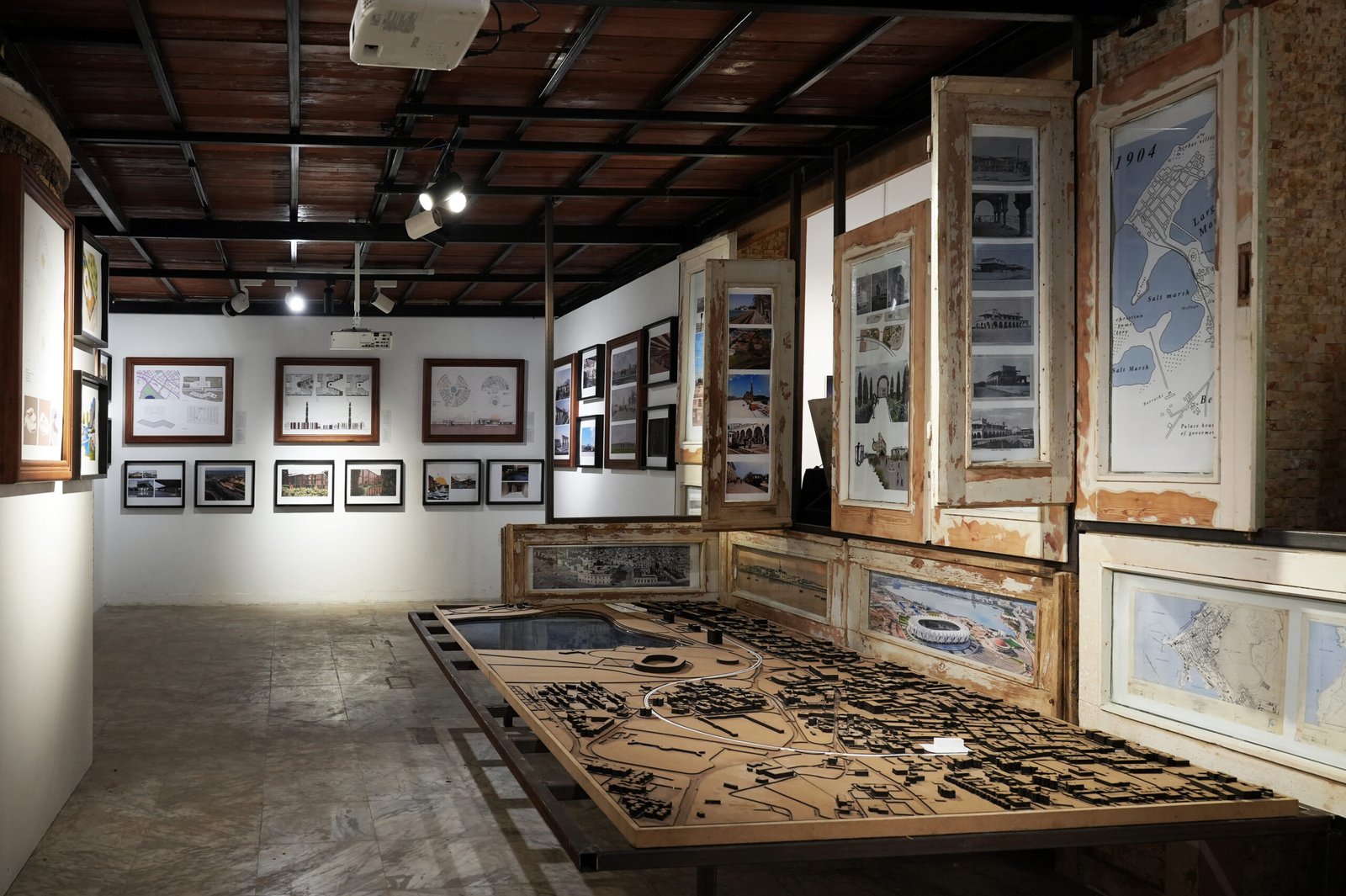
Highlights include African Aperture, a layered installation that juxtaposes salvaged mahogany windows with archival photographs and fresh architectural proposals, embodying both the weight of history and the possibility of renewal. The exhibition also presents speculative student projects and evocative photography, expanding the conversation beyond preservation or demolition toward a broader reimagining of Benghazi’s future. By positioning reclamation as both an artistic and civic practice, the show explores how architecture can move beyond displays of colonial power to become a tool for collective identity and shared heritage.

Jawad Elhusuni at the Central Drawing Room of the Italian Era Barah Gallery. Photo: Sanad Egrima
ART AFRICA: This exhibition takes you back to Benghazi, more than a decade after the renovation of Shajara Square. How has the city’s shifting landscape since then influenced your approach as both architect and curator?
Jawad Elhusuni: Greatly so. The level of reconstruction currently taking place is breathtaking. The Old Town has become a flashpoint between those who want to start anew – a sort of Tabula Rasa – and those who wish to preserve colonial architecture. Putting together this exhibition was my way of trying to find a middle ground, and get the conversation going, as many buildings that were damaged during the war have now been demolished, and how, or rather “what” to rebuild has become a big question.
‘Post-Colonial Reclamations’ calls for new ways of engaging with colonial architectural legacies. How do you define “reclamation” in this context, and what makes it an urgent practice in Libya today?
“Reclamation” was a word that took us a long time to choose. The Arabic word “istirdad” was selected by one of the artists on display, Islam Alfallah, who has as much nuance as, if not more than, the English word. It means to take ownership of something that was once yours. In architectural history, reclamations have happened many times before. My favourite is Damascus, where the Umayyad Mosque was reconstructed and reconstituted from a Byzantine Church, which itself was once a Roman pagan temple. In architecture, it is known as spolia. In art, it’s not too dissimilar from Marcel Duchamp’s found objects. Using an old material in a new way.
When local populations renovate a colonial building and restore it to its original state, without altering its function, a range of complex emotions arises regarding how it is perceived.

The Main Exhibition Gallery. Photo: Sanad Egrima
The exhibition brings together architects, students, and photographers. Why was it essential for you to create such a collaborative platform, and how do these different voices enrich the narrative?
Every artistic medium has a different story to tell. For one, there’s a real dearth of high-quality photography in Benghazi at the moment, which captures architecture generally, let alone colonial architecture, or Italian-era machinery and objects. Islam Alfallah and Ali Elyadry’s photographs of the old Grain Silo interiors were really provocative. Likewise, combining built works and speculative projects from the Libyan International University in Benghazi, where I teach, offers very different modes of engagement.
The central installation, African Aperture, juxtaposes salvaged materials, archival images, and new architectural proposals. Could you speak about how this layered work embodies your ideas of shared heritage and re-appropriation?
There was something a little biased in me that chose to do that. I love African Mahogany, particularly when I consider how it dominated the market in the late 19th and early 20th centuries, essentially replacing American varieties, which were deeply intertwined with the complexities of the slave trade.
We can revisit our friend Duchamp, who used black leather instead of glass in his 1920s installation, “Fresh Widow,” to obscure the view. We were more interested in our much beloved local African trees framing Italian colonial photographs – both literally and metaphorically. This gives agency. Intent is absolutely central to my approach to everything in art and architecture. It changes everything.
Regarding shared heritage, during Libya’s time under Italian colonial rule, the concept of shared heritage was discussed, but the intentions were not always pure. One of the students on display quotes Mia Fuller on this, the intent of colonial architects to “display power”. True shared heritage only happens when we all come to the table as equals.

Windows from the installation African Aperture with colonial era photographs of the now disused Benghazi Rail Line. Photo: Sanad Egrima
Your practice often contrasts Islamic architectural traditions with Western modernism. How does this tension manifest in the works on display, particularly in relation to colonial-era buildings in Al-Berka and Sidi Hussein?
In so many of the works, particularly Saif Alhasi’s new conceptual train station to take the place of the now demolished Stazione. He used what Italians would have considered primitive local building materials. Still, he totally rescaled them to show that they can absolutely be used for even large institutional buildings, such as central transport infrastructure.
The subtitle of the exhibition references a famous Benghazi song, “Between Al-Berka and Sidi Hussein.” How do music, memory, and cultural expression beyond architecture feed into your curatorial vision?
Lyrics are straightforward in their impact. Whether it is Sufi lyrics or national songs, in the Islamic world, they play a pivotal role. There is an idea in North African culture that in the early 20th century, the urbane elite always lived in the old town centres, so we’re playing with that.

Works by practicing architects in Benghazi. Photo: Sanad Egrima
Looking forward, what role do you believe exhibitions like ‘Post-Colonial Reclamations’ can play in Libya’s broader reconstruction efforts, both in rethinking urban space and in shaping collective identity?
This is why art is a powerful tool in Africa. In Libya, we have always felt a great affinity with the African cause, more so than nearly all our neighbours. And so we’re carefully watching what is happening on the continent. It was a huge moment when Diebedo Kere won the Pritzker prize three years ago (the equivalent of the Nobel Prize for architects), becoming the first African to do so, and coming from Burkina Faso, which is a country with close ties to Libya. What was remarkable was the use of native mud in his buildings and the communal involvement. Throughout the continent, art and architecture are becoming tools for thought, and it’s an exciting time.
‘Post-Colonial Reclamations’ is on view at Barah Gallery, Benghazi, from 27 September to 3 November 2025. Visit barah.ly for more information.
[ad_2]
Source link