[ad_1]
At Fondazione Sabe per l’arte in Ravenna, the exhibition Molteplice senza disordine (Manifold without disorder) curated by Enrico Camprini, features three artists from different generations who engage with and interact with the exhibition space, creating a synthesis that explores the dialogue between the exhibition space and the atmosphere created by the works.

AA.VV., “Molteplice senza disordine”, exhibition view, Fondazione Sabe, Ravenna, 2026. Photo by Daniele Casadio, courtesy Fondazione Sabe per l’arte
The works of the participating artists interact in hybridized and mutually influencing gazes. Alice Cattaneo invades the exhibition space with the site-specific work Se questo margine è di tempo (If this margin is of time), which extends across the floor, leading the viewer through the array of glass blocks that compose it. The work explores the material, particularly glass, an element the artist considers dull, hard, and difficult. These Murano glass cubes are imperfect and cracked, some burned, others rendered opaque by the internal flaws created by the process. The unexpected is a key feature of this work; through the imperfection of the material, it evokes limits, breaking points. The artist adopted a similar approach in Untitled, which she conceived in 2011. This site-specific work, created and conceived directly in relation to its location, explores the boundary between equilibrium and imbalance, the limit of a fall that evokes the breaking point of glass. The alternation of solids and voids in a slender, unbalanced structure thus confronts the heaviness and firmness of the glass blocks, creating a powerful and generative contrast.

From left to right: Alice Cattaneo, “Untitled”, 2011; Elisabetta Di Maggio, “Untitled”, 2026. AA.VV., “Molteplice senza disordine”, exhibition view, Fondazione Sabe, Ravenna, 2026. Photo by Daniele Casadio, courtesy Fondazione Sabe per l’arte
Elisabetta Di Maggio uses space in a very different way, activating a process that considers the communication network essential to transmitting information and the time necessary for these processes to occur, she exhibits two intimate and poetic works side by side. In the case of Untitled (2026), the connection with the body is essential. A Marseille soap is displayed inside a leaded Murano glass case. This object is engraved with a shape that recalls a spine and, at the same time, the Ravenna’s typical cobblestone pavement. These suggestions are then contrasted with rose thorns planted on the object itself. The dialogue between these two elements recalls the most diverse fields of investigation, such as self-care and the pitfalls of life, all immersed in an atmosphere of suspension created by the reflection of light passing through the imperfect, wavy Murano glass, which recalls the effect of water. The use of light to create suspended situations also returns in the work Untitled (2024). A leaf cut so that only its veins remain is hung on a white surface on which the artist has traced in pencil the shadow of the leaf at different times of the day. As the hour changes, the projection of the shadow on the sheet of paper is added to the previous ones, creating a synthesis that highlights the passage of time. Added to this ensemble of elements there is the actual shadow of the leaf, completing the resulting synthesis, creating the perception of a continuation of past time in the present.

AA.VV., “Molteplice senza disordine”, exhibition view, Fondazione Sabe, Ravenna, 2026. Photo by Daniele Casadio, courtesy Fondazione Sabe per l’arte
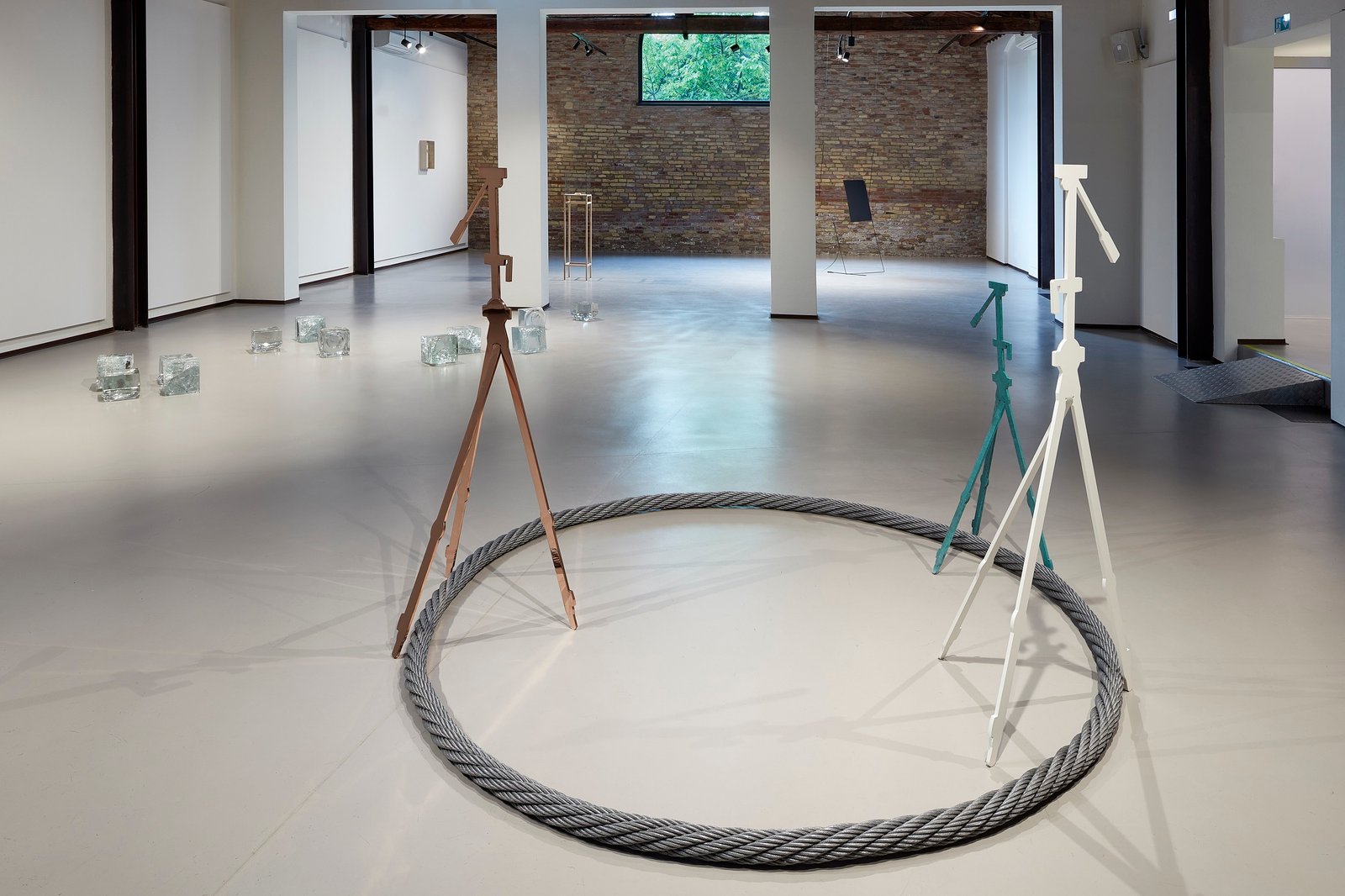
Finally, the exhibition features works by Remo Salvadori (1947), one of the most important artists of his generation. Grounded in the interaction between the observer and elements such as water, color and metals, the artist’s poetics enters the exhibition with the interpenetration of two past works: Continuo infinito presente (Continuous Infinite Present) and L’osservatore non l’oggetto osservato (The observer not the observed object). In this new synthesis, a large circle created with intertwined steel cables intersects three metal elements that recall the shape of photographic easels. These are of different sizes, coinciding with the heights of the artist’s three grandchildren. The exhibition Molteplice senza disordine thus presents itself as a synthesis of a connection between different works and poetics, generated by a dialogue that has expanded to the point of taking this form. An exhibition that could be considered a veritable collection of signs that open the viewer’s vision to the influence of different perspectives.
Info:
Alice Cattaneo, Elisabetta Di Maggio, Remo Salvadori. Molteplice senza disordine
curated by Enrico Camprini
19/04/2026 – 28/06/2026
Fondazione Sabe per l’arte
via Giovanni Pascoli 31, Ravenna
www.sabeperlarte.org

Always connected to the art world, Samuel Tonelli attended the course in Art Education and Communication at the Academy of Fine Arts in Bologna and furthered his studies with the two-year master’s program in Education and Cultural Mediation of Artistic Heritage. After gaining experience mediating in various exhibitions and teaching art history at the art high school in Bologna, he developed a passion for art writing, which he sees as a powerful means of expression capable of opening up visions, broadening horizons and enriching the understanding of diverse perspectives on reality.
[ad_2]
Source link