

[ad_1]
By Lauren Kaufmann
An MFA exhibition traces how Amsterdam’s Jewish community shaped the artist’s imagination, revealing a rich interplay of daily life, biblical narrative, and cultural exchange.
Reality and Imagination: Rembrandt and the Jews in the Dutch Republic at the MFA/Boston On view through November 29.
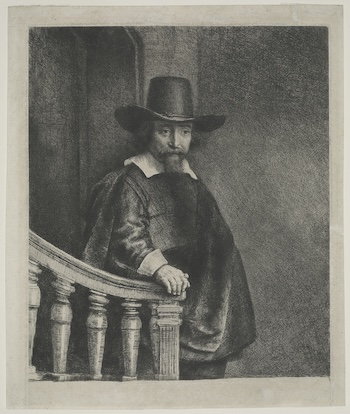
Ephraim Bonus, Physician, Rembrandt Harmensz. van Rijn, 1647. Photo: Museum of Fine Arts, Boston
In the Pantheon of European artists, Rembrandt is a giant. Renowned for his mastery of light, his radiant portraits, and finely rendered group scenes, The artist made hundreds of paintings inspired by the Bible, Greek mythology, and history. He also produced nearly 100 self-portraits.
Reality and Imagination: Rembrandt and the Jews in the Dutch Republic, explores one particular aspect of the man’s work: how his relationships with his Jewish neighbors influenced his art.
The exhibition opens with a map of Rembrandt’s neighborhood—the heart of Amsterdam’s Jewish community. The label notes that many artists and dealers lived here, as well as a small community of free Black Africans. Rembrandt lived in the neighborhood for about twenty years, from 1639 until 1659. His home was across the street from Saul Levi Mortera, a learned rabbi and, from the top floor of his home, Rembrandt could see the local synagogue. Menasseh ben Israel, another rabbi, lived close by. Over the years, Rembrandt recieved commissions from both rabbis.
Rembrandt painted during what’s traditionally been called the ‘Dutch Golden Age’ or as some prefer to call it, the ‘Dutch Miracle.’ It was a period of tremendous growth and prosperity. During this time, from 1588 until 1672, the Netherlands became an economic and maritime superpower. It was during this era that Sephardic Jews from Portugal and Spain made their way to Amsterdam to escape the Inquisition. While most of Rembrandt’s neighbors were of Sephardic descent, some were Ashkenazi, having left eastern European countries to avoid pogroms.
By 1639, there were more than 1,000 Jews living in Amsterdam. Although they were allowed to practice their religion, Jews lived under a “don’t ask, don’t tell” policy. They were permitted to pray in their temples, but they were not allowed to participate in local trades, hold public office, or send their children to local schools. Despite these restrictions, Jews found greater freedom in Amsterdam than in any other European city during the period. And, because there were many successful Portuguese merchants, Dutch officials tolerated Jews because of the economic benefits that they brought to the local economy.
Interestingly, Jews were allowed to practice medicine; the exhibit includes a wonderful etching by Rembrandt of Ephraim Bonus, a neighbor who was a practicing physician. Dressed in typical Dutch garb and sporting a large ring on his right hand, Bonus wears the telltale signs of success.
There are works in the exhibit made by artists other than Rembrandt. In Claude Du Bosc’s etching, Dedication of the Portuguese Synagogue in Amsterdam, 1733-1738, a crowd of well-dressed citizens gathers to celebrate the inauguration of the temple. The synagogue was built on one of the city’s major streets, evidence of the growing comfort that Jews felt about worshipping in a more visible way. When Spanish and Portuguese Jews first arrived in Amsterdam in the early 1600s, they prayed in homes and warehouses, but by the early 1700s, the community was prosperous and confident enough to build its own synagogue.
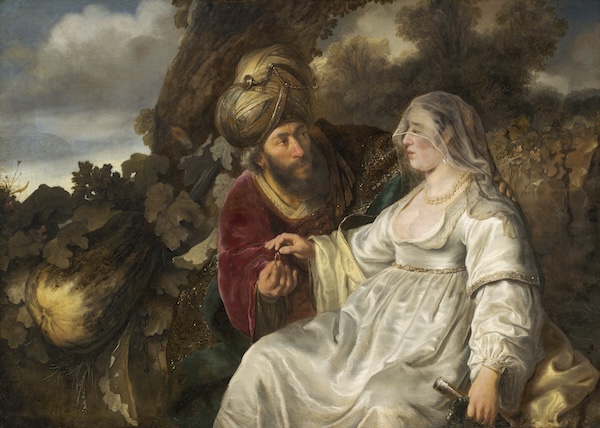
Judah and Tamar, Ferdinand Bol, 1644. Photo: Museum of Fine Arts, Boston
The relationship of the Jewish community with the local government was complicated. Jews in Amsterdam diligently worked to blend in, dressing like their Dutch neighbors and decorating their homes with local furnishings. However, they also acquires religious objects that they used to celebrate Jewish holidays at home; the exhibit includes a brass Hanukkah lamp, or menorah, that was used in a Dutch Jewish home. The label states that its exact age is uncertain, but its style dates from the early 1600s.
A pair of Torah Finials, 1649 are also on display. These intricate silver finials sat on top of the Torah scroll. They were used by a synagogue in Rotterdam, but they were most likely made by a Christian artisan.
In 1627, Rabbi Menasseh ben Israel, one of Rembrandt’s neighbors, founded Amsterdam’s first Hebrew printing press, becoming one of Europe’s leading Hebrew book publishers. For a book that Rabbi Menasseh ben Israel published—Piedra Gloriosa (The Glorious Stone)—Rembrandt drew four images that depicted biblical stories. The label tells us that, despite his customary unwillingness to modify his work in order to please patrons, Rembrandt changed two of his prints to better align with the text.
The title of the exhibition—Reality and Imagination: Rembrandt and the Jews in the Dutch Republic—refers to Rembrandt’s blurring of past and present. In painting scenes from the Hebrew Bible, he depicted biblical figures wearing Ashkenazi styles that he saw on the streets of Amsterdam. Likewise, in some of his works portraying New Testament scenes, Rembrandt represented figures with the hats and long beards of his Jewish neighbors.
Judah and Tamar, 1644, was painted by Ferdinand Bol, Rembrandt’s pupil. In this Old Testament scene, Tamar is shown with her father-in-law Judah. Tamar’s two husbands died before she bore any children, so she hatched a plan to seduce Judah. She is seen here dressed as a prostitute and receiving, from Judah, a ring that she will later employ to legitimize the twins that were born from their union. The label informs us that Judah’s turban and Tamar’s low-cut dress were intended to appeal to collectors’ interest in both the Hebrew Bible and erotic images.
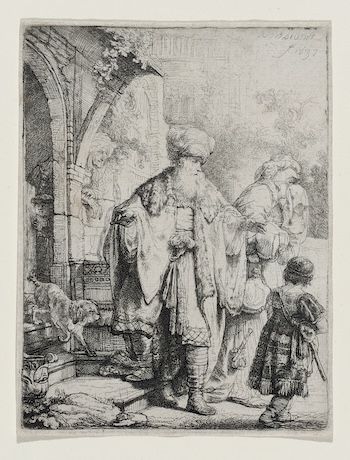
Abraham Casting out Hagar and Ishmael, Rembrandt Harmensz. van Rijn, 1637. Photo: Museum of Fine Arts, Boston
In Abraham Casting Out Hagar and Ishmael, 1637, Rembrandt captures an emotional scene in which Abraham expels his enslaved servant Hagar, and their son, Ishmael, after Sarah asks him to throw them out. Sarah looks on with satisfaction as Isaac, Abraham, and Sarah’s son peer out from behind the door. Rembrandt shows Abraham’s conflicting emotions; although he loved Ishmael, Abraham had made a covenant with the Lord in which Isaac, not Ishmael, would inherit Abraham’s house. Rembrandt’s etching ended up at the center of a legal dispute between Rembrandt and a Jewish painter, Samuel d’Orta, who had bought the copper plate in 1637 to make his own impressions.
The exhibit includes a painting by Rembrandt’s teacher, Pieter Lastman. In Wedding Night of Tobias and Sarah, 1611, Lastman depicts a scene from the Book of Tobit, which was omitted from the Hebrew Bible, but remained popular among Sephardi Jews. Lastman’s painting shows Sarah, a new bride, watching from her bed as her husband, Tobias, fights off a serpentine demon. Lastman painted many scenes from the Old Testament, motivating Rembrandt and other artists to depict and collect these works.
The exhibition was curated by a group of thirteen students from Boston University’s Department of History of Art & Architecture, with supervision from the MFA’s Curator of Judaica, Simona Di Nepi, Michael Zell, Professor of History of Art & Architecture at BU, and Christopher Atkins, the MFA’s Director of the Center for Netherlandish Art. Most of the art and objects here come from the MFA’s own collection.
This is an impressive group effort that illuminates a fascinating and significant aspect of Rembrandt’s work—the inspiration and patronage provided by his Jewish neighbors. It is a showcase for outstanding works that also serves as an invitation to think more deeply about the complicated history of the Jews at a time when anti-Semitism is on the rise around the world.
Lauren Kaufmann has worked in the museum field for the past 14 years and has curated a number of exhibitions.
[ad_2]
Source link