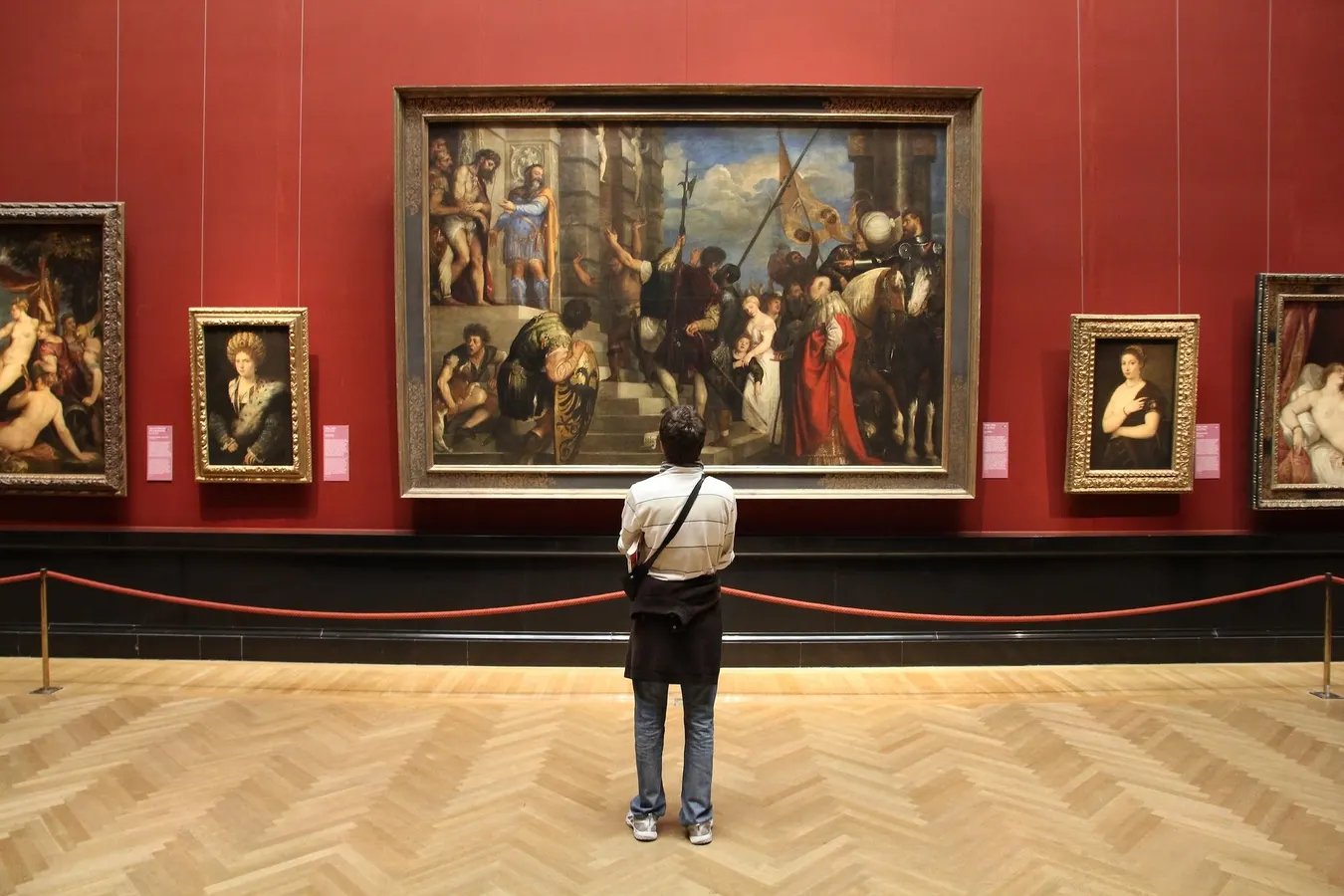

Thanks to AI and something called “gait analysis”, it’s possible to determine a painting’s authenticity.
Deposit Photos
What if masterpieces hanging in museums worldwide have been credited to the wrong artist? This is the worry of art law attorney Daniel Novela. Based in Florida, his firm advises on significant artworks, guiding the acquisition and due diligence process for auction consignments and private sales, making his insider concerns valid. “We may soon discover that many of the most beloved paintings weren’t created by the hands we thought. And AI may be the mechanism that exposes the truth,” he told me via interview.
Unexpected and unsettling, Novela’s suggestion conjures up conspiracies described in Dan Brown novels like The DaVinci Code. To unpack it, let’s explore a critical technological concept. “Gait analysis involves the systematic study of human locomotion, focusing on the movement patterns of the lower limbs, pelvis, and torso. When integrated with AI, it leverages machine learning algorithms, computer vision, and sensor technologies to analyze and interpret these patterns,” according to Meegle.com.
In other words, AI is now so sophisticated it can identify someone by their walk, much like how criminals can be picked out from their individual fingerprints. As recfaces.com explains, “Gait biometric systems capture step patterns using video images and then convert the collated data into a mathematical equation.”
Here’s how it works: AI models train on video footage of people walking. All that watching enables AI to detect patterns no human could possibly perceive. Databases in various countries are already compiling such information. They can surveil environments without the obtrusiveness of retinal scanners in public places or the facial recognition technology so often seen in airports nowadays.
There’s utility in using this technology for crime detection and prevention. As citysecuritymagazine.com explains, “In the notorious case dubbed by the media as ‘The Night Stalker’, gait analysis was used in the investigation by helping to find the perpetrator. This was one of the UK’s most high profile and longstanding, unsolved cases of serial gerontophile rape, burglary and indecent assault. Here, the gait analysis information was of considerable benefit in helping to find and to arrest the offender.”
Play Puzzles & Games on Forbes
In a similar way to how AI-enabled gait analysis enabled The Night Stalker’s capture by reviewing factors like the sway of one’s hips or the angle of their knees in their stride, AI can verify artist authenticity. “Each brushstroke carries a kinetic signature,” Novela explains. “It reveals speed, pressure, hesitation, even how they dilute their paint. AI can pick up on those cues and check it against other paintings to detect identity patterns.”
Over time, algorithms could assign probability scores based on recurring motifs in an artist’s work with the kind of precision we associate with DNA analysis. This isn’t a recent phenomenon either. As far back as 2019, leading figures in the art world turned to AI to detect art forgeries. As Artnome.com explains, “Two women in Switzerland, Dr. Carina Popovici and her co-founder Christiane Hoppe-Oehl, have developed an algorithm that correctly detected La Horde and several other known fakes using just a single photograph of the artworks in question. Their solution, the Art Recognition algorithm, looks at brushstrokes and produces an easy-to-read heat map that pinpoints which areas of the painting are most suspect. Their neural network is trained using machine learning and a comprehensive set of images of the artist’s works.”
The growing accuracy of this technology should be welcome news, especially when we consider the problem’s scale. Thomas Hoving, Former Director of the Metropolitan Museum of Art, once suggested 40% of artworks for sale at any given time are fake. But is it welcome news? What if all this AI analysis proves much of what we thought was real is not? Not only would that unleash societal shock waves, but it could also hurt museum-based tourism. Then again, it could help it as suddenly curious visitors showed up to gauge such art themselves.
Already, AI is being used to identify counterfeits. “A ‘Monet’ and a ‘Renoir’ are among up to 40 fake paintings that are being offered for sale on eBay, according to research by a leading expert,” explains The Guardian. “Dr Carina Popovici, a specialist in authenticating artwork, said she applied cutting-edge artificial intelligence (AI) technology to pictures advertised on the online platform and was shocked to discover that many had a ‘high probability’ of being ‘not authentic.’” Using the AI algorithm led Dr. Popovici to find up to 40 counterfeits. There may even be more.
Such misattribution isn’t just a public relations challenge for curators. It undermines the very foundation of cultural trust underpinning society. For as Novela says, “These aren’t just pretty pictures. Paintings are financial assets, historical records, even national treasures. If AI shows they’re not authentic, that changes everything from a museum’s credibility to insurance coverage.”
For now, it seems like the art world has little incentive to embrace such soothsaying technology. After all, museums stand to lose out big if their prized works are called into question. Any controversy could undermine philanthropic efforts. All those donors who were once so keen to celebrate the masters could be disillusioned by the fallout, leading to a withdrawal of support. Even if the misattribution wasn’t malicious or fraud, but rather the result of an innocent error, it could sink valuations, tanking the prestige of institutions.
Despite these concerns the shift could be ultimately healthy, leading to a market correction, not an extinction event. Though chastened by disclosures, resilient museums don’t have to vanish. They can evolve, eventually coming to use such tools themselves as a form of future triage. The next time they’re presented with a new work, they can turn to AI to ascertain its legitimacy. Humans don’t have to disappear from the process either. If AI screens first, people can follow up with their own expert review.
Looking ahead, a more difficult problem may emerge: criminals using the same technology to perfect their forgeries. AI can cut both ways. Not only can detect frauds, but it can also facilitate future chicanery. It’s not so difficult to imagine scammers using AI to make their own fakes better and harder to spot with advanced machine learning tools. For now, despite so much being up in the air for the art world, let us not lose sight of why such beauty matters in the first place: to evoke awe, to help us contemplate this mystery we call life. Though AI can detect patterns we humans cannot, only people can truly appreciate the wonders of creation. And that’s something you can’t fake.