
A groundbreaking exhibition at Tokyo’s National Museum of Modern Art invites visitors to reflect on Japan’s wartime actions through a compelling selection of paintings from the period.
Marking 80 years after the country’s defeat in World War II, the show features works commissioned by the Imperial Japanese Army.
Titled “Opening Documents, Weaving Memories,” the exhibition that runs through Oct. 26 ranks as the museum’s largest-ever show of wartime art. A total of 24 military paintings will be presented over the course of the exhibition, as well as related wartime publications and artworks from the postwar period.
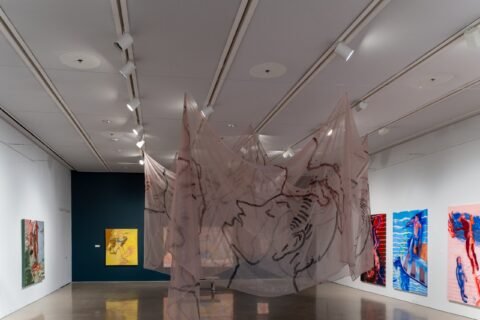
While the scale of the exhibition is unprecedented, it is intentionally subdued: no flyers or catalogs were produced for the event, nor was much done in the way of promotional efforts. Organizers hope visitors will engage with the art in a quiet, reflective space.
Among the featured works is Saburo Miyamoto’s 1945 painting “Banda Unit Fighting Fiercely off the Philippines,” which depicts a kamikaze attack on the U.S. fleet. The work is tinged with Romanticism.
Nearby hangs Usaburo Ihara’s “Special Attack Corps Setting Out from a Homeland Base I,” which he completed in 1944. It shows kamikaze planes lined up for takeoff.
The museum has 153 war paintings in its collection. Many of the works were created for propaganda purposes or documentation for wartime exhibitions typically organized by military-affiliated groups and The Asahi Shimbun.
They were seized by Allied forces after the war and shipped to Washington, sparking debate over whether they were war trophies or cultural artifacts. In 1970, they were returned to Japan on permanent loan and stored at the museum.
Plans to display many of the paintings in 1977 were scrapped due to concerns they could be misinterpreted as an attempt to glorify Japan’s militarist past.
There were also fears the exhibition might fuel anti-Japanese sentiment among Asian neighbors that bore the brunt of Japan’s military aggression.
A milestone 1994 symposium on war art inspired further studies and publications about the paintings, paving the way for regular displays of the artworks.
In recent years, the museum has tended to display just a few of its military paintings at any one time as part of its revolving collection exhibitions.
This summer’s exhibition seeks to break new ground by placing the paintings in a broader historical and media context rather than framing the works solely as propaganda or art.
“As the number of war survivors dwindles, now is the right time to hold this exhibition,” said Katsuo Suzuki, the museum’s senior curator.
Despite the exhibition’s significance, financial constraints and concerns over sensationalism shaped its modest presentation.
The museum had initially considered partnering with major media outlets but ultimately decided against it. Officials cited the exhibition’s academic nature and its heavy use of explanatory text as hardly a formula for the crowd-drawing, profitable shows that sponsors typically seek.
This ultimately resulted in a smaller-budget project with insufficient funding remaining for flyers and catalogues.
Organizers also chose not to highlight the war paintings in the exhibition’s main promotional visuals. Even the show’s title avoids the word “war” to prevent audiences from focusing too narrowly on World War II, as the exhibition includes works from a broader postwar period.
Concerns over potential controversy on social media also influenced the museum’s low-key approach.
Suzuki emphasized that the war remains a sensitive topic, with people holding a range of opinions.
“We need to be careful, or the word ‘war’ could be taken out of context,” he said. “We want audiences to see the exhibition for themselves.”
Reita Hirase, director of the Aichi Prefectural Museum of Art and an expert on war art, praised the exhibition.
“This is a careful display that places these military paintings in their proper historical context,” Hirase said. “While I agree that sensational promotion should be avoided, I do think posters and brochures could have helped reach a wider audience.”
As Japan marks the 80th summer since the war’s end, this exhibition may represent a quiet but significant turning point in how the nation comes to terms with the legacy of its wartime art.