
[ad_1]
Rising ocean temperatures, unbearable heat waves, floods—the effects of climate change are no longer distant warnings but present-day realities, disrupting ecosystems, endangering livelihoods, threatening food and water security, and deepening social inequalities across the globe.
However, despite all the warning signs, many of us—including those in positions of power—still don’t take climate change seriously until it directly affects our lives, homes, and health.
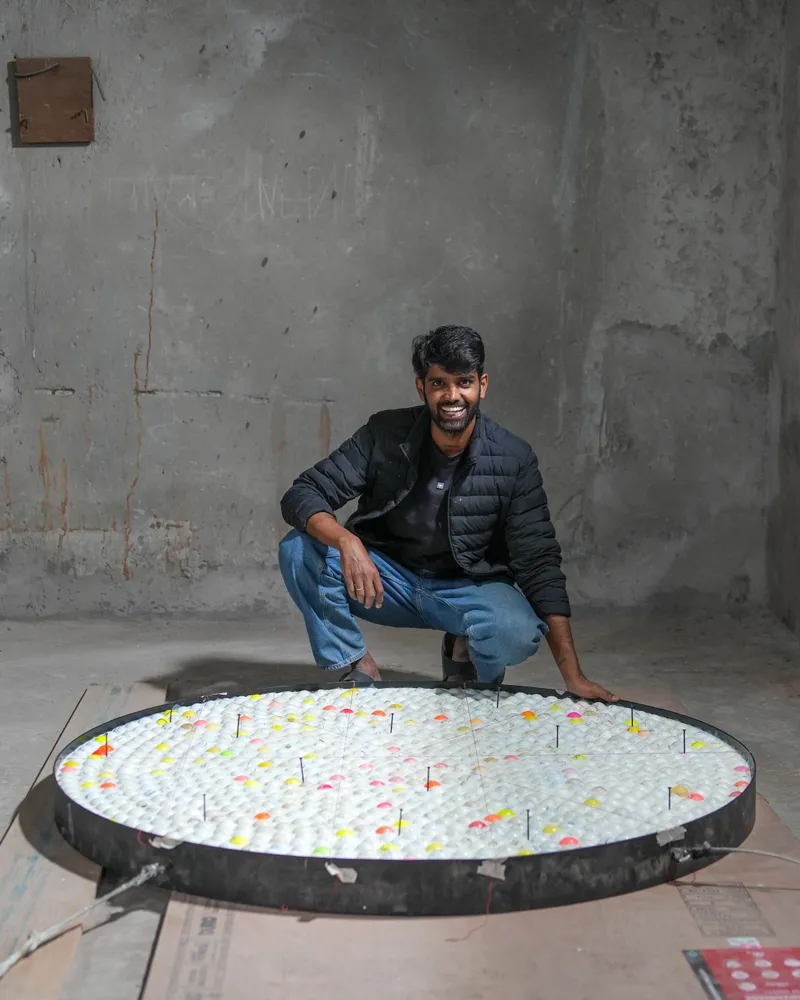
Aakash Ranison
To change people’s perspective and remove the notion that the crisis is happening somewhere else, climate activist and artist Aakash Ranison decided to bring the realities of climate change closer home.
He has created a “climate clock”—a striking installation made from 1,000 discarded golf balls that will melt when Delhi’s temperature reaches a catastrophic 53 degrees Celsius.
His latest work, titled Below 2°, sits at the Karma Lake Lands Resort in Gurugram, and is free for public viewing.
“I am trying to bring the fear, or the impact or change the thought that it is happening somewhere else, in Antarctica and the Arctic, not here, I am trying to bring it closer to home,” Ranison tells SocialStory.
From travelling to climate advocacy
Ranison shares that his journey to climate activism wasn’t born from loss or anger, but from love. After completing his schooling, he ran the Golden Bird Foundation, an NGO that provides education to the underprivileged, until 2014.
Later, he spent years cycling, walking, and hitchhiking across different places, including Bhutan. This decade of travel cultivated in him a deep affection for the natural world.
“I haven’t lost anything. Travelling instilled in me a love for nature. I wanted to protect it, and that’s how my work in climate change began,” he reveals.
This love translated into action through his organisation, Greener Earth Foundation, which he founded three years ago. The foundation focuses on what Ranison calls “ABCs of climate change”—A for agriculture, B for biodiversity, and C for carbon footprint. The non-profit helps individuals, businesses, and corporates pledge for a greener earth.
The Melting Point installation
A chance conversation with Diki Bhutia from Karma Lake Lands about 1,000 golf balls that couldn’t be used anymore led to the creation of something meaningful in the hope that it would raise awareness of climate change.
Ranison’s research led him to an alarming realisation about temperature targets. According to the India Meteorological Department, the annual mean land surface air temperature averaged over India during 2024 was +0.65°C above the long-term average (1991–2020), marking the warmest year since nationwide records began in 1901.
Scientists predict that exceeding the 2°C threshold could trigger irreversible consequences, including extreme weather patterns, rising sea levels, biodiversity loss, and habitat destruction.
Below2° was first introduced as a concept at the Digital Innovation Pavillion in the Blue Zone of COP29, held in Baku, Azerbaijan.
The globe is structured with a specialised wax blend engineered to melt at 53°C, serving as a metaphor for the consequences of surpassing critical climate thresholds. The Below 2° installation is hand-painted by schoolchildren to symbolise the generation inheriting the planet.
A key element of the installation is the surrounding 14 3D-printed endangered species listed under the IUCN RedList, printed from recycled plastic. These include critically endangered species such as the Siberian Crane, African Forest Elephant, and Hawksbill Turtle, along with the extinct Bramble Cay Melomys—the first subspecies to go extinct due to climate change. These serve as a visual representation of the species most at risk due to climate change.
The clock is ticking
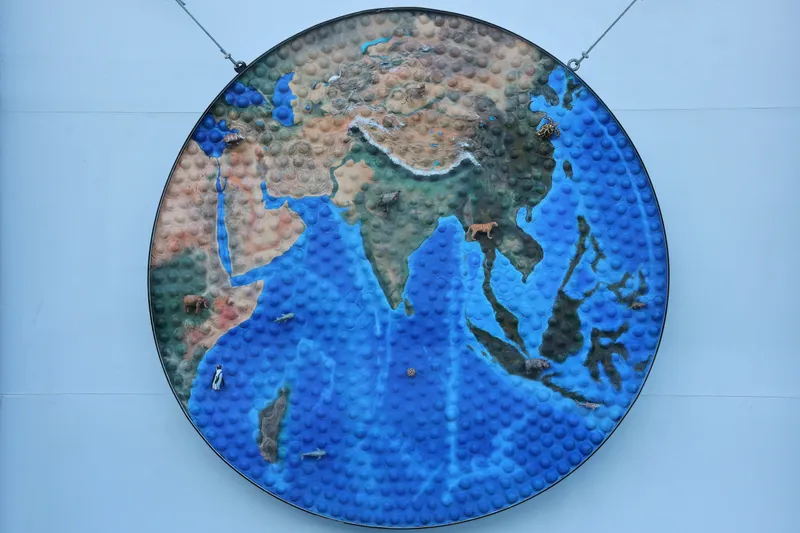
The installation
Ranison believes that people often refrain from addressing climate change because it seems distant from their immediate reality.
“People are saying that climate change is happening somewhere else, not here, and it will happen in the future; it’s not happening right now. So, it’s like a clock. Imagine, there is a kid, who is not wearing a watch, so he doesn’t care about the time,” he explains.
The installation forces viewers to confront a grim reality. “We will go very easily to 53 degrees. We have already touched 49.9 degrees Celsius last year. We need 3-4 degrees more, which we will move forward very easily,” Ranison predicts.
Ranison’s climate work extends beyond art installations. He’s authored “I’m a Climate Optimist,” a handbook focused on simplifying climate change and sustainability. He works on documentaries and also serves as a civil society representative with the Paris Peace Forum and as a delegate with UN Migration. He has attended COP 28 and COP 29, with plans for COP 30 in Brazil.
His upcoming documentary “Can Art Save the Planet?” features actress Dia Mirza and other environmental advocates.
One of Ranison’s biggest challenges is funding his work without compromising his values.
“I get approached by some of the biggest companies in the world. I cannot work with them, because for them, it’s a greenwashing campaign, they don’t really mean what they are saying, and by working with them, I will be just helping them cover their environmental destruction with greenwashing.”
He says he chose Karma Lakelands because its owners, Ashwini Khurana and Diki Bhutia, exemplify a sincere commitment to the environment. “They acquired this 270-acre tract years ago when it was completely barren—there was nothing here. Today, it’s home to millions of trees. They could have developed the land for any number of commercial purposes, yet they chose to let the majority of it remain dedicated to nature.”
Ranison believes that change can happen only with community action and a citizen-driven movement. His goal therefore combines awareness with action. “Indians have a natural connection to environmental protection. I want to build an army of people, a community to drive change,” he says.
[ad_2]
Source link