
[ad_1]
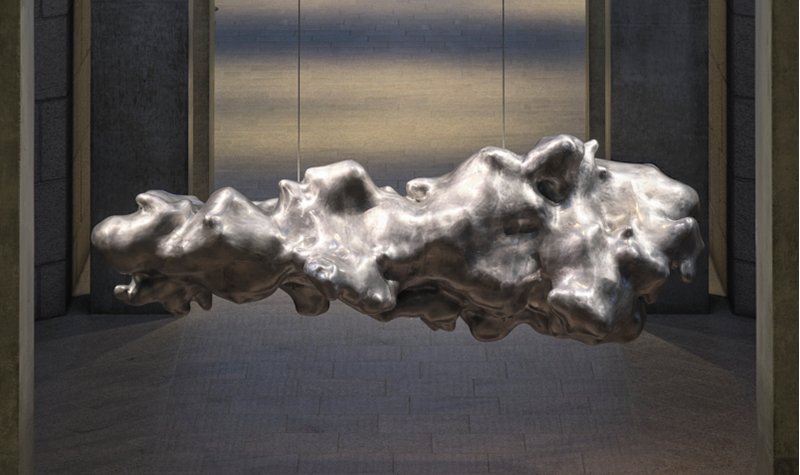
There is a saying in Spanish – A las palabras se las lleva el viento (Words are carried away by the wind) – that alludes to the ephemeral nature of discourse. The curiosity of Mexican-Canadian artist Rafael Lozano-Hemmer, however, has managed to defy this idea through one of his works. His Listen to the World, a long, bubbling sculpture of cast aluminum, elegantly hanging from the ceiling by steel cables, is indeed a tangible speech bubble of the spoken words “listen to the world.”
Born in Mexico City in 1967, Lozano-Hemmer graduated in Physical Chemistry from Concordia University in Montreal in 1989. Today, this internationally recognized and award-winning artist continues to live and work in Montreal, where he leads Antimodular, a studio team of various international collaborators. For over two decades, his work has been widely exhibited, has received numerous awards, and has been the subject of many conferences in different countries on five continents. In Canada, he was made a Compagnon des Arts et des Lettres du Québec and awarded the Governor General’s Award in 2015. He has shown work in more than two dozen biennials worldwide and in 2007 was the first artist to represent Mexico at the Venice Biennale.
Since Lozano-Hemmer’s parents owned nightclubs and bars in Mexico City, he grew up surrounded by lights, sounds, and stage sets, with opportunities to observe people’s participation in these chaotic environments. This combination has uniquely informed his art practice. His works lie at the intersection of architecture and performance art, combining technologies – such as robotics, multimedia walls, custom software, projections, internet links, cell phones, sensors, LEDs, cameras and tracking systems – to become a stage on which the public, a key component of his work, can express itself. This provocative interaction with technology often reflects difficult social, economic and political dynamics. As he has stated in interviews, he tries to create works that are intimate, not intimidating.
One of the realities to which Lozano-Hemmer alludes in his work is the transient nature of one’s passage through life. His uncle, poet Octavio Paz, the only Mexican winner of the Nobel Prize for Literature (1990), also referred to this aspect of human experience. In Call on Water, Lozano-Hemmer presents dozens of Paz’s poems, words that momentarily appear in floating vapour above a water basin, and then disappear again. Although short-lived, this brief moment stays with the viewer. Lozano-Hemmer encourages the viewers to interact with his works, and these passing experiences provoke reflections that go beyond just observing a work in a museum.
This type of technological ode to the human experience can be found in exceptionally insightful works that find ways to transform the transient into a material manifestation. The theme of pulse and heartbeat is a major theme in his œuvre. Pulse Room (2006), for example, is an interactive installation of approximately 300 incandescent light bulbs hanging from a wire, distributed across the exhibition room. At one end, there is a sensor that, once touched, detects the heart rate of a visitor. It then transmits it to the nearest bulb to flare in the exact rhythm of that heart, pushing forward all previous pulse recordings and erasing the oldest one. Just imagine a room illuminated by the rhythm of people’s heartbeats!
In 2022, the National Gallery of Canada acquired its first work by Lozano-Hemmer, Field Atmosphonia (2020), and in 2024 Lozano-Hemmer’s Listen to the World (2019–21), a gift from Mexico to the people of Canada, on the occasion of the Confederation’s Sesquicentennial, the artwork donated by Fundación Jumex Arte Contemporáneo (Mexico City).
Field Atmosphonia combines sound and light to create an environment featuring 3,000 audio channels, played through speakers with LED lights. The work is a soundscape of different sounds, including sounds of more than 200 types of insects and 300 types of birds, wind, water, fire, ice, bells, metronomes, among others. Participants can explore this installation by following a particular light and sound. As they move through the installation, lights become brighter or darker, and sounds become amplified and dimmer. It is part of a series of works, as the artist explains, that investigate “the perception of thousands of simultaneous sounds,” also reflecting the artist’s interest in making the viewer stop and listen.
Lozano-Hemmer’s Listen to the World is a sculpture made of cast polished aluminum in the shape of a speech bubble (or Volute), which is suspended less than 2 metres above floor level. The work is a 3D print of a laser-tomography scan, which captured the breath exhaled from a person’s mouth when saying the words “Listen of the world.” The spoken words, the breath emitted into air, thus achieve materiality.
In this work, the artist manages to counteract the Spanish saying A las palabras se las lleva el viento (Words are carried away by the wind), by creating a material representation of an ephemeral experience. This work is a beautiful combination of the two main artistic influences in his life. The first stems from his Mexican heritage: Volute alludes to the speech or music bubbles in the drawings of the Olmec, Mayan, Mixtec and other pre-Columbian cultures. The second acknowledges his adoptive country, Canada, as he has dedicated Listen to the World to the acclaimed Canadian composer R. Murray Schafer, who transformed the arts with his concepts of acoustic ecology and soundscapes. Schafer argued that we currently suffer from an overabundance of acoustic information and, at the same time, a decrease in our ability to hear the nuances and subtleties of sound. He emphasized the importance of discerning the sounds that enrich and nourish us and then using them to create healthier environments for ourselves.
Giving material form to speaking or breathing as it extends into the environment, Lozano’s works, such as Listen to the World, reflect his thinking about the multiplicity of human interactions with the Earth. To create a materialized form of spoken words, Lozano-Hemmer and his team collaborated with the Georgia Institute of Technology, Auburn University and New York University. With the use of laser tomography and photogrammetry, they created a three-dimensional model of the breath ejected during speech, which then was CNC-printed onto styrofoam, and then wax applied to create the final sculpture’s cast. This project was the first in the world to print speech bubbles.
For decades, through his work Lozano-Hemmer has been quietly prompting audiences worldwide to participate in shared encounters. Having the opportunity to interact with his works not only grants the visitor an entertaining and reflective experience but also an educational one. Each work brings to light a transcendental – often current – issue, making an impact no matter what cultural or socio-economic background one comes from. This notable skill of uniting the audience based on a shared experience is an element that is ever-present in each of his works, adding to his ingenuity in giving material form to the invisible – yet indispensable – aspects of being a human: hearing, voice, pulse, breath, and much more.
Listen to the world by Rafael Lozano-Hemmer, a gift from Mexico to the people of Canada, on the occasion of the Confederation’s Sesquicentennial, the artwork donated by Fundación Jumex Arte Contemporáneo (México City), is installed in the Rotunda at the National Gallery of Canada, Ottawa. Share this article and subscribe to our newsletters to stay up-to-date on the latest articles, Gallery exhibitions, news and events, and to learn more about art in Canada.
[ad_2]
Source link