
[ad_1]
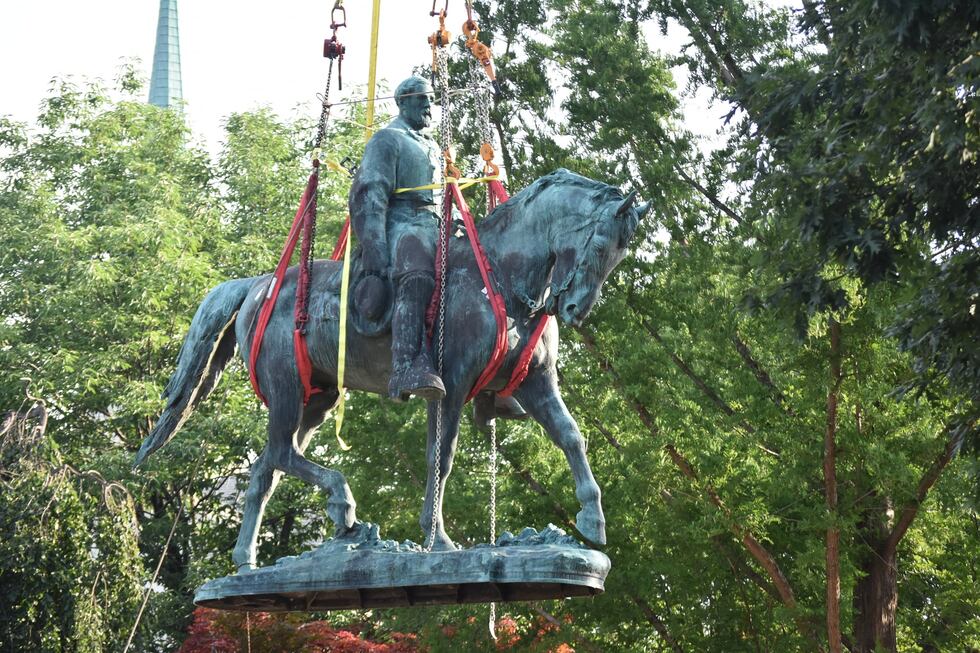
CHARLOTTESVILLE, Va. (WVIR) – The Jefferson School African American Heritage Center is narrowing down designs that would turn material from a former Confederate statue into new public art shaped by the community.
The center is calling on artists from around the area to forge something from the past to something new.
Push Studio LLC is one of three finalists for the project, proposing “Land Forge.” The plan calls for a series of towers and pillars built across six city parks. The design uses granite and bronze from the statue of Robert E. Lee that stood in Market Street Park.
“They bring to the conversation over 30 years of work in cultural landscape design,” said Andrea Douglas, executive director of the Jefferson School African American Heritage Center. “They are of the three, I think the smaller group of the three, but nonetheless carry just as much as a punch.”
Push Studio is led by Glen LaRue Smith and is based in Washington, D.C. The proposal calls for two towers, both 25 feet high, in Washington Park and Market Street Park. The design also includes smaller pillars in four other parks: Tonsler Park, Forest Hills Park, Court Square and Market Street.
The project would unfold over two years instead of one. The first year would focus on community engagement, including conversations, collecting oral histories and understanding people’s sense of the landscape. The second year would be an artist residency.
“In the artist engagement, it is actually inviting the community to help make the object,” Douglas said.
The design would use a process called rammed earth. Push Studio is the only finalist that addresses sustainability and plans to use both the bronze and granite from the Lee statue. The granite would serve as the supporting substrate for the towers and pillars, while the bronze would be used as an interior space and supporting space between sections of rammed earth.
“If you look at their drawings, you can enter into the work, sort of move around in them, and then there will be some sort of wording that comes out of the oral history,” Douglas said. “I think it’s an interesting project because of the way that it really wants to engage in community.”
The heritage center has received 315 responses so far, including from Charlottesville fifth graders who toured the center and filled out advising sheets.
“We’ve got a good spread on the age group, which is really important to us,” Douglas said. “This is not an object that we’re building for today, but we’re trying to be informed by the ideas, the cultural space of today.”
Douglas said the project is intended to inform people 20 years from now and 30 years from now as the community asks whether its cultural values hold.
The center plans to announce a finalist on July 10. An exhibition of the three finalists is available at sipsevo.com, which includes oral histories and resources.
“What we are hoping to do is bring the most informed community that we can to the next stage of the process,” Douglas said.
Douglas said public art is about turning history into something visible, lasting and shared.
“Our knowledge of ourselves is embedded in our histories,” Douglas said. “Our senses, it’s about a sense of identity. One defines ourselves by who we are in our history.”
She said public art works best when a community sees itself in it.
“It sees itself both critically and it sees itself equally as an intimate place where you know that this thing articulates where you are right now,” Douglas said. “I think art in public spaces when it’s doing the best work is when it really does resonate to multiple people.”
Do you have a story idea? Send us your news tip here.
Copyright 2026 WVIR. All rights reserved.
[ad_2]
Source link