[ad_1]
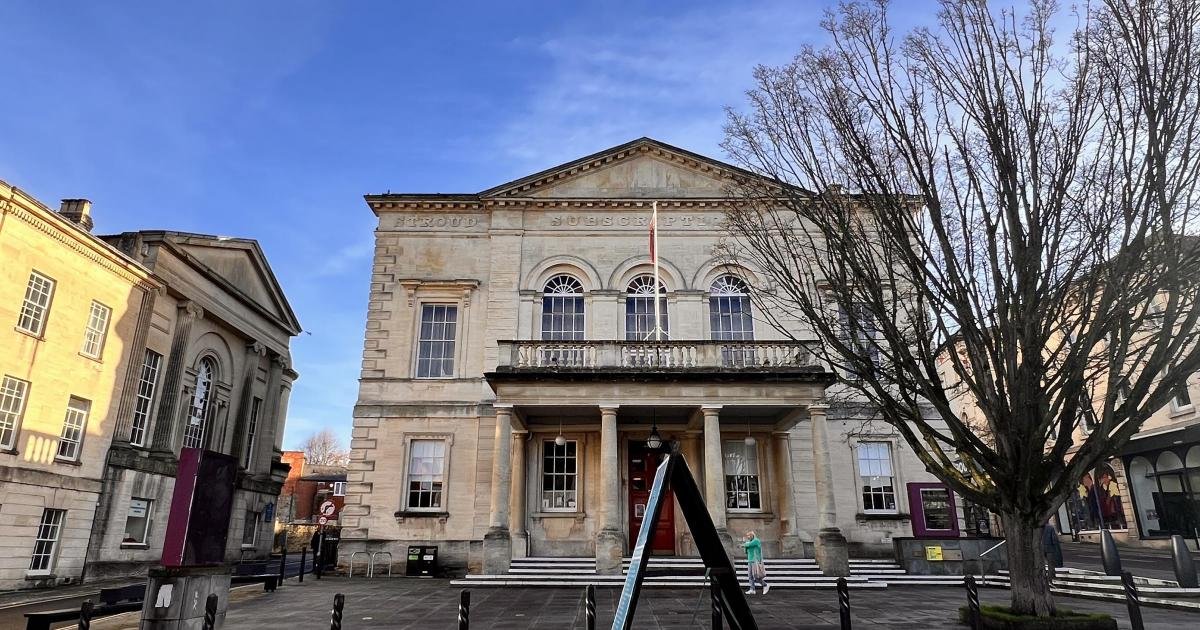
A bold 1970s sign makes a loud statement in Stroud’s most central landmark building where arts and heritage succinctly come together. The original stage sign from Top of the Pops is proudly displayed in the Subscriptions Rooms, a venue which has hosted and continues to host many of those much-loved bands and performers, including The Beatles, Van Morrison, Lulu, Leo Sayer and Toyah Willcox, who appeared on this prominent former Thursday-night television show.
Sub Rooms director Hugh Phillimore stands next to this retro artwork, which he bought at auction a few years ago.
‘The sign was for sale, and I put down the lowest bid not expecting to get it, but sure enough we did. I love the idea that we are aiming to have as many people as possible who played Top of the Pops coming through this building. I think it is a lovely show piece to have in reception. It’s fun and so many of us loved that show and miss it.’

Endless high-profile names trip off his tongue. It’s been his natural habitat after all. But connections like this benefit Stroud and Hugh is proud to show off this prominent 500-capacity award-winning venue to up-and-coming stars and, of course, the big names he knows personally.
As a former talent scout, he has worked with music legends like the late Frank Sinatra, Elton John, and hosted parties for Whitney Houston, Jamie Cullum, Joss Stone, Pierce Brosnan, Rod Stewart, Lionel Richie, Billy Joel, Prince William (I could go on) over his impressive 40-year career. Hugh also ran The Cornbury Festival in the Cotswolds with the likes of Joe Cocker, Robert Plant, James Blunt, Bryan Adams and Jools Holland and his Sound Advice business, set up in 1981, continues to supply music for private and corporate events.
‘I just feel it’s a real honour to work with these people. What we have tried to do here at the Sub Rooms is to be so welcoming that eventually it will be the show that everyone must play, I want it to have this reputation for being an unusual, but lovely place to play,’ says Hugh.
Today, together with his hard-working team at the Subs, Hugh Phillimore has been instrumental in bringing some impressive names to Stroud and this year alone we can expect Suzanne Vega, T’Pau, KT Tunstall and possibly Kid Creole.
This gritty, hardworking, creative, pioneering Gloucestershire town knows how to lead and nurture talent. The Beatles performed not once, but twice in this building and over the years, countless artists – famous, emerging, and everything in between – have taken to this polished stage, adding their own frequencies to the building’s foundations. But the magic of the Sub Rooms lies in the way the past and present fuse together.

This is not a building stuck in nostalgia. Instead, it is constantly bursting with life in the form of gigs, exhibitions, comedy, food and jamming nights, films, dance and most of all community spirit. The Subscription Rooms is not just a venue — it is a creative lung, and the perfect starting point for understanding Stroud’s vibrant spirit.
This creative pulse spills easily into the town. Stroud is a place where creativity is not confined to galleries or studios; it is evident in the shop fronts, café conversations, market stalls and workshops.
There is a gentle yet insistent hum of people who make things, think things, discuss and challenge things.
To understand Stroud’s modern artistic surge, you must begin to explore its history. The valleys were once alive with cloth mills – they were known worldwide for their scarlet cloth. Though industrial production has declined, many of those same mill buildings now house studios, collectives, workshops and artisan businesses.

A new beat on Locking Hill
A former chemist shop has recently been turned into Locking Hill Streaming Studio, a music and arts venue founded by artist and sound engineer Everest Wilson-Copp who grew up in the Slad valley – former home of the late writer and poet Laurie Lee. Having spent many years working in London, he wanted to give up-and-coming bands a chance to thrive.
‘I do small grassroots gigs, for local bands and bands who are touring. I have acoustic boards [brilliantly illustrated by Everest] which mean I can block out sound and light. I can do theatre, poetry, film screening, art and sculpture exhibitions.

‘It is small, but not too small, and it is not too big. It is great place for people to nurture their talent. If you are a young band, you don’t have to worry about filling the space. It is important to have something at grassroots level,’ says Everest.
‘My dream is that I can offer a really diverse programme for different events, exciting art and music projects. I wanted to bring all my sound engineering experience back to the Cotswolds into a cosy intimate space. My dream was to bring light to a dark corner.’
Everest’s role in Stroud’s cultural reawakening feels both timely and significant. By quietly championing emerging bands, artists and poets, it is helping to fan the flames of a vibrant new creative energy. And this momentum isn’t happening in isolation; it’s part of a wider artistic heartbeat that’s pulsing through the landscape.

Where artists gather
At the centre of this is Stroud Valley Artspace (SVA), one of the town’s most cherished creative anchors. With studios, exhibition areas and performance spaces spanning two much-loved locations – the characterful, refurbished warehouse on John Street and the evocative Goods Shed, a Brunel-designed industrial treasure – SVA offers artists and the community a place to gather, make and imagine. Its year-round programme of exhibitions, performances and workshops keeps the cultural conversation alive, while the annual Site Festival, with its celebrated Open Studios, continues to draw people into the rich, eclectic world of local creativity.
Further along the valleys, tucked into Chalford, Pangolin Editions adds another remarkable layer to Stroud’s artistic tapestry. Established in 1985, this renowned sculpture foundry casts and fabricates works for many of the leading sculptors working today. Alongside it, Gallery Pangolin provides a beautifully curated contemporary sculpture space, connecting local audiences with art that resonates far beyond the valleys.
Having brushed shoulders with many artists, the creators of independent arts magazine, Good on Paper know only too well the texture of Stroud’s creative life. Adam Hinks with Alex Hobbis launched their venture in 2015.
‘When we set it up, we noticed there was a disconnect between everyone,’ says Adam. ‘They were promoting their own shows in their own silos.
‘Partially the intention was to connect everyone up and create a bond between the different locations. We wanted to form a glue between everyone, help people collaborate and make new projects and new art.
‘Stroud has for a long time been a gritty, urban part of the Cotswold and I think artists flock here knowing that is what they want.’

Thread of the past and present
One volunteer-run charity which keeps the town’s rich woollen heritage alive is Stroudwater Textile Trust, which preserves and promotes the historic woollen industry and operates Dunkirk Mill Museum and the Gigg Mill Weaving Shed.
And bringing a fresh spin on this love for textiles into the town centre, is The Fold, a contemporary haberdashery on George Street, adding colour with vibrant fabrics and threads.
It’s run by Nikki Green, who has already launched a stitch community project and is hosting various workshops.
‘I’ve lived in Stroud for 15 years, my children have grown up here and it’s always felt like home. It’s such a warm, creative, and vibrant town – people here really want to make things happen and are brilliant at supporting local and independent businesses.
‘I wanted to build something that adds to it – a space that connects textile artists, makers, and anyone who loves to create. Stroud has such a rich textile history, and it deserves to stay alive and thriving. There’s so much skill and creativity here already, and I want to help nurture it — especially among young people. I hope the shop will inspire people to make, repair, and alter their own clothing which not only connects them to that heritage but also gives them confidence and a sense of sustainability that feels very relevant today.’

Nikki’s desire to see The Fold become an integral part of the making community and for Stroud to grow as a creative hub, is shared by Annabel Richmond, who this month will launch the first ever Just SUST festival. It’s the town’s newest celebration of creativity, community, and sustainability — held in the historic Brimscombe Mill, a former industrial site now transformed into an inspiring hub for positive change.
‘The festival transforms that legacy into something hopeful and humane: a vibrant day of workshops, makers’ markets, and a joyful community runway show celebrating pre-loved fashion.
‘It’s about connection, care, and bringing people together through creativity — honouring Stroud’s past while shaping a more sustainable future,’ says Annabel.
‘I was born and raised in the Stroud valleys and have never wanted to live anywhere else. I feel utterly blessed to be surrounded by such beauty, steeped in rich history, and part of a community that hums with creativity and independence. The Just SUST Festival grew from that spirit — it’s a celebration of what we can do together, reimagining our relationship with clothing in a place that once drove the textile industry.
The event on Saturday, February 28, feels perfectly placed in a town passionate about green living and brilliant ideas which include the award-winning social enterprise The Long Table, which also supports arts and local bands, and Stroud Brewery, again a fantastic venue for creatives to meet.
Festival spirit runs through the veins of this Gloucestershire town. Stroud has an abundance of festivals which celebrate everything to do with arts and heritage.
Following the Just SUST festival, Stroud’s year unfolds in a lively rhythm of arts and heritage. Spring brings the Stroud Festival of Food & Drink, three bustling days of flavours, music and family fun, before early summer offers the gentler, soul-lifting notes of the Sacred Music Festival. August then bursts into colour with the Fringe Festival, filling the town with performance and joyful spontaneity. As the year turns, the Stroud Film Festival brings fresh perspectives to screens across the town, followed by the long-established Stroud Arts Festival in autumn and the ever-popular Book Festival in early November. Finally, as winter approaches, the Festival of Wonder rounds off the year – a sparkling celebration of creativity that invites us all to pause and reconnect with a sense of awe. And forgive me if I’ve missed any – Stroud’s creative spirit is so abundant that this is by no means a definitive list.

Everyday artistry
That same spirit pours into everyday life. Made in Stroud stands as a vibrant showcase of local makers who create amazing ceramics, textiles, jewellery, candles, skincare, prints and beautifully crafted gifts as well as food and drink. As Ry Gerbrands, shop manager explains, the shop been serving the town for 25 years and now works with 250 makers.
‘Not only do we give them a space to showcase to the public, but we also do a lot of social media promoting them,’ he says. ‘Stroud has always been a creative place. It is a mill town and as it we do work with some local seamstresses and weavers, which pulls on that heritage. I do think that Stroud has for a long time attracted those who are creative whether that is arts or music and we have noticed that even more in the past five years.’

Walk down the High Street and a different kind of artistry fills the air: warm sourdough, toasted seeds, flour meeting heat. Leola, Stroud’s new artisan bakery, is already a community love affair, with walls displayed with work by local artists. Owned by husband-and-wife team Andy Strang and Ruth Batham, here you can even buy a Stroudie, a heavily seeded sourdough, one of Leola’s four signature loaves.
‘It all started with bread for me. We have four breads and I love all of them,’ says Andy. ‘There is something about bakeries, they have a certain energy, and magnetism. They are places where people come in and feel at home and enjoy some great food. We wanted to bring a bit of life back into the high street.’

And just round the corner, is another creative hub at The Lansdown Gallery, a fabulous space for artists of all disciplines to showcase their talent. Today, I happen to meet members of Stroud Artists Cooperative – made up of 180 full members and around 90 associate members – run by Clare Hines and Chris James.
‘Stroud’s heritage attracts people who have an artistic bent, but life gets in the way. Not everyone can make a living from being an artist or have the connections in their art journey. We fulfil that aspect, we are a peer group of artists and we support each other. Everyone learns from each other,’ says Clare.

The group hosts open exhibitions in the spring and winter and will be part of the Park Life programme, exhibiting work about activities that take place in park settings in the Museum in the Park in August. Tucked within the greenery of Stratford Park, this popular attraction is one of Stroud’s treasures and is a place where the town’s past and present fuse together. It’s been housed in this beautifully preserved 17th-century wool merchant’s home for the past 25 years and offers free entry and an open invitation to learn about the stories that have shaped the district – including the world’s first lawn mower in 1830, invented by Edwin Budding, who was inspired by local machines used to trim wool.
Arts and heritage creativity is the town’s lifeblood. It lives in its hills, its mills, its studios, its workshops, its food, its galleries, its bakeries, its festivals. Five Valleys Shopping Centre is a prime place to see the buzz of makers and creators coming together. This former traditional shopping precinct has been transformed into a bustling indoor food quarter but has also expanded to include a series of permanent craft and maker booths, giving local artisans, jewellers, textile printers, illustrators and small creative enterprises their own dedicated spaces.
As I walk back home – as I am indeed a Stroudie and grew up here – I take time to study the Sub Rooms’ forecourt billboard. There is much to look forward to. But I wonder if Stroud was a music genre or indeed a band, what would it be? Hugh Phillimore has the answer.
‘I would like to think it was one of those great crossover bands that’s funky, has a solid beat and has got some interesting squeaks. Is it Sledgehammer by Peter Gabriel, or a Was (Not Was) track like Walk the Dinosaur? I don’t know. Stroud is an exciting mix of lots of different things, and I am just thrilled to be part of it.’.

[ad_2]
Source link