[ad_1]
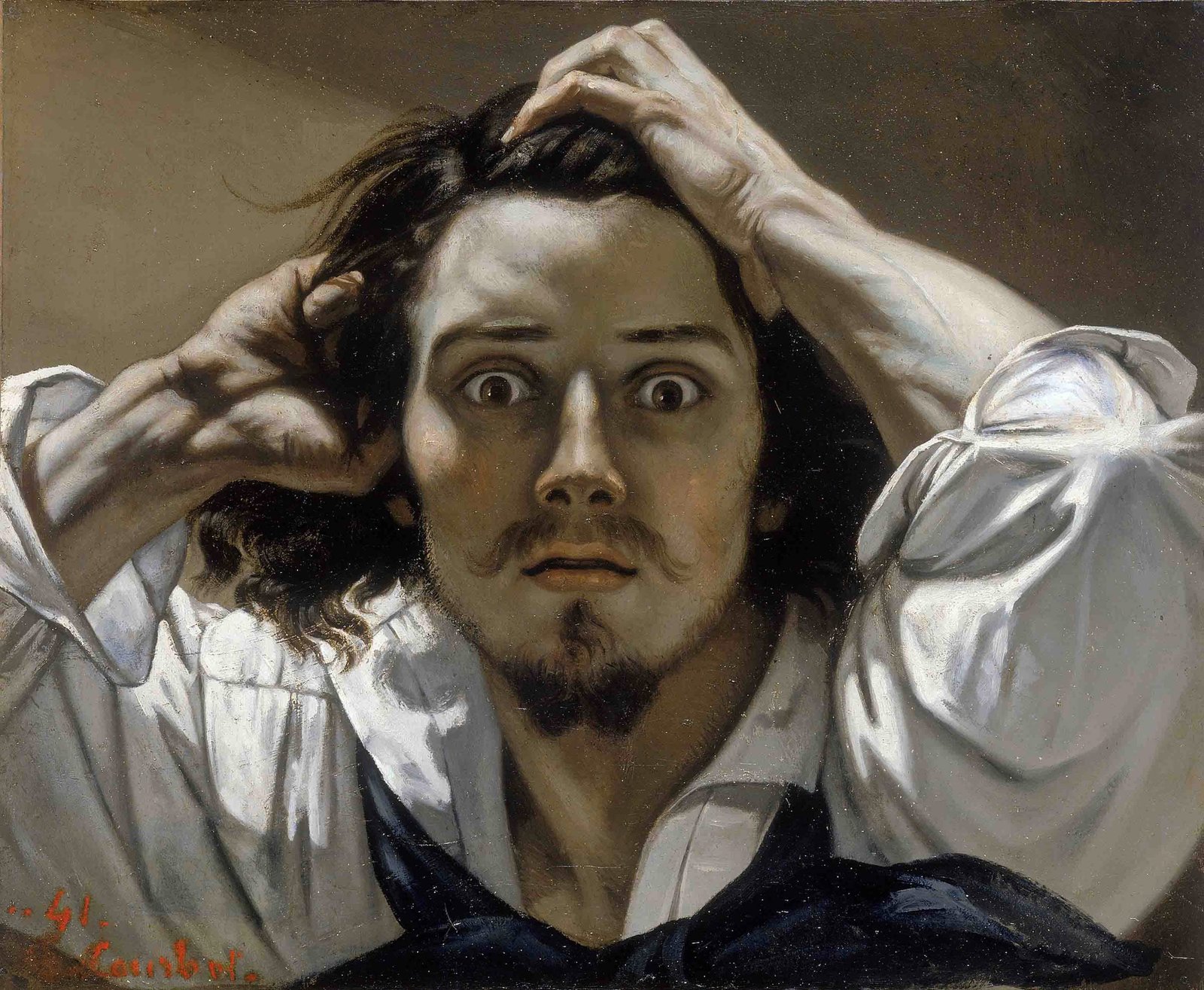
News broke last week that Gustave Courbet’s iconic self-portrait Le Désespéré (The Desperate Man) (1843–45) is returning to the French painter’s homeland for the first time in 17 years. The small, intense artwork is officially on view for the next five years at Paris’s Musée d’Orsay—the same institution that houses Courbet’s massive Realist masterpiece A Burial at Ornans (1849–50) and his confrontational nude L’origin du monde (1866). The artwork’s homecoming is made possible by Qatar Museums, who was revealed to be the artwork’s owner when the Musée d’Orsay made the surprise announcement of its return.
Details around how Qatar acquired the work proved scarce at first. But, Le Monde reported on October 21 that Qatar bought The Desperate Man from a descendant of one of Courbet’s patrons about 10 years ago, for €50 million. The Musée d’Orsay has stated that after its five-year stay, The Desperate Man will travel to the Art Hill Museum in Doha, which is still under construction. The work will subsequently alternate between France and Qatar.
Maybe it’s Courbet’s notorious good looks or maybe it’s his accessible Realism, but this particular self-portrait has proven one of those rare artworks that has permeated the collective consciousness, even becoming a bona fide meme. That can make The Desperate Man all the easier to brush off, however. Here, we explore this complicated depiction of a man who shaped contemporary notions of the artist’s role in society.
Courbet Painted Many Self-Portraits

Gustave Courbet, The Cellist (1847). Photo: Heritage Art / Heritage Images via Getty Images.
The self-taught Courbet painted scores of self-portraits beyond The Desperate Man—20 between 1842 and 1850 alone. What else could we expect from France’s self-proclaimed most arrogant man? Art history best remembers Courbet for pioneering Realism from the 1850s onwards—often on a monumental scale (although L’origin Du Monde, which became easily his most infamous work when it was finally shown in 1988, is rather tiny, perhaps in part because it was a private commission). Courbet’s self-portraits, however, are an entire sub-genre within his oeuvre—and a rather puzzling one at that. Many hail from the 1840s, early in Courbet’s career, when he was still negotiating his place amidst the dominating movements of Romanticism and Neoclassicism.
These works—in which he plays a noble martyr, a pipe-smoking heartthrob, and a concentrated cellist, among other guises—straddle Romanticism and Realism. They also arise from a known academic exercise. “It was tradition for artists to paint ‘studies of heads,’ in which they showed their aptitude for painting emotions,” the Musée d’Orsay states. That’s partially why Courbet bears such theater kid bravado throughout these roles—as a Casanova in The Man with the Leather Belt (1945–46), and a panicked bohemian in The Desperate Man, for instance. From the Musée d’Orsay’s widely held perspective, Courbet’s self-portraits constitute emotional character studies.

Gustave Courbet, Self-Portrait with a Black Dog (1842–44). Photo: Heritage Art / Heritage Images via Getty Images.
Maybe Courbet felt the self-portrait was a winning formula, too. It was this trope which finally paved his way into the Paris Salon, after all. Four excruciating years of failed attempts concluded in 1844, when the notoriously conservative state-sanctioned institution opened its gilded doors to the artist by accepting Courbet with a black dog (1842–44). That work didn’t end Courbet’s run of self-portraits, though. It’s actually one of the first he did, suggesting that he may have felt he’d found a beat.
The Real Desperation Behind Desperate Man
Viewers don’t need art-historical context to understand where The Desperate Man is coming from. Here, a dashing 24-year-old Courbet stares directly out at the viewer, his rich brown eyes radiating charged currents of fear above his chiseled cheekbones, droll lips parted as if in a panicked gasp, his dramatically lit hands clutching at his flowing dark locks. It’s a picture of fear and panic with keen emotional resonance.
Though the stylistic elements of this artwork are decidedly Romantic, one could argue that Courbet’s purported devotion to encapsulating unadulterated emotion renders The Desperate Man Realist. But, in recent years, Courbet’s authenticity—the authenticity of any individual, in fact—has come into question, as experts continue studying social psychology. In 2020, art historian Claude Cernuschi cited his contemporary Petra Chu’s position that Courbet’s self-portraits were really an exercise in personal branding.

Gustave Courbet (1819–1877). Photo: © Hulton-Deutsch Collection / CORBIS / Corbis via Getty Images.
It’s generally accepted that The Desperate Man conveys Courbet’s early career anxiety amidst his rejections from the Paris Salons. Cernuschi, however, posits that Courbet likely exaggerated this desperation to curry sympathy from viewers. Citing Courbet’s many contradictions—like his desire for fame, despite his anti-establishment rhetoric—Cernuschi’s stance doesn’t negate but rather augments the agreed-upon read. Courbet may have betrayed his own Realism by purposefully crafting (sometimes conflicting) narratives about himself for his own personal benefit. Examples of such behavior abound throughout the artist’s career.
Courbet Kept the Painting All to Himself for Decades
Complicating Cernuschi’s interpretation is the fact that, although Courbet exhibited numerous self-portraits throughout his career, he kept The Desperate Man all to himself until it was shown at the Vienna World’s Fair of 1873—the same year France reopened its case regarding Courbet’s participation in the Paris Commune.
That retrial found Courbet liable to pay 300,000 francs for the construction of a new Vendôme Column, the monument to Napoleon III’s military victories whose destruction Courbet supported. The ruling also stripped the artist of his studio’s contents, as Cernuschi noted. Ahead of that verdict, Courbet fled for Switzerland. The Desperate Man went on view again amidst his exile in 1877—a week before his death, which happened just one day before he was due to start making annual payments towards the Column.

Gustave Courbet (ninth from the right with a large beard) at the overthrow of the statue of Napoleon I on top of the Vendôme Column, during the Paris Commune, 1871. Photo: Hulton Archive / Getty Images.
Courbet had served nearly six months in prison the first time French authorities litigated his involvement with the Commune, a short-lived Socialist government that seized Paris on March 18, 1871 amidst the chaos of France’s defeat in the Franco-Prussian war. He even painted several self-portraits in custody. But his level of commitment to the Commune remains disputed—as do his true political beliefs.
Courbet was born to a well-to-do family in rural Ornans, near France’s Swiss border, where his revolutionary grandmother fostered his radical tendencies. Although his Realism boasted a political bent to aggravate the Bourgeoisie and elevate the Proletariat, Courbet sometimes took pride in his affluent origins. Some experts, like those at Montpellier’s Musée Fabre, notes that Courbet “gladly received a gold medal at the 1849 Salon for After Dinner at Ornans which he did not hesitate to sell to the state.” He also sold work to Napoleon III’s half-brother, Charles de Morny. Like this, Courbet was a somewhat seminal figure in the contemporary art of virtue-signaling.

Gustave Courbet, The Desperate Man (1843–45), on view at the Musee d’Orsay in Paris, 2025. Photo by Ian Langsdon / AFP via Getty Images.
But, Courbet truly did form the Commune’s Federation of Artists, which wrested control of the arts away from the state and espoused policies elevating artist rights and gender equality. The week after the Federation’s first meeting, the Commune gave orders to destroy the Vendôme Column. Though Courbet wasn’t an official Commune member at that point, he had written an unfortunately damning letter to the Third Republic’s Government of National Defense in September 1870 advocating for the column’s destruction, which left him liable for the blame. This ending makes it easy to understand why Courbet appears to have felt a lifelong kinship with the version of himself in The Desperate Man—a crazed, cornered animal.
[ad_2]
Source link