[ad_1]
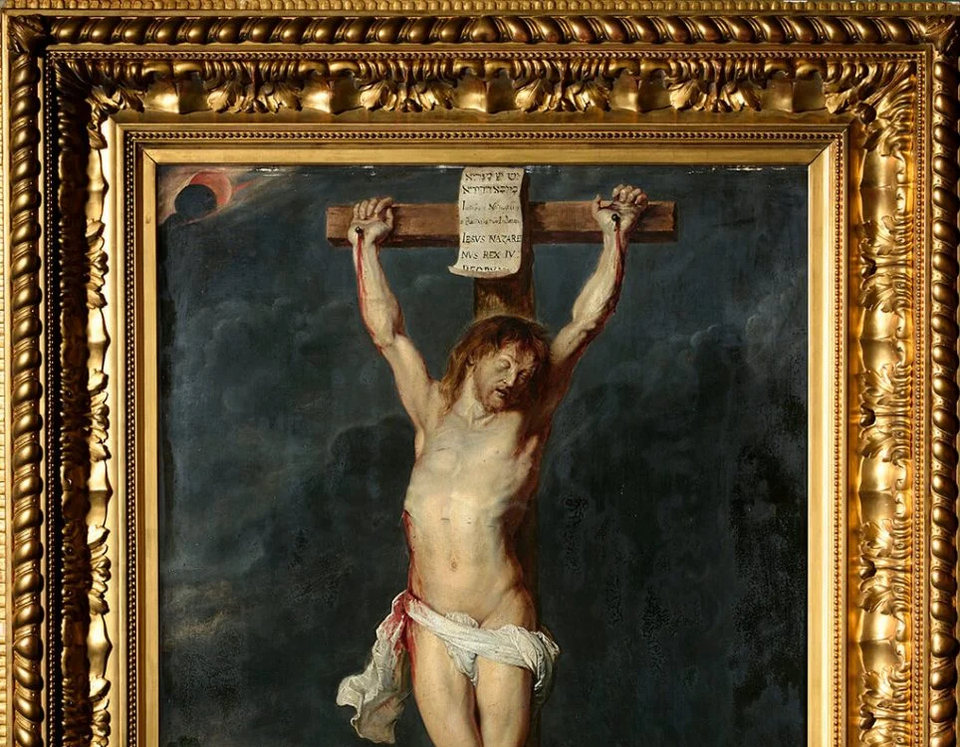
For about four centuries, *Christ on the Cross*, attributed to Peter Paul Rubens, had vanished from public view. Rediscovered in September 2024, this major work sold at auction last December for €2.94 million, far exceeding its estimates.
Peter Paul Rubens (1577–1640) is one of the greatest Flemish painters of the Baroque period, an artistic movement that emerged in the 17th century and is characterized by dynamism, theatricality, contrasting light, and emotional intensity. Trained in Italy, Rubens absorbed the lessons of masters such as Michelangelo and Titian, developing a style recognizable by its monumental figures, complex compositions, and vibrant colors. His works span religious, mythological, and historical painting: among the most famous are The Landing of Marie de’ Medici at Marseille, The Descent from the Cross, and The Abduction of the Daughters of Leucippus. Each painting illustrates his ability to capture the movement and dramatic power of bodies and emotions, as well as to explore the crucifixion.
On this International Museum Day, we look back at the major rediscovery of a work by a leading Flemish painter, exhibited in the world’s greatest museums, from the Louvre to the Prado in Madrid, including the Royal Museum of Fine Arts in Antwerp and the Alte Pinakothek in Munich.
An Unexpected Rediscovery
Christ on the Cross was painted by Rubens around 1613, when he was at the height of his talent. It highlights his work on religious drama and the intensity of human emotions. It depicts Jesus Christ crucified, alone on his cross. The focus is on his solitude and suffering, with blood and water flowing from his side wound. This painting, measuring approximately 105.5 cm by 72.5 cm, had been lost for 400 years. The work’s existence was known primarily through an old engraving made by a contemporary of Rubens. But it remained impossible to locate until September 2024.
The art world was then shaken by its rediscovery. The painting was found during an inventory of a Parisian mansion in the 6th arrondissement, as part of the sale of the property. Spotted by auctioneer Jean-Pierre Osenat, it underwent numerous scientific analyses, including X-rays, pictorial techniques, and pigment studies—the use of blue and green for skin tones being typical of the artist’s work. To the delight of art aficionados, these expert assessments, validated by the committee of experts at the Rubenianum (Antwerp), confirmed that it was indeed an original by Rubens.
Click here to read the full article in Luxus Magazine.
Featured photo: Unsplash
[ad_2]
Source link